The dawn of 2026 has brought with it a fundamental shift in the artificial intelligence landscape, moving away from the era of conversational "copilots" toward a future defined by "Agentic AI." For years, AI was largely reactive—a user would provide a prompt, and the model would generate a response. Today, the industry is pivoting toward autonomous agents that don't just talk, but act. These systems are capable of planning complex, multi-step workflows, navigating software interfaces, and executing tasks with minimal human intervention, effectively transitioning from digital assistants to digital employees.
This transition is being accelerated by a powerful "one-two punch" of hardware and software innovation. On the hardware front, NVIDIA (NASDAQ: NVDA) has officially detailed its Rubin platform, a successor to the Blackwell architecture specifically designed to handle the massive reasoning and memory requirements of autonomous agents. Simultaneously, Microsoft (NASDAQ: MSFT) has signaled its commitment to this new era through the strategic acquisition of Osmos, a startup specializing in autonomous agentic workflows for data engineering. Together, these developments represent a move from "thinking" models to "doing" models, setting the stage for a massive productivity leap across the global economy.
The Silicon and Software of Autonomy: Inside Rubin and Osmos
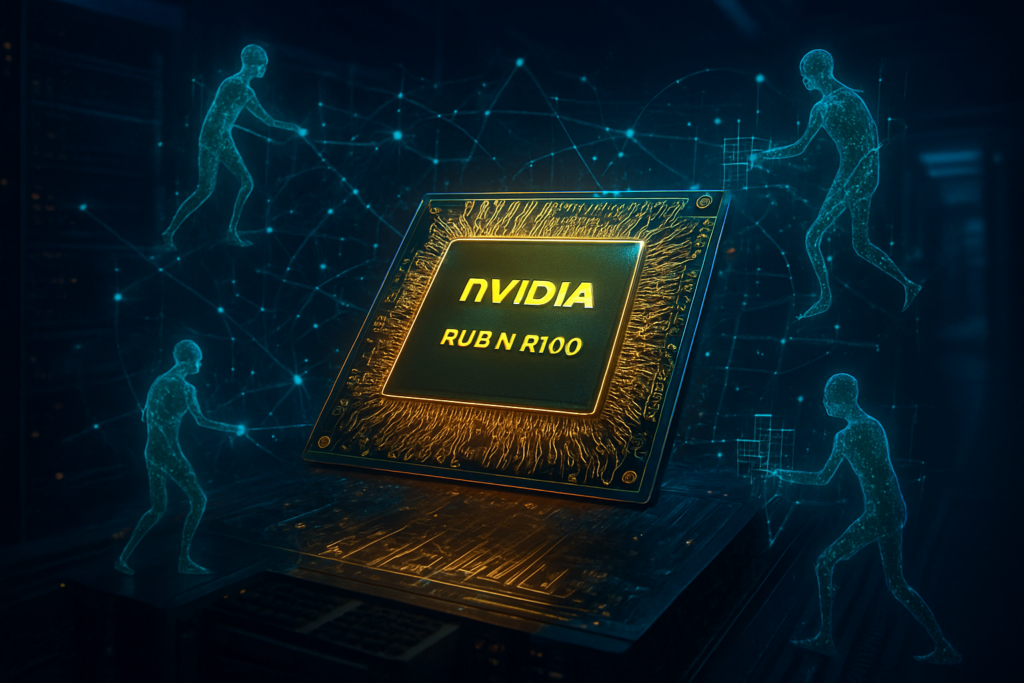
The technical backbone of this shift lies in NVIDIA’s new Rubin architecture, which debuted at the start of 2026. Unlike previous generations that focused primarily on raw throughput for training, the Rubin R100 GPU is architected for "test-time scaling"—a process where an AI agent spends more compute cycles "reasoning" through a problem before delivering an output. Built on TSMC’s 3nm process, the R100 boasts a staggering 336 billion transistors and is the first to utilize HBM4 memory. With a memory bandwidth of 22 TB/s, Rubin effectively breaks the "memory wall" that previously limited AI agents' ability to maintain long-term context and execute complex, multi-stage plans without losing their place.
Complementing this hardware is the "Vera" CPU, which features 88 custom "Olympus" cores designed to manage the high-speed data movement required for agentic reasoning. This hardware stack allows for a 5x leap in inference performance over the previous Blackwell generation, specifically optimized for Mixture-of-Experts (MoE) models. These models are the preferred architecture for agents, as they allow a system to consult different "specialist" sub-networks for different parts of a complex task, such as writing code, analyzing market data, and then autonomously generating a financial report.
On the software side, Microsoft’s acquisition of Osmos provides the "brain" for these autonomous workflows. Osmos has pioneered "Agentic AI for data engineering," creating agents that can navigate messy, unstructured data environments to build production-grade pipelines without human coding. By integrating Osmos into the Microsoft Fabric ecosystem, Microsoft is moving beyond simple text generation. The new "AI Data Wrangler" and "AI Data Engineer" agents can autonomously identify data discrepancies, normalize information across disparate sources, and manage entire infrastructure schemas. This differs from previous "Copilot" iterations by removing the human from the "inner loop" of the process; the user sets the goal, and the Osmos-powered agents execute the entire workflow.
Initial reactions from the AI research community have been overwhelmingly positive, with experts noting that the Rubin-Osmos era marks the end of the "hallucination-heavy" chatbot phase. By providing models with the hardware to "think" longer and the software frameworks to interact with real-world data systems, the industry is finally delivering on the promise of Large Action Models (LAMs).
A Seismic Shift in the Competitive Landscape
The move toward Agentic AI is redrawing the competitive map for tech giants and startups alike. NVIDIA (NASDAQ: NVDA) continues to cement its position as the "arms dealer" of the AI revolution. By tailoring the Rubin architecture specifically for agents, NVIDIA is making it difficult for competitors like AMD (NASDAQ: AMD) or Intel (NASDAQ: INTC) to catch up in the high-end inference market, where low-latency reasoning is now the most valuable currency. The Rubin NVL72 racks are already becoming the gold standard for "AI Superfactories," ensuring that any company wanting to run high-performance agents must go through NVIDIA.
For Microsoft (NASDAQ: MSFT), the Osmos acquisition is a direct shot across the bow of data heavyweights like Databricks and Snowflake (NYSE: SNOW). By embedding autonomous data agents directly into the Azure and Fabric core, Microsoft is attempting to make manual data engineering—a multi-billion dollar industry—obsolete. If an autonomous agent can handle the "grunt work" of data preparation and pipeline management, the value proposition of traditional data platforms shifts dramatically toward those who can offer the best agentic orchestration.
Startups are also finding new niches in this ecosystem. While the giants provide the base models and hardware, a new wave of "Agentic Service Providers" is emerging. These companies focus on "fine-tuning for action," creating highly specialized agents for legal, medical, or engineering fields. However, the barrier to entry is rising; as hardware requirements for reasoning increase, startups must rely more heavily on cloud partnerships with the likes of Microsoft or Amazon (NASDAQ: AMZN) to access the Rubin-class compute needed to remain competitive.
The Broader Significance: From Assistant to Operator
The shift to Agentic AI represents more than just a technical upgrade; it is a fundamental change in how humans interact with technology. We are moving from the "Copilot" era—where AI suggests actions—to the "Operator" era, where AI takes them. This fits into the broader trend of "Universal AI Orchestration," where multiple agents work together in a hierarchy to solve business problems. For example, a "Manager Agent" might receive a high-level business objective, decompose it into sub-tasks, and delegate those tasks to "Worker Agents" specialized in research, coding, or communication.
This evolution brings significant economic implications. The automation of multi-step workflows could lead to a massive productivity boom, particularly in white-collar sectors that involve heavy data processing and administrative coordination. However, it also raises concerns about job displacement and the "black box" nature of autonomous decision-making. Unlike a chatbot that provides a source for its text, an autonomous agent making changes to a production database or executing financial trades requires a much higher level of trust and robust safety guardrails.
Comparatively, this milestone is being viewed as more significant than the release of GPT-4. While GPT-4 proved that AI could understand and generate human-like language, the Rubin and Osmos era proves that AI can reliably interact with the digital world. It is the transition from a "brain in a vat" to an "agent with hands," marking the true beginning of the autonomous digital economy.
The Road Ahead: What to Expect in 2026 and Beyond
As we look toward the second half of 2026, the industry is bracing for the first wave of "Agent-First" enterprise applications. We expect to see the rollout of "Self-Healing Infrastructure," where AI agents powered by the Rubin platform monitor global networks and autonomously deploy code fixes or re-route traffic before a human is even aware of an issue. In the consumer space, this will likely manifest as "Personal OS Agents" that can manage a user’s entire digital life—from booking complex travel itineraries across multiple platforms to managing personal finances and taxes.
However, several challenges remain. The "Agentic Gap"—the difference between an agent planning a task and successfully executing it in a dynamic, unpredictable environment—is still being bridged. Reliability is paramount; an agent that fails 5% of the time is a novelty, but an agent that fails 5% of the time when managing a corporate supply chain is a liability. Developers are currently focusing on "verifiable reasoning" frameworks to ensure that agents can prove the logic behind their actions.
Experts predict that by 2027, the focus will shift from building individual agents to "Agentic Swarms"—groups of hundreds or thousands of specialized agents working in concert to solve massive scientific or engineering challenges, such as drug discovery or climate modeling. The infrastructure being laid today by NVIDIA and Microsoft is the foundation for this decentralized, autonomous future.
Conclusion: The New Foundation of Intelligence
The convergence of NVIDIA’s Rubin platform and Microsoft’s Osmos acquisition marks a definitive turning point in the history of artificial intelligence. We have moved past the novelty of generative AI and into the era of functional, autonomous agency. By providing the massive memory bandwidth and reasoning-optimized silicon of the R100, and the sophisticated workflow orchestration of Osmos, these tech giants have solved the two biggest hurdles to AI autonomy: hardware bottlenecks and software complexity.
The key takeaway for businesses and individuals alike is that AI is no longer just a tool for brainstorming or drafting emails; it is becoming a primary driver of operational execution. In the coming weeks and months, watch for the first "Rubin-powered" instances to go live on Azure, and keep an eye on how competitors like Google (NASDAQ: GOOGL) and OpenAI respond with their own agentic frameworks. The "Agentic AI" shift is not just a trend—it is the new operating model for the digital age.
This content is intended for informational purposes only and represents analysis of current AI developments.
TokenRing AI delivers enterprise-grade solutions for multi-agent AI workflow orchestration, AI-powered development tools, and seamless remote collaboration platforms.
For more information, visit https://www.tokenring.ai/.