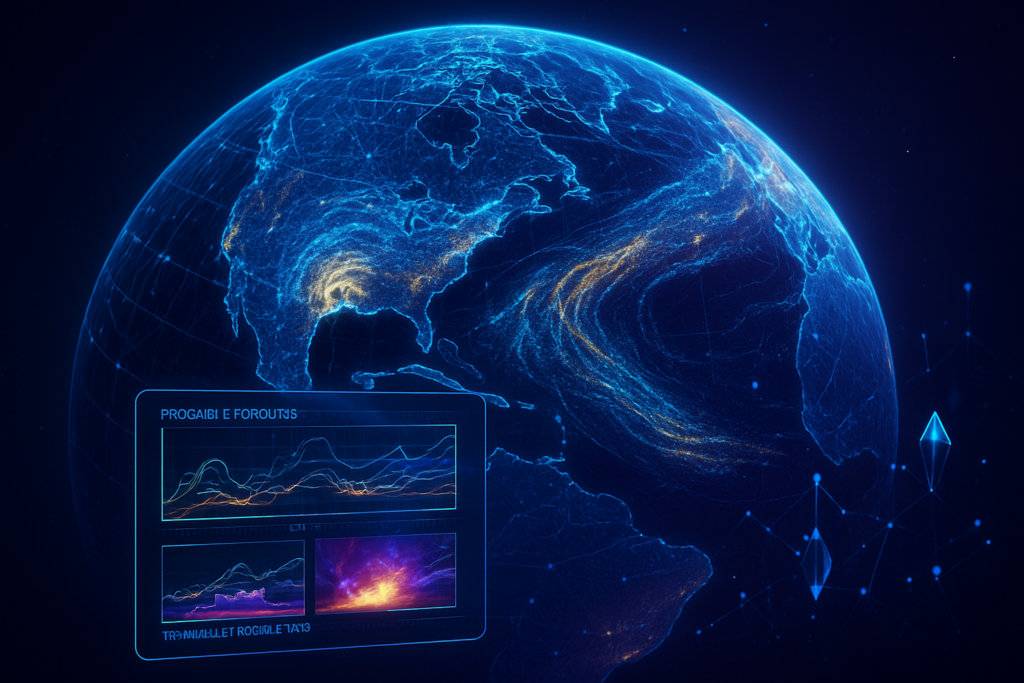
In a landmark shift for the field of meteorology, Google DeepMind’s GenCast has officially transitioned from a research breakthrough to the cornerstone of a new era in atmospheric science. As of January 2026, the model—and its successor, the WeatherNext 2 family—has demonstrated a level of predictive accuracy that consistently surpasses the "gold standard" of traditional physics-based systems. By utilizing generative AI to produce ensemble-based forecasts, Google has solved one of the most persistent challenges in the field: accurately quantifying the probability of extreme weather events like hurricanes and flash floods days before they occur.
The immediate significance of GenCast lies in its ability to democratize high-resolution forecasting. Historically, only a handful of nations could afford the massive supercomputing clusters required to run Numerical Weather Prediction (NWP) models. With GenCast, a 15-day global ensemble forecast that once took hours on a supercomputer can now be generated in under eight minutes on a single TPU v5. This leap in efficiency is not just a technical triumph for Alphabet Inc. (NASDAQ: GOOGL); it is a fundamental restructuring of how humanity prepares for a changing climate.
The Technical Shift: From Deterministic Equations to Diffusion Models
GenCast represents a departure from the deterministic "best guess" approach of its predecessor, GraphCast. While GraphCast focused on a single predicted path, GenCast is a probabilistic model based on conditional diffusion. This architecture works by starting with a "noisy" atmospheric state and iteratively refining it into a physically realistic prediction. By initiating this process with different random noise seeds, the model generates an "ensemble" of 50 or more potential weather trajectories. This allows meteorologists to see not just where a storm might go, but the statistical likelihood of various landfall scenarios.
Technical specifications reveal that GenCast operates at a 0.25° latitude-longitude resolution, equivalent to roughly 28 kilometers at the equator. In rigorous benchmarking against the European Centre for Medium-Range Weather Forecasts (ECMWF) Ensemble (ENS) system, GenCast outperformed the traditional model on 97.2% of 1,320 evaluated targets. Furthermore, for lead times greater than 36 hours, its accuracy reached a staggering 99.8%. Unlike traditional models that require thousands of CPUs, GenCast’s use of Graph Transformers and refined icosahedral meshes allows it to process complex atmospheric interactions with a fraction of the energy.
Industry experts have hailed this as the "ChatGPT moment" for Earth science. By training on over 40 years of ERA5 historical weather data, GenCast has learned the underlying patterns of the atmosphere without needing to explicitly solve the Navier-Stokes equations for fluid dynamics. This data-driven approach allows the model to identify "tail risks"—those rare but catastrophic events like the 2025 Mediterranean "Medicane" or the sudden intensification of Pacific typhoons—that traditional systems frequently under-predict.
A New Arms Race: The AI-as-a-Service Landscape
The success of GenCast has ignited an intense competitive rivalry among tech giants, each vying to become the primary provider of "Weather-as-a-Service." NVIDIA (NASDAQ: NVDA) has positioned its Earth-2 platform as a "digital twin" of the planet, recently unveiling its CorrDiff model which can downscale global data to a hyper-local 200-meter resolution. Meanwhile, Microsoft (NASDAQ: MSFT) has entered the fray with Aurora, a 1.3-billion-parameter foundation model that treats weather as a general intelligence problem, learning from over a million hours of diverse atmospheric data.
This shift is causing significant disruption to traditional high-performance computing (HPC) vendors. Companies like Hewlett Packard Enterprise (NYSE: HPE) and the recently restructured Atos (now Eviden) are pivoting their business models. Instead of selling supercomputers solely for weather simulation, they are now marketing "AI-HPC Infrastructure" designed to fine-tune models like GenCast for specific industrial needs. The strategic advantage has shifted from those who own the fastest hardware to those who control the most sophisticated models and the largest historical datasets.
Market positioning is also evolving. Google has integrated WeatherNext 2 directly into its consumer ecosystem, powering weather insights in Google Search and Gemini. This vertical integration—from the TPU hardware to the end-user's smartphone—creates a proprietary feedback loop that traditional meteorological agencies cannot match. As a result, sectors such as aviation, agriculture, and renewable energy are increasingly bypassing national weather services in favor of API-based intelligence from the "Big Four" tech firms.
The Wider Significance: Sovereignty, Ethics, and the "Black Box"
The broader implications of GenCast’s dominance are a subject of intense debate at the World Meteorological Organization (WMO) in early 2026. While the accuracy of these models is undeniable, they present a "Black Box" problem. Unlike traditional models, where a scientist can trace a storm's development back to specific physical laws, AI models are inscrutable. If a model predicts a catastrophic flood, forecasters may struggle to explain why it is happening, leading to a "trust gap" during high-stakes evacuation orders.
There are also growing concerns regarding data sovereignty. As private companies like Google and Huawei become the primary sources of weather intelligence, there is a risk that national weather warnings could be privatized or diluted. If a Google AI predicts a hurricane landfall 48 hours before the National Hurricane Center, it creates a "shadow warning system" that could lead to public confusion. In response, several nations have launched "Sovereign AI" initiatives to ensure they do not become entirely dependent on foreign tech giants for critical public safety information.
Furthermore, researchers have identified a "Rebound Effect" or the "Forecasting Levee Effect." As AI provides ultra-reliable, long-range warnings, there is a tendency for riskier urban development in flood-prone areas. The false sense of security provided by a 7-day evacuation window may lead to a higher concentration of property and assets in marginal zones, potentially increasing the economic magnitude of disasters when "model-defying" storms eventually occur.
The Horizon: Hyper-Localization and Anticipatory Action
Looking ahead, the next frontier for Google’s weather initiatives is "hyper-localization." By late 2026, experts predict that GenCast-derived models will provide hourly, neighborhood-level predictions for urban heat islands and micro-flooding. This will be achieved by integrating real-time sensor data from IoT devices and smartphones into the generative process, a technique known as "continuous data assimilation."
Another burgeoning application is "Anticipatory Action" in the humanitarian sector. International aid organizations are already using GenCast’s probabilistic data to trigger funding and resource deployment before a disaster strikes. For example, if the ensemble shows an 80% probability of a severe drought in a specific region of East Africa, aid can be released to farmers weeks in advance to mitigate the impact. The challenge remains in ensuring these models are physically consistent and do not "hallucinate" atmospheric features that are physically impossible.
Conclusion: A New Chapter in Planetary Stewardship
Google’s GenCast and the subsequent WeatherNext 2 models have fundamentally rewritten the rules of meteorology. By outperforming traditional systems in both speed and accuracy, they have proven that generative AI is not just a tool for text and images, but a powerful engine for understanding the physical world. This development marks a pivotal moment in AI history, where machine learning has moved from assisting humans to redefining the boundaries of what is predictable.
The significance of this breakthrough cannot be overstated; it represents the first time in over half a century that the primary method for weather forecasting has undergone a total architectural overhaul. However, the long-term impact will depend on how society manages the transition. In the coming months, watch for new international guidelines from the WMO regarding the use of AI in official warnings and the emergence of "Hybrid Forecasting," where AI and physics-based models work in tandem to provide both accuracy and interpretability.
This content is intended for informational purposes only and represents analysis of current AI developments.
TokenRing AI delivers enterprise-grade solutions for multi-agent AI workflow orchestration, AI-powered development tools, and seamless remote collaboration platforms.
For more information, visit https://www.tokenring.ai/.