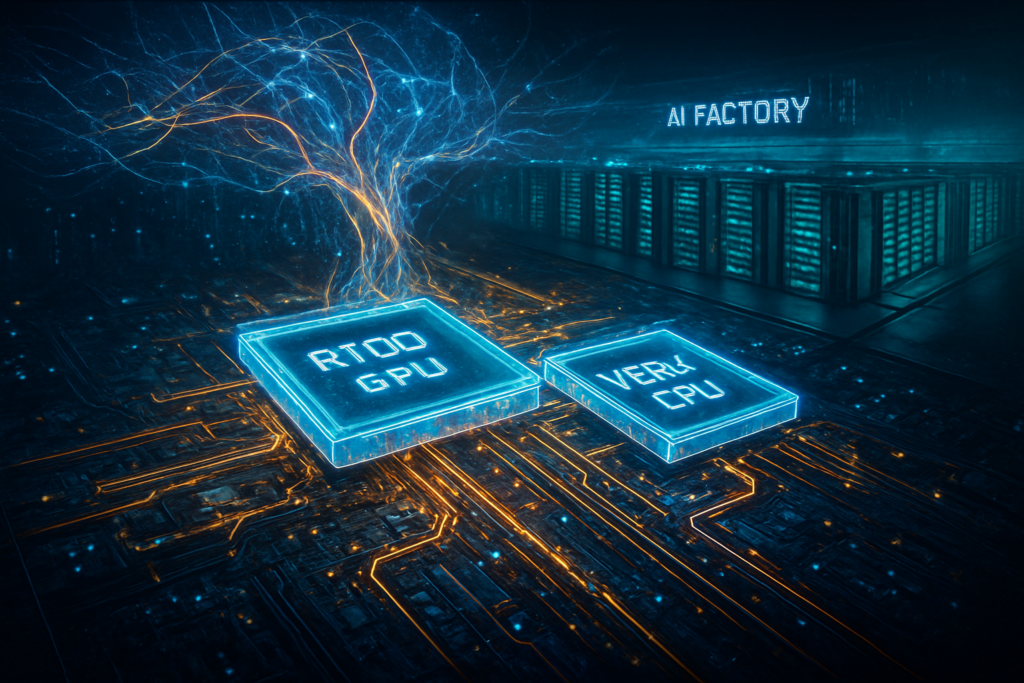
The artificial intelligence landscape has reached a pivotal milestone as NVIDIA (NASDAQ: NVDA) officially transitions its next-generation "Rubin" platform into the production phase. Named in honor of the pioneering astronomer Vera Rubin, whose work provided the first evidence of dark matter, the platform is designed to illuminate the next frontier of AI supercomputing. As of January 2, 2026, the Rubin architecture has moved beyond its initial sampling phase and into trial production, signaling a shift from the highly successful Blackwell era to a new epoch of "AI Factory" scale compute.
The immediate significance of this announcement cannot be overstated. With the Rubin platform, NVIDIA is not merely iterating on its hardware; it is fundamentally redesigning the architecture of the data center. By integrating the new R100 GPU, the custom "Vera" CPU, and the world’s first implementation of HBM4 memory, NVIDIA aims to provide the massive throughput required for the next generation of trillion-parameter "World Models" and autonomous reasoning agents. This transition marks the first time a chiplet-based architecture has been deployed at this scale in the AI sector, promising a performance-per-watt leap that addresses the growing global concern over data center energy consumption.
At the heart of the Rubin platform lies the R100 GPU, a technical marvel fabricated on the performance-enhanced 3nm (N3P) process from TSMC (NYSE: TSM). Moving away from the monolithic designs of the past, the R100 utilizes a sophisticated chiplet-based architecture housed within a massive 4x reticle size interposer. This design is brought to life using TSMC’s advanced CoWoS-L packaging, allowing for a 100x100mm substrate that accommodates more high-bandwidth memory (HBM) sites than ever before. Early benchmarks for the R100 indicate a staggering 2.5x to 3.3x performance leap in FP4 compute over the previous Blackwell architecture, providing roughly 50 petaflops of inference performance per GPU.
The platform is further bolstered by the Vera CPU, the successor to the Arm-based Grace CPU. The Vera CPU features 88 custom "Olympus" Arm-compatible cores, supporting 176 logical threads through simultaneous multithreading (SMT). In a "Vera Rubin Superchip" configuration, the CPU and GPU are linked via NVLink-C2C (Chip-to-Chip) technology, boasting a bidirectional bandwidth of 1.8 TB/s. This allows for total cache coherency, which is essential for the complex, real-time data shuffling required by multi-modal AI models. Experts in the research community have noted that this tight integration effectively eliminates the traditional bottlenecks between memory and processing, allowing the Vera CPU to deliver twice the performance of its predecessor.
Perhaps the most significant technical advancement is the integration of HBM4 memory. The Rubin R100 is the first GPU to utilize this standard, featuring 288GB of HBM4 memory across eight stacks with a 2,048-bit interface. This doubles the interface width of HBM3e and provides a memory bandwidth estimated between 13 TB/s and 15 TB/s. To secure this supply, NVIDIA has partnered with industry leaders including SK Hynix (KRX: 000660), Micron (NASDAQ: MU), and Samsung (KRX: 005930). This massive influx of bandwidth is specifically tuned for "Million-GPU" clusters, where the ability to move data between nodes is as critical as the compute power itself.
The shift to the Rubin platform is sending ripples through the entire tech ecosystem, forcing competitors and partners alike to recalibrate their strategies. For major Cloud Service Providers (CSPs) like Microsoft (NASDAQ: MSFT), Amazon (NASDAQ: AMZN), and Alphabet (NASDAQ: GOOGL), the arrival of Rubin is both a blessing and a logistical challenge. Microsoft has already committed to a massive deployment of Rubin hardware to support its 1GW compute deal with Anthropic, while Amazon is integrating NVIDIA NVLink Fusion into its infrastructure to allow customers to blend Rubin's power with its own custom Trainium4 chips.
In the competitive arena, AMD (NASDAQ: AMD) is attempting to counter the Rubin platform with its Instinct MI400 series. AMD’s strategy focuses on sheer memory capacity, offering 432GB of HBM4—nearly 1.5 times the initial capacity of the Rubin R100 (288GB). By emphasizing open standards like UALink and Ethernet, AMD hopes to attract enterprises looking to avoid "CUDA lock-in." Meanwhile, Intel (NASDAQ: INTC) has pivoted its roadmap to the "Jaguar Shores" chip, built on the Intel 18A process, which seeks to achieve system-level parity with NVIDIA through deep co-packaging with its Diamond Rapids Xeon CPUs.
Despite these challenges, NVIDIA’s market positioning remains formidable. Analysts expect NVIDIA to maintain an 85-90% share of the AI data center GPU market through 2026, supported by an estimated $500 billion order backlog. The strategic advantage of the Rubin platform lies not just in the silicon, but in the "NVL144" rack-scale solutions. These liquid-cooled racks are becoming the blueprint for modern "AI Factories," providing a turnkey solution for nations and corporations looking to build domestic supercomputing centers. This "Sovereign AI" trend has become a significant revenue lever, as countries like Saudi Arabia and Japan seek to bypass traditional cloud providers.
The broader significance of the Rubin platform lies in its role as the engine for the "AI Factory" era. As AI models transition from static text generators to dynamic agents capable of "World Modeling"—processing video, physical sensors, and reasoning in real-time—the demand for deterministic, high-efficiency compute has exploded. Rubin is the first platform designed from the ground up to support this transition. By focusing on FP4 and FP6 precision, NVIDIA is enabling a level of inference efficiency that makes the deployment of trillion-parameter models economically viable for a wider range of industries.
However, the rapid scaling of these platforms has raised significant concerns regarding energy consumption and global supply chains. A single Rubin-based NVL144 rack is projected to draw over 500kW of power, making liquid cooling a mandatory requirement rather than an optional upgrade. This has triggered a massive infrastructure cycle, benefiting power management companies but also straining local energy grids. Furthermore, the "Year of HBM4" has led to a global shortage of DRAM, as memory manufacturers divert capacity to meet NVIDIA’s high-margin requirements, potentially driving up costs for consumer electronics.
When compared to previous milestones like the launch of the H100 or the Blackwell architecture, Rubin represents a shift toward "system-level" scaling. It is no longer about the fastest chip, but about the most efficient cluster. The move to a chiplet-based architecture mirrors the evolution of the semiconductor industry at large, where physical limits on die size are being overcome by advanced packaging. This allows NVIDIA to maintain its trajectory of exponential performance growth, even as traditional Moore’s Law scaling becomes increasingly difficult and expensive.
Looking ahead, the roadmap for the Rubin platform includes the "Rubin Ultra" variant, scheduled for 2027. This successor is expected to feature 12-high HBM4 stacks, potentially pushing memory capacity to 1TB per GPU and FP4 performance to 100 petaflops. In the near term, the industry will be watching the deployment of "Project Ceiba," a massive supercomputer being built by AWS that will now utilize the Rubin architecture to push the boundaries of climate modeling and drug discovery.
The potential applications for Rubin-class compute extend far beyond chatbots. Experts predict that this level of processing power will be the catalyst for "Physical AI"—the integration of large-scale neural networks into robotics and autonomous manufacturing. The challenge will be in the software; as hardware capabilities leapfrog, the development of software stacks that can efficiently orchestrate "Million-GPU" clusters will be the next major hurdle. Furthermore, as AI models begin to exceed the context window limits of current hardware, the massive HBM4 bandwidth of Rubin will be essential for the next generation of long-context, multi-modal reasoning.
NVIDIA’s Rubin platform represents more than just a hardware refresh; it is a foundational shift in how the world processes information. By combining the R100 GPU, the Vera CPU, and HBM4 memory into a unified, chiplet-based ecosystem, NVIDIA has solidified its dominance in an era where compute is the new oil. The transition to mass production in early 2026 marks the beginning of a cycle that will likely define the capabilities of artificial intelligence for the remainder of the decade.
The key takeaways from this development are clear: the barrier to entry for high-end AI training is rising, the "AI Factory" is becoming the standard unit of compute, and the competition is shifting from individual chips to entire rack-scale systems. As the first Rubin-powered data centers come online in the second half of 2026, the tech industry will be watching closely to see if this massive leap in performance translates into the long-promised breakthrough in autonomous AI reasoning. For now, NVIDIA remains the undisputed architect of the intelligence age.
This content is intended for informational purposes only and represents analysis of current AI developments.
TokenRing AI delivers enterprise-grade solutions for multi-agent AI workflow orchestration, AI-powered development tools, and seamless remote collaboration platforms.
For more information, visit https://www.tokenring.ai/.