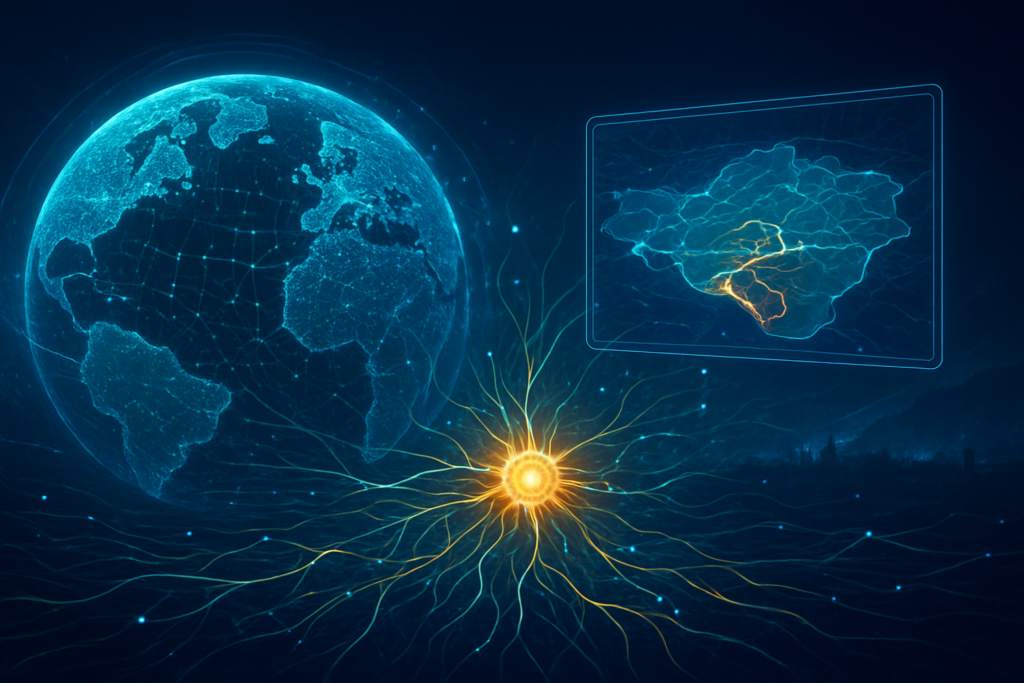
Alphabet Inc. (NASDAQ: GOOGL) has reached a historic milestone in its mission to leverage artificial intelligence for climate resilience, announcing that its AI-powered flood forecasting system now provides life-saving alerts across 100 countries. By integrating advanced machine learning with global hydrological data, the platform now protects an estimated 700 million people, offering critical warnings up to seven days before a disaster strikes. This expansion represents a massive leap in "anticipatory action," allowing governments and aid organizations to move from reactive disaster relief to proactive, pre-emptive response.
The center of this initiative is the 'Flood Hub' platform, a public-facing dashboard that visualizes high-resolution riverine flood forecasts. As the world faces an increase in extreme weather events driven by climate change, Google’s ability to provide a full week of lead time—a duration previously only possible in countries with dense physical sensor networks—marks a turning point for climate adaptation in the Global South. By bridging the "data gap" in under-resourced regions, the AI system is significantly reducing the human and economic toll of annual flooding.
Technical Precision: LSTMs and the Power of Virtual Gauges
At the heart of Google’s forecasting breakthrough is a sophisticated architecture based on Long Short-Term Memory (LSTM) networks. Unlike traditional physical models that require manually entering complex local soil and terrain parameters, Google’s LSTM models are trained on decades of historical river flow data, satellite imagery, and meteorological forecasts. The system utilizes a two-stage modeling approach: a Hydrologic Model, which predicts the volume of water flowing through a river basin, and an Inundation Model, which maps exactly where that water will go and how deep it will be at a street-level resolution.
What sets this system apart from previous technology is the implementation of over 250,000 "virtual gauges." Historically, flood forecasting was restricted to rivers equipped with expensive physical sensors. Google’s AI bypasses this limitation by simulating gauge data for ungauged river basins, using global weather patterns and terrain characteristics to "infer" water levels where no physical instruments exist. This allows the system to provide the same level of accuracy for a remote village in South Sudan as it does for a monitored basin in Central Europe.
Initial reactions from the AI research community have been overwhelmingly positive, particularly regarding the system's "generalization" capabilities. Experts at the European Centre for Medium-Range Weather Forecasts (ECMWF) have noted that Google’s model successfully maintains a high degree of reliability (R2 scores above 0.7) even in regions where it was not specifically trained on local historical data. This "zero-shot" style of transfer learning is considered a major breakthrough in environmental AI, proving that global models can outperform local physical models that lack sufficient data.
Strategic Dominance: Tech Giants in the Race for Climate AI
The expansion of Flood Hub solidifies Alphabet Inc.'s position as the leader in "AI for Social Good," a strategic vertical that carries significant weight in Environmental, Social, and Governance (ESG) rankings. While other tech giants are also investing heavily in climate tech, Google’s approach of providing free, public-access APIs (the Flood API) and open-sourcing the Google Runoff Reanalysis & Reforecast (GRRR) dataset has created a "moat" of goodwill and data dependency. This move directly competes with the Environmental Intelligence Suite from IBM (NYSE: IBM), which targets enterprise-level supply chain resilience rather than public safety.
Microsoft (NASDAQ: MSFT) has also entered the arena with its "Aurora" foundation model for Earth systems, which seeks to predict broader atmospheric and oceanic changes. However, Google’s Flood Hub maintains a tactical advantage through its deep integration into the Android ecosystem. By pushing flood alerts directly to users’ smartphones via Google Maps and Search, Alphabet has bypassed the "last mile" delivery problem that often plagues international weather agencies. This strategic placement ensures that the AI’s predictions don't just sit in a database but reach the hands of those in the path of the water.
This development is also disrupting the traditional hydrological modeling industry. Companies that previously charged governments millions for bespoke physical models are now finding it difficult to compete with a global AI model that is updated daily, covers entire continents, and is provided at no cost to the public. As AI infrastructure continues to scale, specialized climate startups like Floodbase and Previsico are shifting their focus toward "micro-forecasting" and parametric insurance, areas where Google has yet to fully commoditize the market.
A New Era of Climate Adaptation and Anticipatory Action
The significance of the 100-country expansion extends far beyond technical achievement; it represents a paradigm shift in the global AI landscape. For years, AI was criticized for its high energy consumption and focus on consumer convenience. Projects like Flood Hub demonstrate that large-scale compute can be a net positive for the planet. The system is a cornerstone of the United Nations’ "Early Warnings for All" initiative, which aims to protect every person on Earth from hazardous weather by the end of 2027.
The real-world impacts are already being measured in human lives and dollars. In regions like Bihar, India, and parts of Bangladesh, the introduction of 7-day lead times has led to a reported 20-30% reduction in medical costs and agricultural losses. Because families have enough time to relocate livestock and secure food supplies, the "poverty trap" created by annual flooding is being weakened. This fits into a broader trend of "Anticipatory Action" in the humanitarian sector, where NGOs like the Red Cross and GiveDirectly use Google’s Flood API to trigger automated cash transfers to residents before a flood hits, ensuring they have the resources to evacuate.
However, the rise of AI-driven forecasting also raises concerns about "data sovereignty" and the digital divide. While Google’s system is a boon for developing nations, it also places a significant amount of critical infrastructure data in the hands of a single private corporation. Critics argue that while the service is currently free, the global south's reliance on proprietary AI models for disaster management could lead to new forms of technological dependency. Furthermore, as climate change makes weather patterns more erratic, the challenge of "training" AI on a shifting baseline remains a constant technical hurdle.
The Horizon: Flash Floods and Real-Time Earth Simulations
Looking ahead, the next frontier for Google is the prediction of flash floods—sudden, violent events caused by intense rainfall that current riverine models struggle to capture. In the near term, experts expect Google to integrate its "WeatherNext" and "GraphCast" models, which provide high-resolution atmospheric forecasting, directly into the Flood Hub pipeline. This would allow for the prediction of urban flooding and pluvial (surface water) events, which affect millions in densely populated cities.
We are also likely to see the integration of NVIDIA Corporation (NASDAQ: NVDA) hardware and their "Earth-2" digital twin technology to create even more immersive flood simulations. By combining Google’s AI forecasts with 3D digital twins of cities, urban planners could use "what-if" scenarios to see how different flood wall configurations or drainage improvements would perform during a once-in-a-century storm. The ultimate goal is a "Google Earth for Disasters"—a real-time, AI-driven mirror of the planet that predicts every major environmental risk with surgical precision.
Summary: A Benchmark in the History of AI
Google’s expansion of the AI-powered Flood Hub to 100 countries is more than just a corporate announcement; it is a milestone in the history of artificial intelligence. It marks the transition of AI from a tool of recommendation and generation to a tool of survival and global stabilization. By protecting 700 million people with 7-day warnings, Alphabet Inc. has set a new standard for how technology companies can contribute to the global climate crisis.
The key takeaways from this development are clear: AI is now capable of outperforming traditional physics-based models in data-scarce environments, and the integration of this data into consumer devices is essential for disaster resilience. In the coming months, observers should watch for how other tech giants respond to Google's lead and whether the democratization of this data leads to a measurable decrease in global disaster-related mortality. As we move deeper into 2026, the success of Flood Hub will serve as the primary case study for the positive potential of the AI revolution.
This content is intended for informational purposes only and represents analysis of current AI developments.
TokenRing AI delivers enterprise-grade solutions for multi-agent AI workflow orchestration, AI-powered development tools, and seamless remote collaboration platforms.
For more information, visit https://www.tokenring.ai/.