As 2025 draws to a close, the landscape of artificial intelligence is being physically reshaped by massive infrastructure projects that dwarf anything seen in the cloud computing era. Microsoft (NASDAQ: MSFT) has officially reached a milestone in this transition with the operational launch of its "Fairwater" data center initiative. Moving beyond the traditional model of distributed server farms, Project Fairwater introduces the concept of the "AI Superfactory"—a high-density, liquid-cooled powerhouse designed to sustain the next generation of frontier AI models.
The completion of the flagship Fairwater 1 facility in Mount Pleasant, Wisconsin, and the activation of Fairwater 2 in Atlanta, Georgia, represent a multi-billion dollar bet on the future of generative AI. By integrating hundreds of thousands of NVIDIA (NASDAQ: NVDA) Blackwell GPUs into a single, unified compute fabric, Microsoft is positioning itself to overcome the "compute wall" that has threatened to slow the progress of large language model development. This development marks a pivotal moment where the bottleneck for AI progress shifts from algorithmic efficiency to the sheer physical limits of power and cooling.
The Engineering of an AI Superfactory
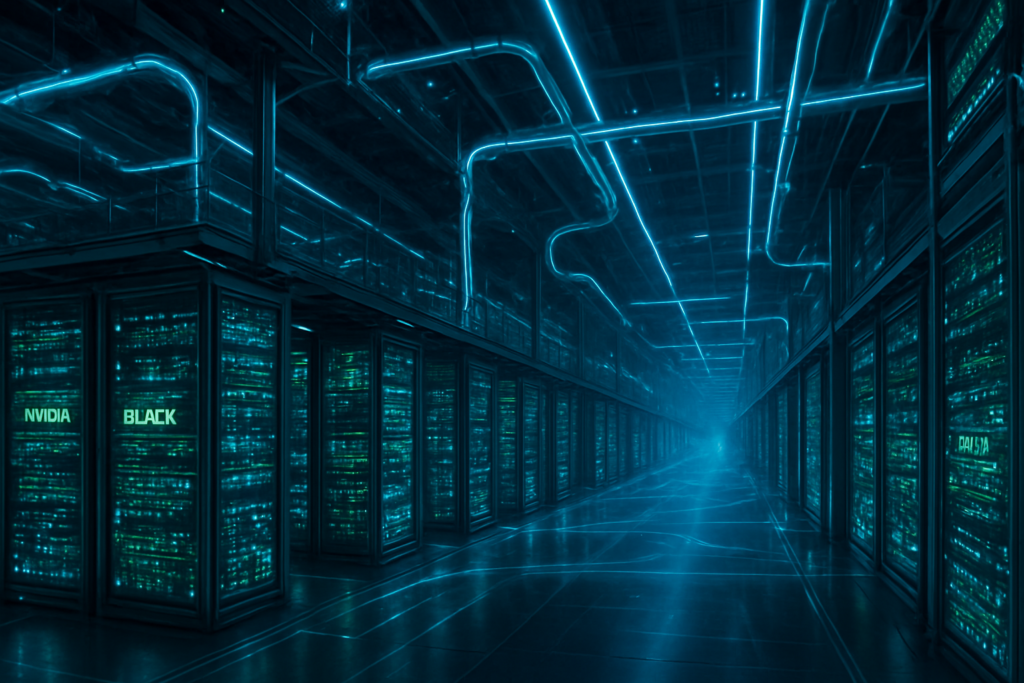
At the heart of the Fairwater project is the deployment of NVIDIA’s Grace Blackwell (GB200 and the newly released GB300) clusters at an unprecedented scale. Unlike previous generations of data centers that relied on air-cooled racks peaking at 20–40 kilowatts (kW), Fairwater utilizes a specialized two-story architecture designed for high-density compute. These facilities house NVL72 rack-scale systems, which deliver a staggering 140 kW of power density per rack. To manage the extreme thermal output of these chips, Microsoft has implemented a state-of-the-art closed-loop liquid cooling system. This system is filled once during construction and recirculated continuously, achieving "near-zero" operational water waste—a critical advancement as data center water consumption becomes a flashpoint for environmental regulation.
The Wisconsin site alone features the world’s second-largest water-cooled chiller plant, utilizing an array of 172 massive industrial fans to dissipate heat without evaporating local water supplies. Technically, Fairwater differs from previous approaches by treating multiple buildings as a single logical supercomputer. Linked by a dedicated "AI WAN" (Wide Area Network) consisting of over 120,000 miles of proprietary fiber, these sites can coordinate massive training runs across geographic distances with minimal latency. Initial reactions from the hardware community have been largely positive, with engineers at Data Center World 2025 praising the two-story layout for shortening physical cable lengths, thereby reducing signal degradation in the NVLink interconnects.
A Tri-Polar Arms Race: Market and Competitive Implications
The launch of Fairwater is a direct response to the aggressive infrastructure plays by Microsoft’s primary rivals. While Google (NASDAQ: GOOGL) has long held a lead in liquid cooling through its internal TPU (Tensor Processing Unit) programs, and Amazon (NASDAQ: AMZN) has focused on modular, cost-efficient "Liquid-to-Air" retrofits, Microsoft’s strategy is one of sheer, unadulterated scale. By securing the lion's share of NVIDIA's Blackwell Ultra (GB300) supply for late 2025, Microsoft is attempting to maintain its lead as the primary host for OpenAI’s most advanced models. This move is strategically vital, especially following industry reports that Microsoft lost earlier contracts to Oracle (NYSE: ORCL) due to deployment delays in late 2024.
Financially, the stakes could not be higher. Microsoft’s capital expenditure is projected to hit $80 billion for the 2025 fiscal year, a figure that has caused some trepidation among investors. However, market analysts from Citi and Bernstein suggest that this investment is effectively "de-risked" by the overwhelming demand for Azure AI services. The ability to offer dedicated Blackwell clusters at scale provides Microsoft with a significant competitive advantage in the enterprise sector, where Fortune 500 companies are increasingly seeking "sovereign-grade" AI capacity that can handle massive fine-tuning and inference workloads without the bottlenecks associated with older H100 hardware.
Breaking the Power Wall and the Sustainability Crisis
The broader significance of Project Fairwater lies in its attempt to solve the "AI Power Wall." As AI models require exponentially more energy, the industry has faced criticism over its impact on local power grids. Microsoft has addressed this by committing to match 100% of Fairwater’s energy use with carbon-free sources, including a dedicated 250 MW solar project in Wisconsin. Furthermore, the shift to closed-loop liquid cooling addresses the growing concern over data center water usage, which has historically competed with agricultural and municipal needs during summer months.
This project represents a fundamental shift in the AI landscape, mirroring previous milestones like the transition from CPU to GPU-based training. However, it also raises concerns about the centralization of AI power. With only a handful of companies capable of building 2-gigawatt "Superfactories," the barrier to entry for independent AI labs and startups continues to rise. The sheer physical footprint of Fairwater—consuming more power than a major metropolitan city—serves as a stark reminder that the "cloud" is increasingly a massive, energy-hungry industrial machine.
The Horizon: From 2 GW to Global Super-Clusters
Looking ahead, the Fairwater architecture is expected to serve as the blueprint for Microsoft’s global expansion. Plans are already underway to replicate the Wisconsin design in the United Kingdom and Norway throughout 2026. Experts predict that the next phase will involve the integration of small modular reactors (SMRs) directly into these sites to provide a stable, carbon-free baseload of power that the current grid cannot guarantee. In the near term, we expect to see the first "trillion-parameter" models trained entirely within the Fairwater fabric, potentially leading to breakthroughs in autonomous scientific discovery and advanced reasoning.
The primary challenge remains the supply chain for liquid cooling components and specialized power transformers, which have seen lead times stretch into 2027. Despite these hurdles, the industry consensus is that the era of the "megawatt data center" is over, replaced by the "gigawatt superfactory." As Microsoft continues to scale Fairwater, the focus will likely shift toward optimizing the software stack to handle the immense complexity of distributed training across these massive, liquid-cooled clusters.
Conclusion: A New Era of Industrial AI
Microsoft’s Project Fairwater is more than just a data center expansion; it is the physical manifestation of the AI revolution. By successfully deploying 140 kW racks and Grace Blackwell clusters at a gigawatt scale, Microsoft has set a new benchmark for what is possible in AI infrastructure. The transition to advanced liquid cooling and zero-operational water waste demonstrates that the industry is beginning to take its environmental responsibilities seriously, even as its hunger for power grows.
In the coming weeks and months, the tech world will be watching for the first performance benchmarks from the Fairwater-hosted clusters. If the "Superfactory" model delivers the expected gains in training efficiency and latency reduction, it will likely force a massive wave of infrastructure reinvestment across the entire tech sector. For now, Fairwater stands as a testament to the fact that in the race for AGI, the winners will be determined not just by code, but by the steel, silicon, and liquid cooling that power it.
This content is intended for informational purposes only and represents analysis of current AI developments.
TokenRing AI delivers enterprise-grade solutions for multi-agent AI workflow orchestration, AI-powered development tools, and seamless remote collaboration platforms.
For more information, visit https://www.tokenring.ai/.