The end of an earnings season can be a great time to discover new stocks and assess how companies are handling the current business environment. Let’s take a look at how Navient (NASDAQ: NAVI) and the rest of the consumer finance stocks fared in Q1.
Consumer finance companies provide loans and credit products to individuals. Growth drivers include increasing consumer spending, financial inclusion initiatives in developing markets, and digital lending platforms reducing distribution costs. Challenges include credit risk during economic downturns, regulatory scrutiny of lending practices, and intensifying competition from traditional banks and fintech firms offering innovative credit solutions.
The 20 consumer finance stocks we track reported a satisfactory Q1. As a group, revenues beat analysts’ consensus estimates by 1.9% while next quarter’s revenue guidance was 0.7% above.
Luckily, consumer finance stocks have performed well with share prices up 14.5% on average since the latest earnings results.
Navient (NASDAQ: NAVI)
Spun off from Sallie Mae in 2014 to handle the company's loan servicing and collection operations, Navient (NASDAQ: NAVI) provides education loan servicing and business processing solutions that help manage federal student loans, private education loans, and government services.
Navient reported revenues of $142 million, down 27.2% year on year. This print exceeded analysts’ expectations by 2.4%. Overall, it was an exceptional quarter for the company with a beat of analysts’ EPS and net interest income estimates.
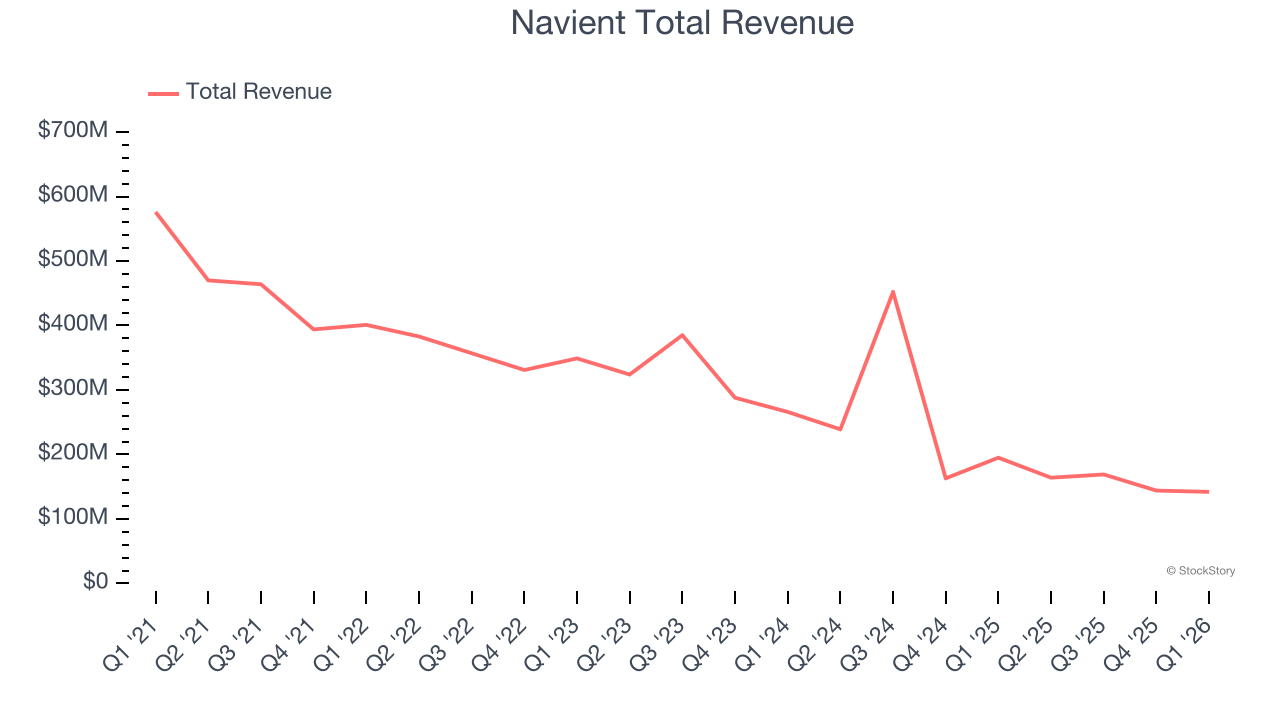
Navient delivered the slowest revenue growth of the whole group. Investor expectations, however, were likely higher than Wall Street’s published projections, leaving some wishing for even better results (analysts’ consensus estimates are those published by big banks and advisory firms, not the investors who make buy and sell decisions). The stock is down 6.4% since reporting and currently trades at $8.58.
Is now the time to buy Navient? Access our full analysis of the earnings results here, it’s free.
Best Q1: Sallie Mae (NASDAQ: SLM)
Originally created as a government-sponsored enterprise before privatizing in 2004, Sallie Mae (NASDAQ: SLM) is a financial services company that provides private education loans, savings products, and educational resources to help students and families pay for college.
Sallie Mae reported revenues of $560 million, down 3.6% year on year, outperforming analysts’ expectations by 3.9%. The business had a stunning quarter with a beat of analysts’ EPS estimates and full-year EPS guidance exceeding analysts’ expectations.
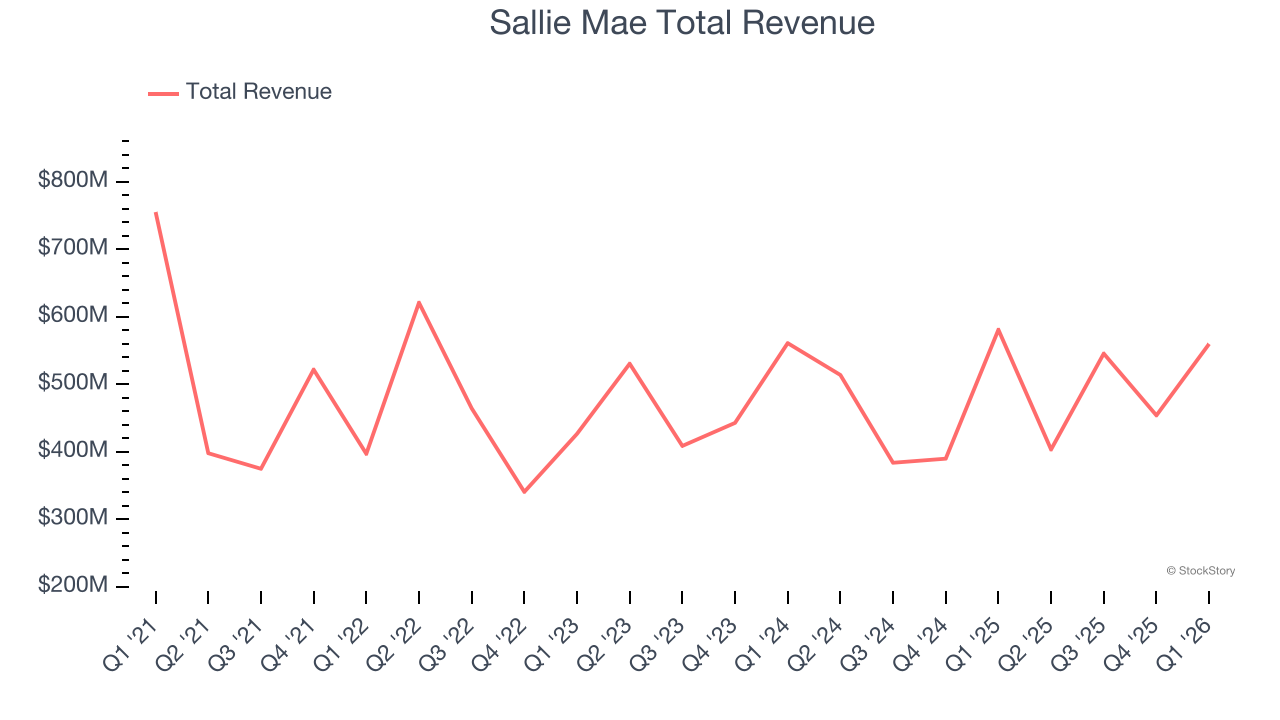
The market seems happy with the results as the stock is up 7.2% since reporting. It currently trades at $25.10.
Is now the time to buy Sallie Mae? Access our full analysis of the earnings results here, it’s free.
Weakest Q1: Nelnet (NYSE: NNI)
Starting as a student loan servicer in the 1970s and evolving through the changing landscape of education finance, Nelnet (NYSE: NNI) provides student loan servicing, education technology, payment processing, and banking services while managing a portfolio of education loans.
Nelnet reported revenues of $353.2 million, down 7.1% year on year, falling short of analysts’ expectations by 20.4%. It was a disappointing quarter as it posted a significant miss of analysts’ net interest income and EPS estimates.
Nelnet delivered the weakest performance against analyst estimates in the group. As expected, the stock is down 4.3% since the results and currently trades at $135.26.
Read our full analysis of Nelnet’s results here.
Affirm (NASDAQ: AFRM)
Founded by PayPal co-founder Max Levchin with a mission to create honest financial products, Affirm (NASDAQ: AFRM) provides a payment network that allows consumers to make purchases and pay for them over time with transparent, flexible installment loans.
Affirm reported revenues of $1.04 billion, up 32.6% year on year. This print surpassed analysts’ expectations by 4.3%. More broadly, it was a slower quarter as it recorded a significant miss of analysts’ EPS estimates.
The stock is up 24.9% since reporting and currently trades at $84.14.
Read our full, actionable report on Affirm here, it’s free.
Sezzle (NASDAQ: SEZL)
Founded in 2016 as an alternative to traditional credit cards for younger shoppers, Sezzle (NASDAQ: SEZL) provides a payment platform that allows consumers to split purchases into four interest-free installments over six weeks at participating retailers.
Sezzle reported revenues of $135.5 million, up 29.2% year on year. This result topped analysts’ expectations by 5.3%. It was a stunning quarter as it also put up full-year EPS guidance exceeding analysts’ expectations and an impressive beat of analysts’ EBITDA estimates.
The stock is up 112% since reporting and currently trades at $182.04.
Read our full, actionable report on Sezzle here, it’s free.
Market Update
Late in 2025 into early 2026, there was hand-wringing around artificial intelligence. For software companies, the fear was that AI would erode pricing power and compress margins as new tools made it easier to replicate what once required expensive enterprise platforms. Crypto investors had their own version of the same anxiety: if AI agents could trade, allocate capital, and manage wallets autonomously, what exactly was the long-term value of today’s crypto infrastructure?
These concerns triggered a noticeable rotation away from these sectors and into safer havens. But markets rarely dwell on one narrative for long. Spring 2026 came, and the focus shifted abruptly from technological disruption to geopolitical risk. The US’ conflict with Iran became the dominant driver of market psychology, and when geopolitics takes center stage, the script changes quickly. Investors stop debating growth rates and start worrying about oil supply, inflation, and global stability.
Want to invest in winners with rock-solid fundamentals? Check out our Strong Momentum Stocks and add them to your watchlist. These companies are poised for growth regardless of the political or macroeconomic climate.