As the Q1 earnings season comes to a close, it’s time to take stock of this quarter’s best and worst performers in the u.s. shale e&p industry, including Northern Oil and Gas (NYSE: NOG) and its peers.
US shale oil producers extract crude from tight rock formations using horizontal drilling and hydraulic fracturing (fracking) techniques, primarily in basins like the Permian, Bakken, and Eagle Ford. Tailwinds include short-cycle investment flexibility allowing rapid production adjustments, technological improvements enhancing well productivity, and proximity to refining and export infrastructure. Capital discipline has improved financial returns. Headwinds include commodity price sensitivity affecting drilling economics, accelerating well decline rates requiring continuous capital investment, and increasing regulatory and ESG scrutiny. Water usage, induced seismicity concerns, and evolving environmental regulations present ongoing operational challenges.
The 11 u.s. shale e&p stocks we track reported a satisfactory Q1. As a group, revenues beat analysts’ consensus estimates by 2.7%.
Amidst this news, share prices of the companies have had a rough stretch. On average, they are down 8.6% since the latest earnings results.
Northern Oil and Gas (NYSE: NOG)
Taking the path less traveled in the oil industry by choosing not to operate its own wells, Northern Oil and Gas (NYSE: NOG) acquires minority stakes in oil and gas wells operated by other companies across major U.S. shale basins.
Northern Oil and Gas reported revenues of $526.5 million, down 11.1% year on year. This print exceeded analysts’ expectations by 3.1%. Despite the top-line beat, it was still a slower quarter for the company with a significant miss of analysts’ EBITDA estimates.
"The current geopolitical environment is creating a dynamic environment for our business, and NOG is well-positioned to navigate it. We are seeing improved field level price realizations — particularly in the Williston — while strong hedging keeps us insulated from the seasonal weakness in natural gas prices. It is the longer-dated strip, however, that matters most, and improvements in 2027 and 2028 forward prices give us confidence in the durability of activity, M&A market liquidity, and our ability to compete for high-quality assets. Despite the current volatility, operator activity has remained relatively unchanged since the prior quarter, but we will continue to monitor operator plans and activity in the coming quarters,” commented Nick O’Grady, Chief Executive Officer.
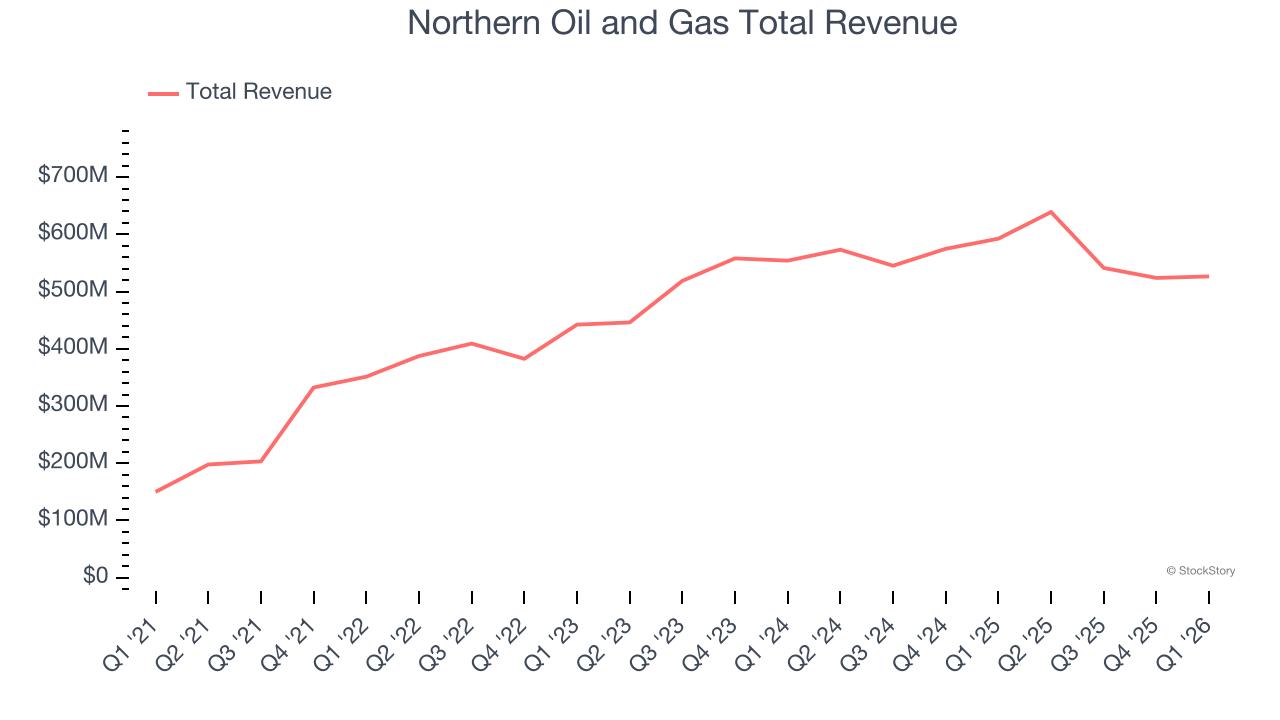
The market seems disappointed with the results as the stock is down 26.3% since reporting and currently trades at $20.32.
Is now the time to buy Northern Oil and Gas? Access our full analysis of the earnings results here, it’s free.
Best Q1: Chord Energy (NASDAQ: CHRD)
Holding the largest acreage position in the Williston Basin, Chord Energy (NASDAQ: CHRD) drills for and produces crude oil, natural gas liquids, and natural gas in North Dakota's Williston Basin.
Chord Energy reported revenues of $1.67 billion, up 37.1% year on year, outperforming analysts’ expectations by 33.1%. The business had an incredible quarter with a beat of analysts’ EPS estimates.
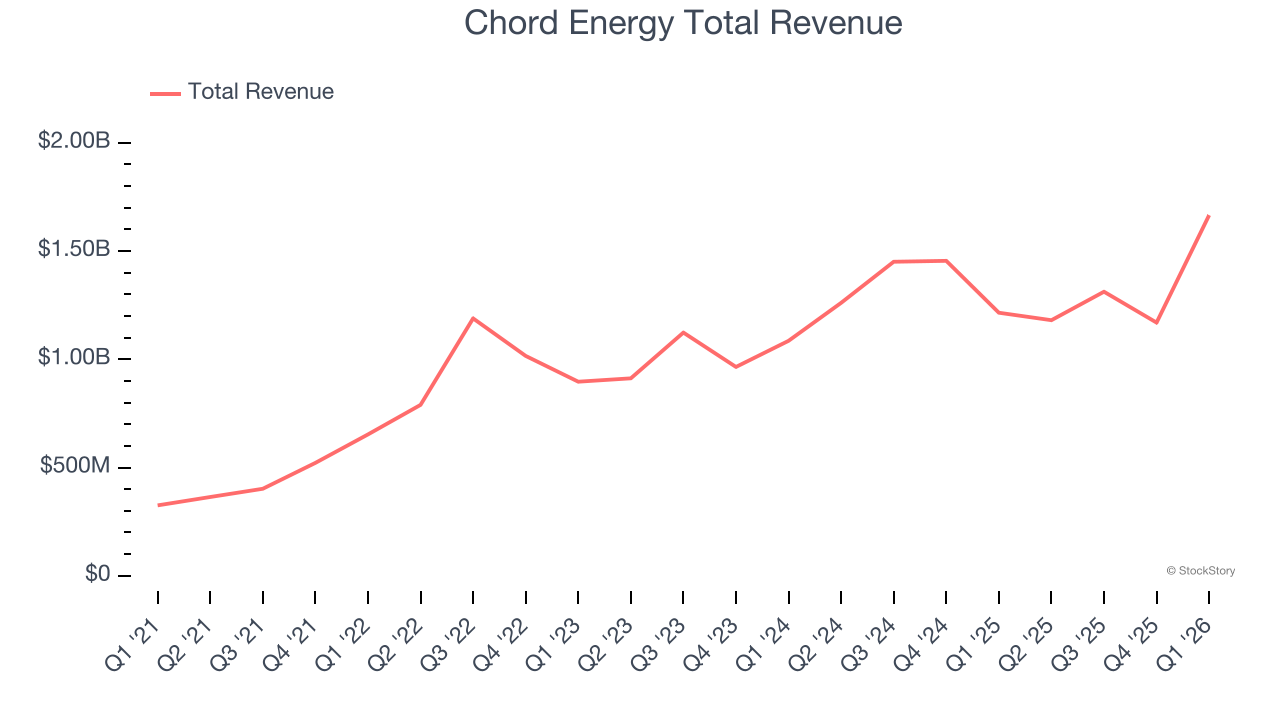
Chord Energy delivered the biggest analyst estimate beat among its peers. Although it had a fine quarter compared to its peers, the market seems unhappy with the results as the stock is down 17.2% since reporting. It currently trades at $123.47.
Is now the time to buy Chord Energy? Access our full analysis of the earnings results here, it’s free.
Weakest Q1: Texas Pacific Land (NYSE: TPL)
One of America's largest private landowners with roughly 868,000 acres in the Permian Basin, Texas Pacific Land (NYSE: TPL) owns land in West Texas and earns revenue from oil and gas royalties, water services, and land leases.
Texas Pacific Land reported revenues of $236.8 million, up 20.8% year on year, falling short of analysts’ expectations by 0.8%. It was a softer quarter as it posted a significant miss of analysts’ EBITDA estimates.
As expected, the stock is down 1.4% since the results and currently trades at $413.78.
Read our full analysis of Texas Pacific Land’s results here.
Cactus (NYSE: WHD)
Named for the spiky wellhead equipment that reminded founders of desert cacti, Cactus (NYSE: WHD) manufactures wellheads, valves, and spoolable pipes used in drilling and producing oil and gas wells.
Cactus reported revenues of $388.3 million, up 38.5% year on year. This print beat analysts’ expectations by 2.3%. Overall, it was a very strong quarter as it also produced a solid beat of analysts’ EBITDA estimates and a beat of analysts’ EPS estimates.
The stock is down 2.8% since reporting and currently trades at $52.97.
Read our full, actionable report on Cactus here, it’s free.
Crescent Energy (NYSE: CRGY)
Controlling over 1.4 million net acres across proven U.S. basins, Crescent Energy (NYSE: CRGY) extracts oil and natural gas from underground reservoirs in Texas and the Rocky Mountains.
Crescent Energy reported revenues of $1.18 billion, up 24.5% year on year. This result was in line with analysts’ expectations. It was a very strong quarter as it also recorded a beat of analysts’ EPS estimates.
The stock is down 25.7% since reporting and currently trades at $10.19.
Read our full, actionable report on Crescent Energy here, it’s free.
Market Update
Over the past year, investors have been forced to repeatedly answer the same question: what is the market’s biggest risk? The answer has changed several times, and each shift has reshaped market leadership.
Late in 2025 and early 2026, artificial intelligence became the market’s primary uncertainty. Investors questioned whether AI would erode software pricing power and weaken competitive moats as AI made it easier to replicate once-differentiated products.
By the spring, technology took a back seat to geopolitics. The U.S. conflict with Iran briefly became the market’s dominant narrative, raising concerns about oil prices, inflation, and global growth. But as energy markets remained orderly and fears of a prolonged supply disruption faded, investors quickly turned their focus back to fundamentals.
Want to invest in winners with rock-solid fundamentals? Check out our 9 Best Market-Beating Stocks and add them to your watchlist. These companies are poised for growth regardless of the political or macroeconomic climate.