Let’s dig into the relative performance of MDU Resources (NYSE: MDU) and its peers as we unravel the now-completed Q1 energy products and services earnings season.
Areas like the energy transition and emission reduction are thematic and front of mind today. This can be a double-edged sword for the energy products and services industry. Those who innovate and build new expertise can jolt demand while those who cling to legacy technologies or fall behind in the trending areas could see their market shares diminish. Bigger picture, energy products and services companies are still at the whim of construction and infrastructure project volumes, which tend to be cyclical and can be impacted heavily by economic factors such as interest rates.
The 4 energy products and services stocks we track reported a slower Q1. As a group, revenues beat analysts’ consensus estimates by 3%.
Amidst this news, share prices of the companies have had a rough stretch. On average, they are down 9.9% since the latest earnings results.
Weakest Q1: MDU Resources (NYSE: MDU)
Founded to provide electricity to towns in Minnesota, MDU Resources (NYSE: MDU) provides products and services in the utilities and construction materials industries.
MDU Resources reported revenues of $606 million, down 10.2% year on year. This print fell short of analysts’ expectations by 12%. Overall, it was a disappointing quarter for the company with a significant miss of analysts’ EPS estimates and full-year EPS guidance missing analysts’ expectations.
"We delivered a strong first quarter when accounting for the impact of warmer weather across our service territory," said Nicole A. Kivisto, president and CEO of MDU Resources.
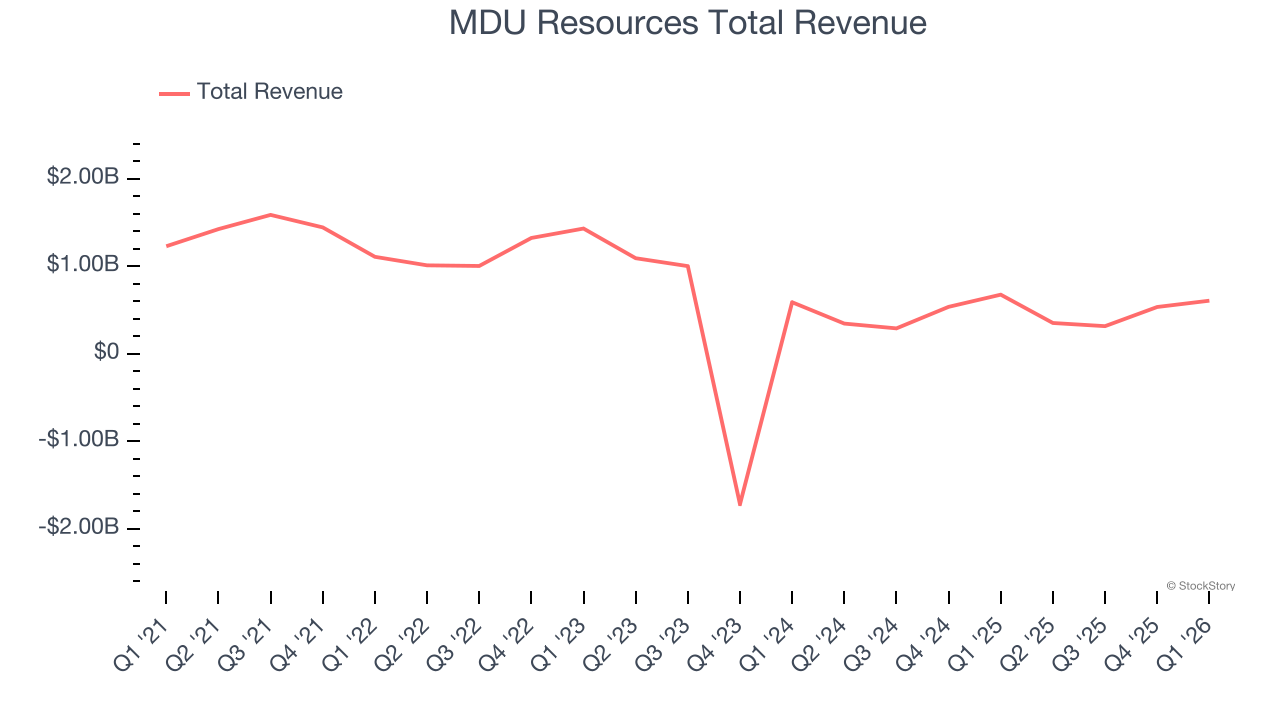
MDU Resources delivered the weakest performance against analyst estimates and slowest revenue growth of the whole group. The market seems disappointed with the results as the stock is down 5.4% since reporting and currently trades at $21.10.
Read our full report on MDU Resources here, it’s free.
Best Q1: Quanta (NYSE: PWR)
A construction engineering services company, Quanta (NYSE: PWR) provides infrastructure solutions to a variety of sectors, including energy and communications.
Quanta reported revenues of $7.87 billion, up 26.3% year on year, outperforming analysts’ expectations by 11.5%. The business had an incredible quarter with a beat of analysts’ EPS and EBITDA estimates.
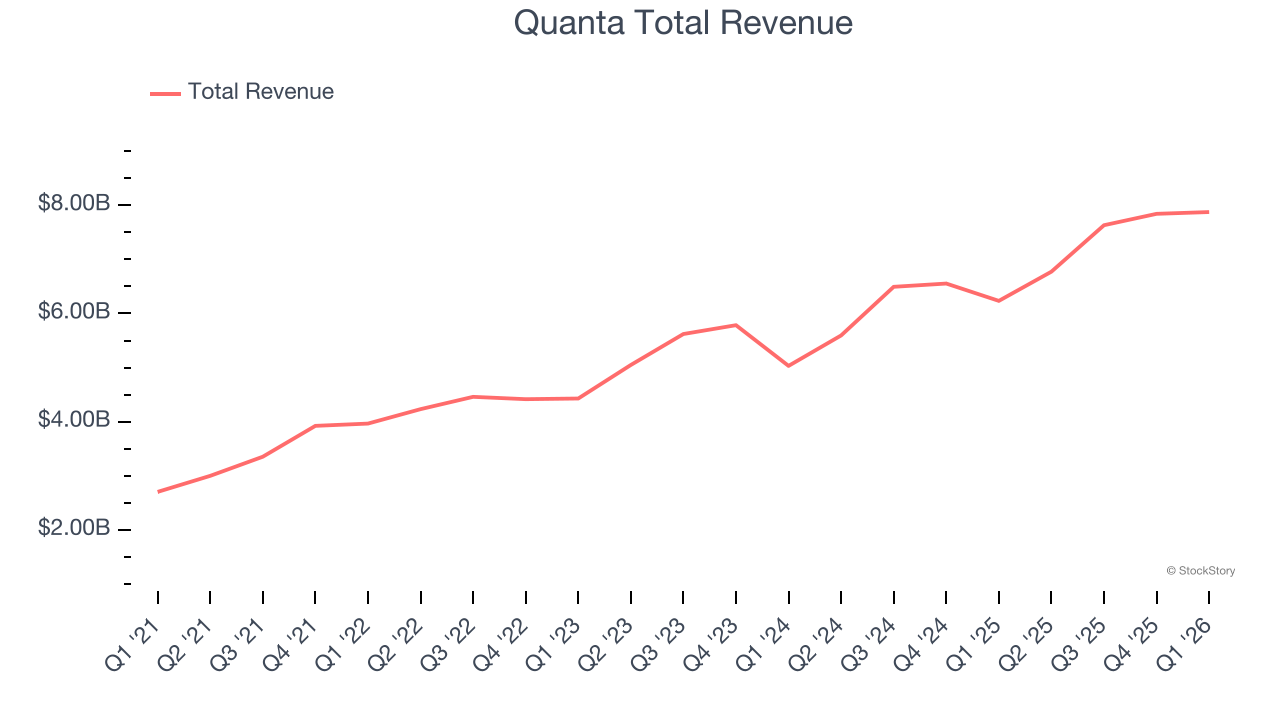
Quanta pulled off the biggest analyst estimate beat and highest full-year guidance raise in the group. The market seems content with the results as the stock is up 2.6% since reporting. It currently trades at $645.05.
Is now the time to buy Quanta? Access our full analysis of the earnings results here, it’s free.
FTAI Infrastructure (NASDAQ: FIP)
Spun off from FTAI Aviation in 2021, FTAI Infrastructure (NASDAQ: FIP) invests in and operates infrastructure and related assets across the transportation and energy sectors.
FTAI Infrastructure reported revenues of $188.4 million, up 95.9% year on year, exceeding analysts’ expectations by 3.3%. Still, it was a slower quarter as it posted a significant miss of analysts’ EBITDA and EPS estimates.
As expected, the stock is down 15.1% since the results and currently trades at $4.36.
Read our full analysis of FTAI Infrastructure’s results here.
Ameresco (NYSE: AMRC)
Having played a role in upgrading the energy solutions of Alcatraz Island, Ameresco (NYSE: AMRC) provides energy and renewable energy solutions for various sectors.
Ameresco reported revenues of $401.5 million, up 13.8% year on year. This result topped analysts’ expectations by 9.4%. Zooming out, it was a slower quarter as it logged full-year EBITDA guidance missing analysts’ expectations and a significant miss of analysts’ EPS estimates.
Ameresco had the weakest full-year guidance update among its peers. The stock is down 21.6% since reporting and currently trades at $24.69.
Read our full, actionable report on Ameresco here, it’s free.
Market Update
Over the past year, investors have been forced to repeatedly answer the same question: what is the market’s biggest risk? The answer has changed several times, and each shift has reshaped market leadership.
Late in 2025 and early 2026, artificial intelligence became the market’s primary uncertainty. Investors questioned whether AI would erode software pricing power and weaken competitive moats as AI made it easier to replicate once-differentiated products.
By the spring, technology took a back seat to geopolitics. The U.S. conflict with Iran briefly became the market’s dominant narrative, raising concerns about oil prices, inflation, and global growth. But as energy markets remained orderly and fears of a prolonged supply disruption faded, investors quickly turned their focus back to fundamentals.
Want to invest in winners with rock-solid fundamentals? Check out our Hidden Gem Stocks and add them to your watchlist. These companies are poised for growth regardless of the political or macroeconomic climate.