Beer, wine, and spirits company Constellation Brands (NYSE: STZ) reported Q2 CY2026 results beating Wall Street’s revenue expectations, but sales fell by 3.3% year on year to $2.43 billion. On the other hand, the company’s full-year revenue guidance of $9 billion at the midpoint came in 1.1% below analysts’ estimates. Its non-GAAP profit of $3.43 per share was 5.2% above analysts’ consensus estimates.
Is now the time to buy Constellation Brands? Find out by accessing our full research report, it’s free.
Constellation Brands (STZ) Q2 CY2026 Highlights:
- Revenue: $2.43 billion vs analyst estimates of $2.39 billion (3.3% year-on-year decline, 1.6% beat)
- Adjusted EPS: $3.43 vs analyst estimates of $3.26 (5.2% beat)
- The company reconfirmed its revenue guidance for the full year of $9 billion at the midpoint
- Management reiterated its full-year Adjusted EPS guidance of $11.55 at the midpoint
- Operating Margin: 34.7%, up from 28.4% in the same quarter last year
- Free Cash Flow Margin: 19.9%, up from 17.7% in the same quarter last year
- Organic Revenue rose 3% year on year (beat)
- Market Capitalization: $24.54 billion
Company Overview
With a presence in more than 100 countries, Constellation Brands (NYSE: STZ) is a globally renowned producer and marketer of beer, wine, and spirits.
Revenue Growth
A company’s long-term performance is an indicator of its overall quality. Any business can have short-term success, but a top-tier one grows for years.
With $9.06 billion in revenue over the past 12 months, Constellation Brands is one of the larger consumer staples companies and benefits from a well-known brand that influences purchasing decisions. However, its scale is a double-edged sword because it’s harder to find incremental growth when your existing brands have penetrated most of the market. To expand meaningfully, Constellation Brands likely needs to tweak its prices, innovate with new products, or enter new markets.
As you can see below, Constellation Brands struggled to generate demand over the last three years. Its sales dropped by 1.9% annually, a poor baseline for our analysis.
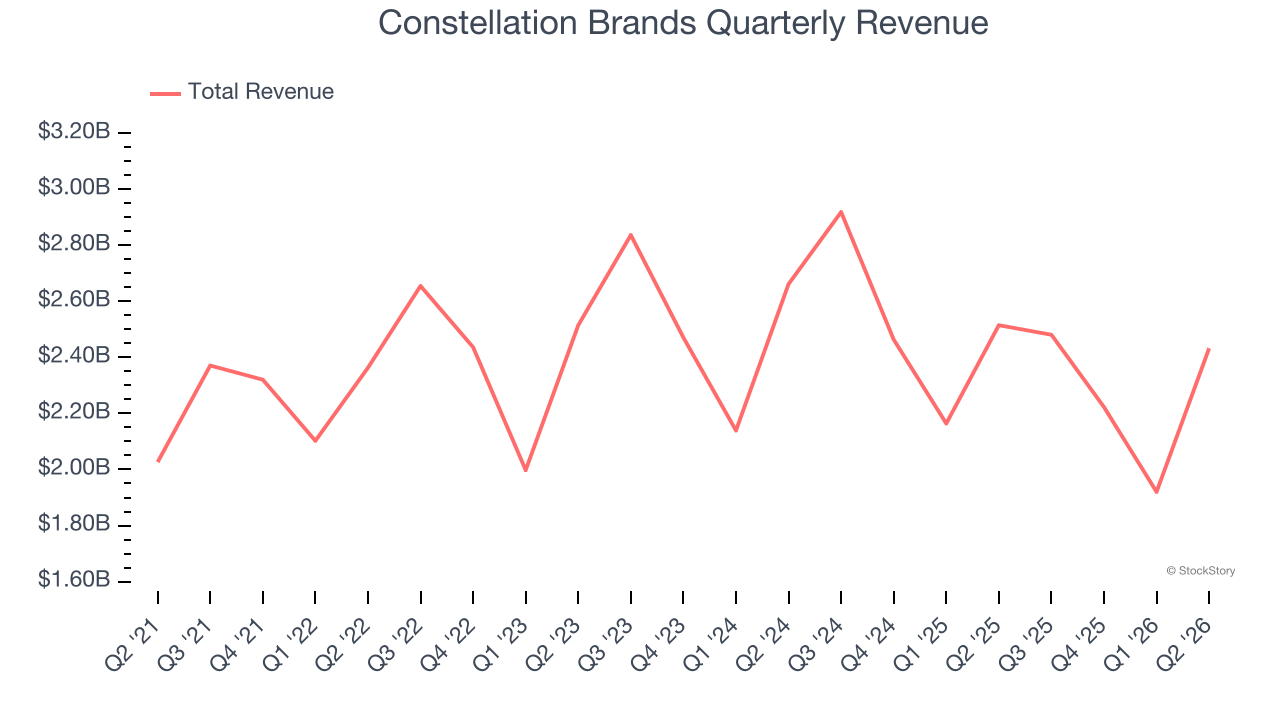
This quarter, Constellation Brands’s revenue fell by 3.3% year on year to $2.43 billion but beat Wall Street’s estimates by 1.6%.
Looking ahead, sell-side analysts expect revenue to remain flat over the next 12 months. Although this projection indicates its newer products will catalyze better top-line performance, it is still below average for the sector.
ONE MORE THING: 3 Hidden Platforms Growing 3X Faster than Amazon, Google, and PayPal. Amazon, Google, and Meta all followed the same playbook: Dominate an ignored market. Build an unbeatable moat. Scale until you’re unstoppable.
These three platforms are running that exact playbook right now. The early investors in Amazon made fortunes. The early investors in these could do the same. Get All 3 Stocks Here for FREE.
Organic Revenue Growth
When analyzing revenue growth, we care most about organic revenue growth. This metric captures a business’s performance excluding one-time events such as mergers, acquisitions, and divestitures as well as foreign currency fluctuations.
The demand for Constellation Brands’s products has barely risen over the last eight quarters. On average, the company’s organic sales have been flat. 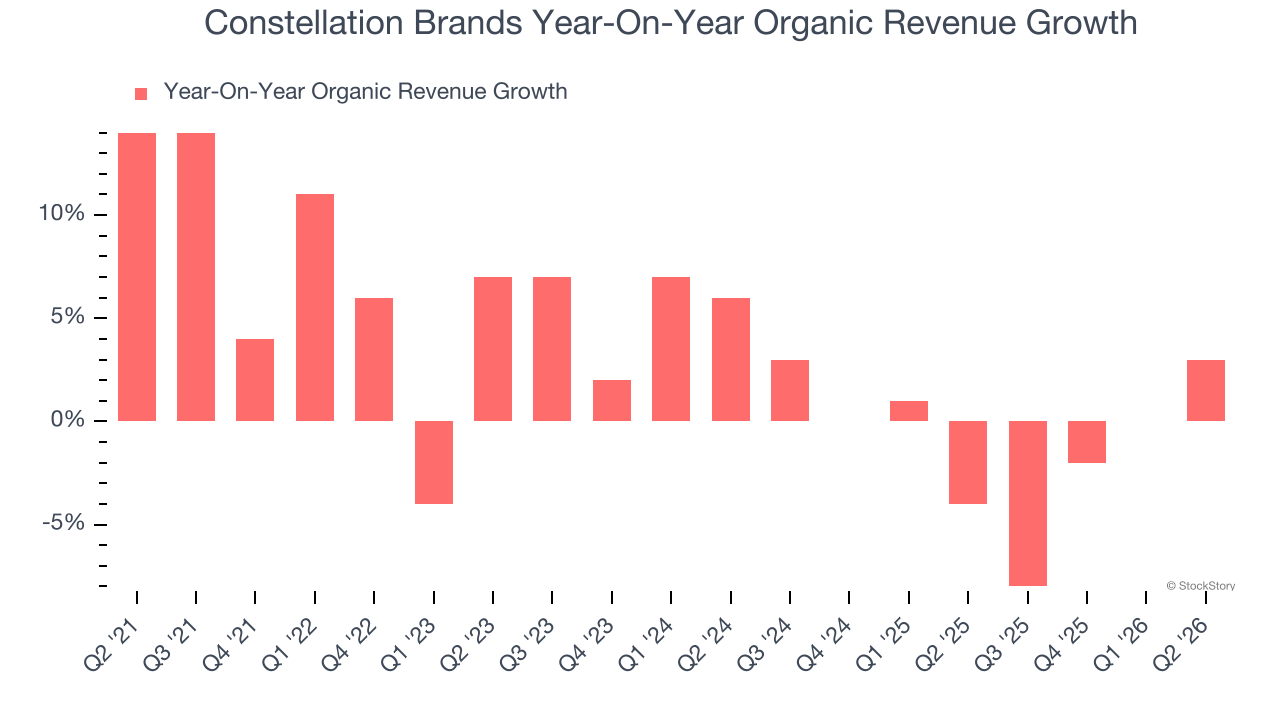
In the latest quarter, Constellation Brands’s organic sales rose by 3% year on year. This growth was a well-appreciated turnaround from its historical levels, showing the business is regaining momentum.
Key Takeaways from Constellation Brands’s Q2 Results
We enjoyed seeing Constellation Brands beat analysts’ organic revenue expectations this quarter. We were also happy its EBITDA outperformed Wall Street’s estimates. On the other hand, its full-year revenue guidance slightly missed and its full-year EPS guidance fell short of Wall Street’s estimates. Overall, this print was mixed but still had some key positives. The stock remained flat at $140.08 immediately after reporting.
Is Constellation Brands an attractive investment opportunity right now? We think that the latest quarter is only one piece of the longer-term business quality puzzle. Quality, when combined with valuation, can help determine if the stock is a buy. We cover that in our actionable full research report which you can read here (it’s free).