As the craze of earnings season draws to a close, here’s a look back at some of the most exciting (and some less so) results from Q1. Today, we are looking at consumer discretionary - travel and vacation providers stocks, starting with Delta (NYSE: DAL).
The Consumer Discretionary sector, by definition, is made up of companies selling non-essential goods and services. When economic conditions deteriorate or tastes shift, consumers can easily cut back or eliminate these purchases. For long-term investors with five-year holding periods, this creates a structural challenge: the sector is inherently hit-driven, with low switching costs and fickle customers. As a result, only a handful of companies can reliably grow demand and compound earnings over long periods, which is why our bar is high and High Quality ratings are rare. Travel and vacation providers operate tour packages, cruise lines, online travel agencies, and vacation rental platforms, connecting consumers with leisure and business travel experiences. Tailwinds include robust post-pandemic travel demand, a consumer preference shift toward experiences over goods, and technology-enabled personalization improving conversion and loyalty. However, headwinds are significant: the industry is acutely sensitive to macroeconomic cycles, geopolitical instability, and fuel price volatility. Low switching costs mean fierce price competition, while capacity additions in segments like cruises can lead to oversupply. Regulatory burdens, weather disruptions, and public health risks further create episodic but potentially severe demand shocks.
The 19 consumer discretionary - travel and vacation providers stocks we track reported a mixed Q1. As a group, revenues beat analysts’ consensus estimates by 1.6% while next quarter’s revenue guidance was 9.3% below.
Luckily, consumer discretionary - travel and vacation providers stocks have performed well with share prices up 19.6% on average since the latest earnings results.
Delta (NYSE: DAL)
One of the ‘Big Four’ airlines in the US, Delta Air Lines (NYSE: DAL) is a major global air carrier that serves both business and leisure travelers through its domestic and international flights.
Delta reported revenues of $15.85 billion, up 12.9% year on year. This print exceeded analysts’ expectations by 4%. Despite the top-line beat, it was still a slower quarter for the company with a significant miss of analysts’ EPS estimates and EPS guidance for next quarter missing analysts’ expectations.
"Delta's results underscore the power of our brand and the durability of our financial foundation. We delivered earnings that were more than 40 percent higher than last year, even with a significant increase in fuel costs and operational disruptions across the industry," said Ed Bastian, Delta's chief executive officer.
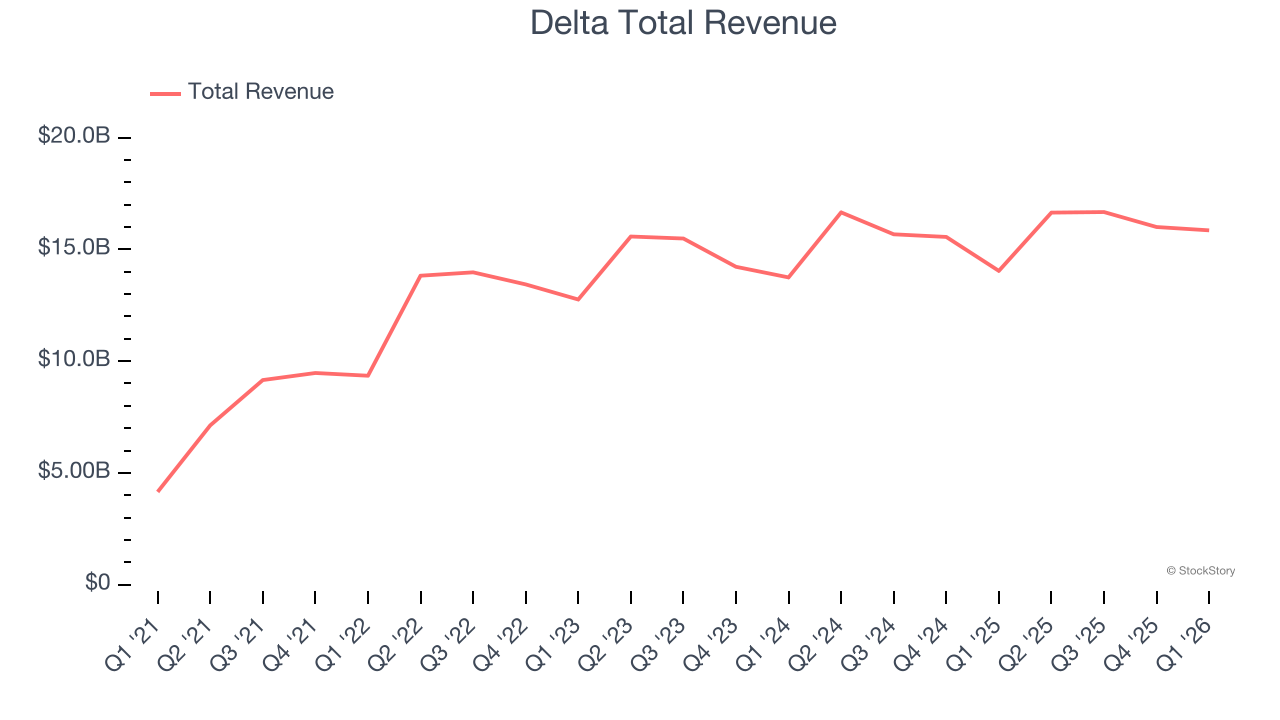
Interestingly, the stock is up 26.8% since reporting and currently trades at $83.19.
Read our full report on Delta here, it’s free.
Best Q1: Sabre (NASDAQ: SABR)
Originally a division of American Airlines, Sabre (NASDAQ: SABR) is a technology provider for the global travel and tourism industry.
Sabre reported revenues of $760.3 million, up 8.3% year on year, outperforming analysts’ expectations by 4.4%. The business had a very strong quarter with a beat of analysts’ EPS and adjusted operating income estimates.
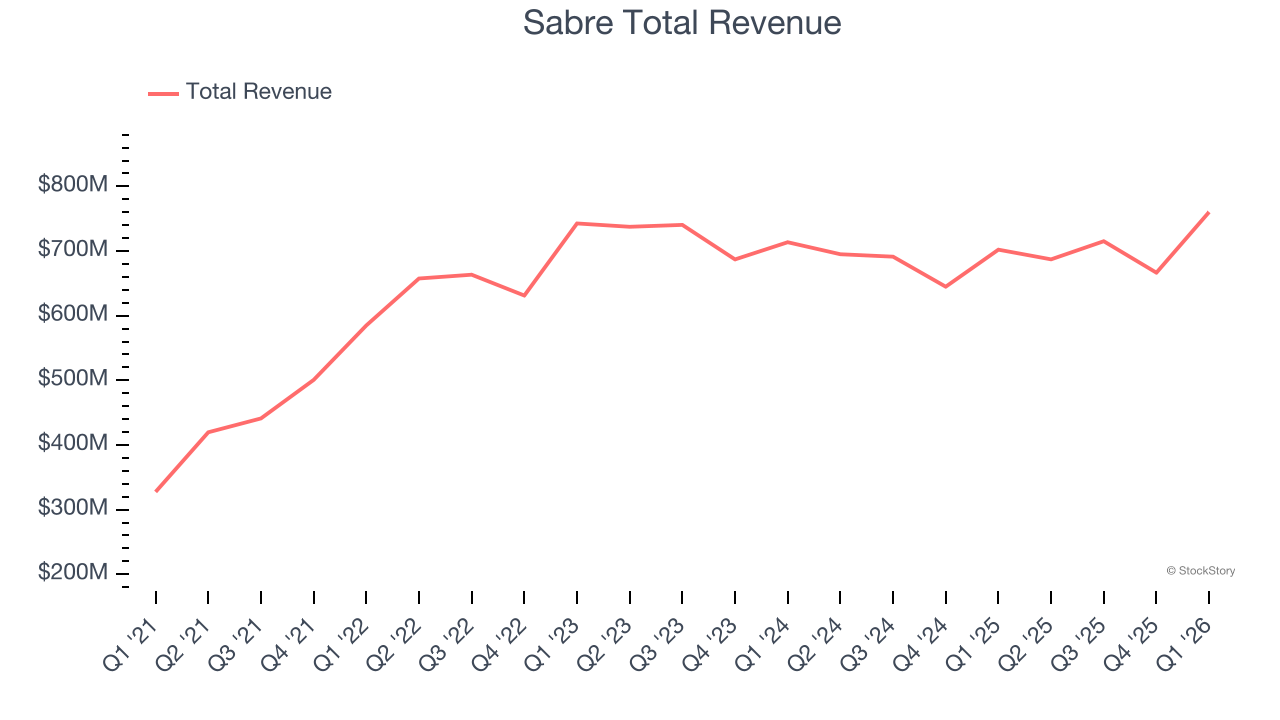
The market seems happy with the results as the stock is up 8.2% since reporting. It currently trades at $1.98.
Is now the time to buy Sabre? Access our full analysis of the earnings results here, it’s free.
Choice Hotels (NYSE: CHH)
With almost 100% of its properties under franchise agreements, Choice Hotels (NYSE: CHH) is a hotel franchisor known for its diverse brand portfolio including Comfort Inn, Quality Inn, and Clarion.
Choice Hotels reported revenues of $340.6 million, up 2.3% year on year, exceeding analysts’ expectations by 2.5%. Still, it was a slower quarter as it posted a significant miss of analysts’ adjusted operating income and EPS estimates.
As expected, the stock is down 1.1% since the results and currently trades at $116.07.
Read our full analysis of Choice Hotels’s results here.
Marriott Vacations (NYSE: VAC)
Spun off from Marriott International in 1984, Marriott Vacations (NYSE: VAC) is a vacation company providing leisure experiences for travelers around the world.
Marriott Vacations reported revenues of $1.26 billion, up 4.8% year on year. This result surpassed analysts’ expectations by 4.6%. However, it was a slower quarter as it produced a significant miss of analysts’ adjusted operating income estimates and a significant miss of analysts’ EPS estimates.
The stock is up 34.4% since reporting and currently trades at $94.37.
Read our full, actionable report on Marriott Vacations here, it’s free.
Lindblad Expeditions (NASDAQ: LIND)
Founded by explorer Sven-Olof Lindblad in 1979, Lindblad Expeditions (NASDAQ: LIND) offers cruising experiences to remote destinations in partnership with National Geographic.
Lindblad Expeditions reported revenues of $208 million, up 15.7% year on year. This print beat analysts’ expectations by 5.1%. Aside from that, it was a satisfactory quarter as it also produced a beat of analysts’ EPS estimates but full-year revenue guidance missing analysts’ expectations.
Lindblad Expeditions delivered the biggest analyst estimate beat but had the weakest full-year guidance update among its peers. The stock is up 33.9% since reporting and currently trades at $23.88.
Read our full, actionable report on Lindblad Expeditions here, it’s free.
Market Update
Late in 2025 into early 2026, there was hand-wringing around artificial intelligence. For software companies, the fear was that AI would erode pricing power and compress margins as new tools made it easier to replicate what once required expensive enterprise platforms. Crypto investors had their own version of the same anxiety: if AI agents could trade, allocate capital, and manage wallets autonomously, what exactly was the long-term value of today’s crypto infrastructure?
These concerns triggered a noticeable rotation away from these sectors and into safer havens. But markets rarely dwell on one narrative for long. Spring 2026 came, and the focus shifted abruptly from technological disruption to geopolitical risk. The US’ conflict with Iran became the dominant driver of market psychology, and when geopolitics takes center stage, the script changes quickly. Investors stop debating growth rates and start worrying about oil supply, inflation, and global stability.
Want to invest in winners with rock-solid fundamentals? Check out our Hidden Gem Stocks and add them to your watchlist. These companies are poised for growth regardless of the political or macroeconomic climate.
StockStory’s analyst team — all seasoned professional investors — uses quantitative analysis and automation to deliver market-beating insights faster and with higher quality.