Genomics company Illumina (NASDAQ: ILMN) missed Wall Street’s revenue expectations in Q3 2026 as revenue rose 4.2% year on year to $1.13 billion. On the other hand, the company’s full-year revenue guidance of $4.65 billion at the midpoint came in 0.6% above analysts’ consensus estimates. Its non-GAAP profit of $1.44 per share was 6.1% above analysts’ consensus estimates.
For more on Illumina, read our full research report for free.
Illumina (ILMN) Q3 2026 highlights:
- Revenue $1.13 billion vs S&P analysts’ consensus estimates of $1.15 billion (4.2% year-on-year growth, 2.1% miss)
- Adjusted EPS $1.44 vs S&P analysts’ consensus estimates of $1.36 (6.1% beat)
- Adjusted operating income $325 million vs analysts’ consensus estimates of $276.8 million (28.8% margin, 17.4% beat)
- Revenue guidance The company slightly lifted its revenue guidance for the full year to $4.65 billion at the midpoint from $4.62 billion
- Adjusted EPS guidance Management raised its full-year adjusted EPS guidance to $5.43 at the midpoint, a 1.4% increase
- Operating margin 27%, up from 20.9% in the same quarter last year
- Free cash flow margin 33.5%, up from 23.3% in the same quarter last year
- Organic revenue rose 4.8% year on year (miss)
- Market capitalization $43.61 billion
"In the third quarter, healthy clinical demand and robust NovaSeq X placements drove results above our guidance. Based on continued momentum, we are raising our full year revenue and earnings guidance," said Jacob Thaysen, Chief Executive Officer of Illumina. "As we continue to execute our strategy, our innovation is broadening the value of the Illumina ecosystem. Together with our customers, we are laying the foundation for AI to transform our understanding of human biology and improve patient outcomes."
Revenue growth
A company’s long-term revenue performance can indicate its overall quality. Even a poor business can perform well for one or two quarters, but a top-tier one grows for years. Illumina’s revenue grew at a tepid 1.2% compounded annual growth rate over the last five years, falling short of our standards.
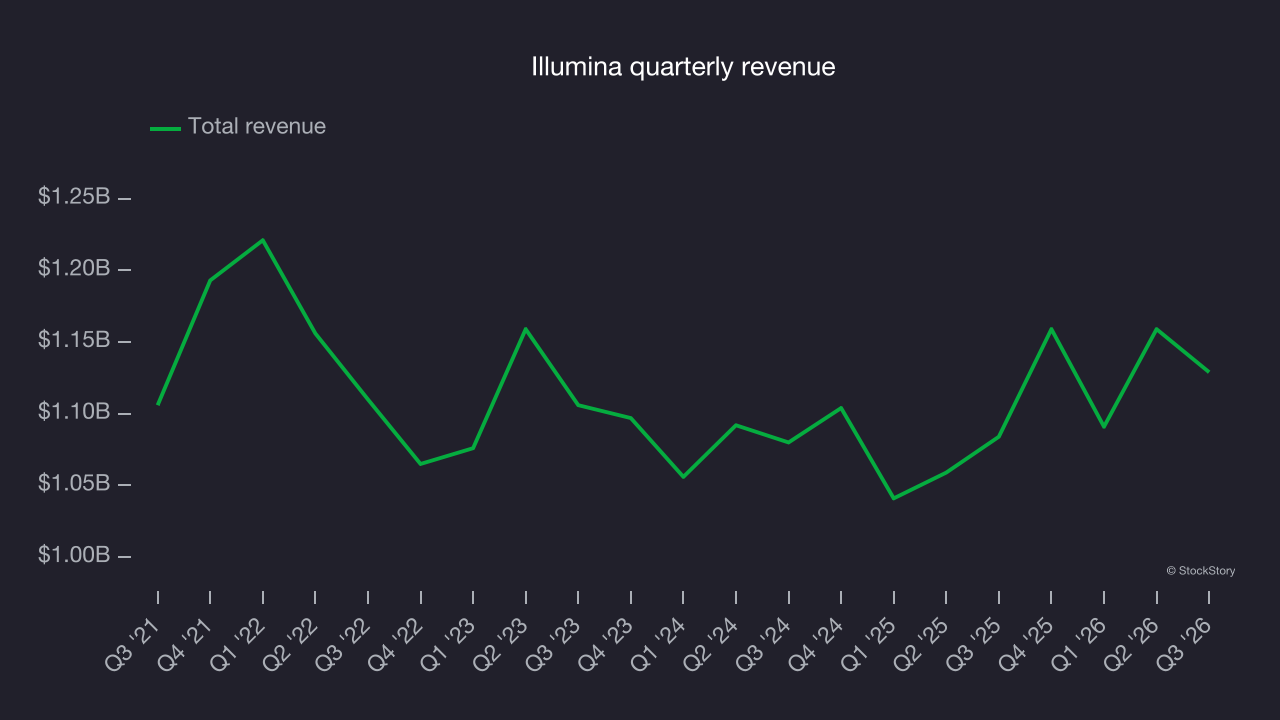
Long-term growth is the most important, but within healthcare, a half-decade historical view may miss new innovations or demand cycles. Illumina’s annualized revenue growth of 2.4% over the last two years is above its five-year trend, a positive sign. 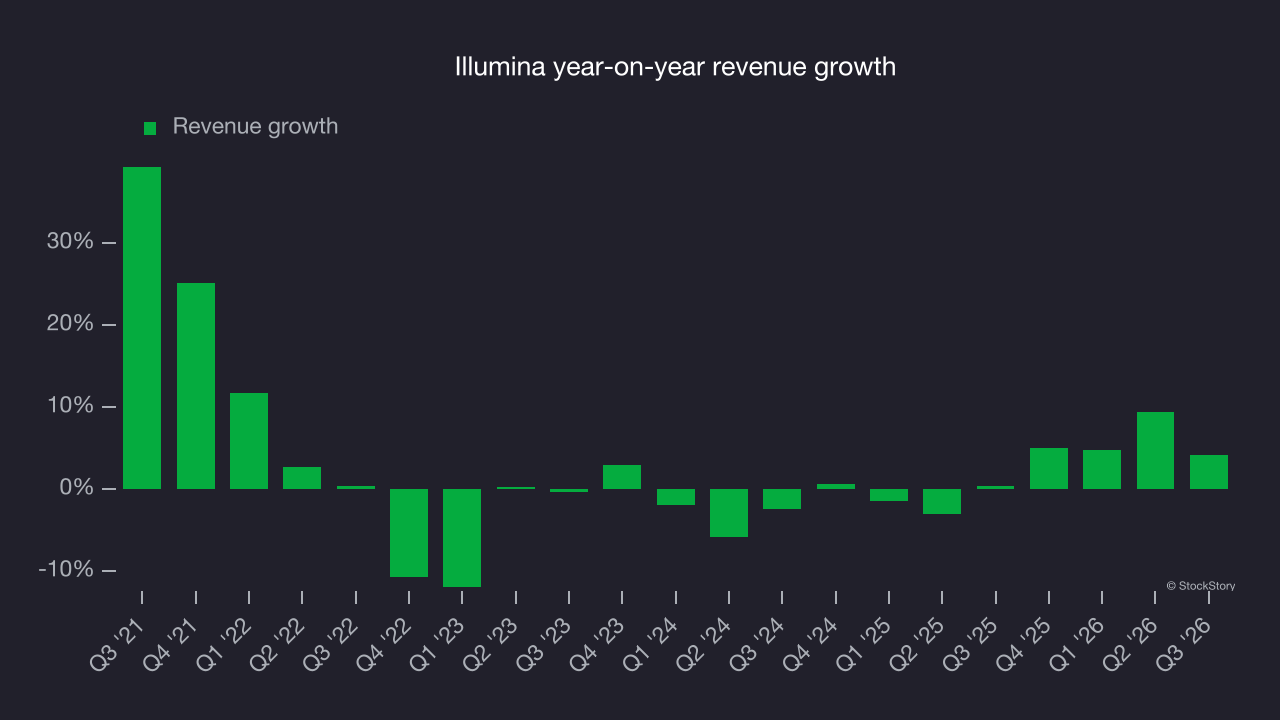
Illumina also reports organic revenue, which strips out one-time events like acquisitions and currency fluctuations that don’t accurately reflect its fundamentals. Over the last two years, Illumina’s organic revenue averaged 1.7% year-on-year growth. This was in line with its two-year revenue growth, indicating that core operations, rather than acquisitions and divestitures, drove most of its results. 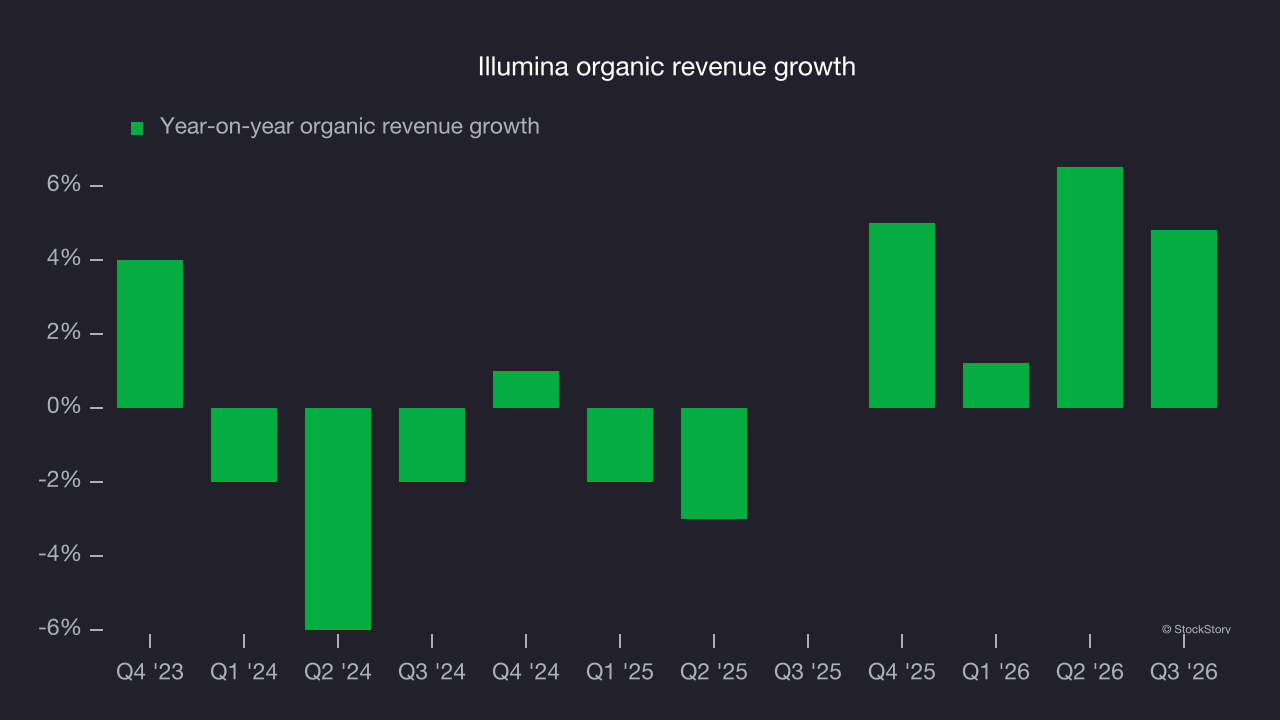
This quarter, Illumina’s revenue grew by 4.2% year on year to $1.13 billion, falling short of Wall Street’s consensus estimates.
Looking ahead, sell-side analysts expect revenue to grow 6.4% over the next 12 months, according to S&P, an improvement versus the last two years. This projection is above the sector average and indicates its newer products and services will fuel better top-line performance.
Adjusted operating margin
Adjusted operating margin is an important measure of profitability as it shows the portion of revenue left after accounting for all core expenses, from the cost of goods sold to advertising and wages. It’s also useful for comparing profitability across companies because it excludes non-recurring expenses, interest on debt and taxes.
Illumina’s adjusted operating margin has risen over the last 12 months and averaged 22.4% over the last five years. Its profitability was also strong for a healthcare business, showing it’s a well-run company with an efficient cost structure.
Looking at the trend in its profitability, Illumina’s adjusted operating margin of 24.2% for the trailing 12 months may be around the same as five years ago, but it has increased by 3.3 percentage points over the last two years.
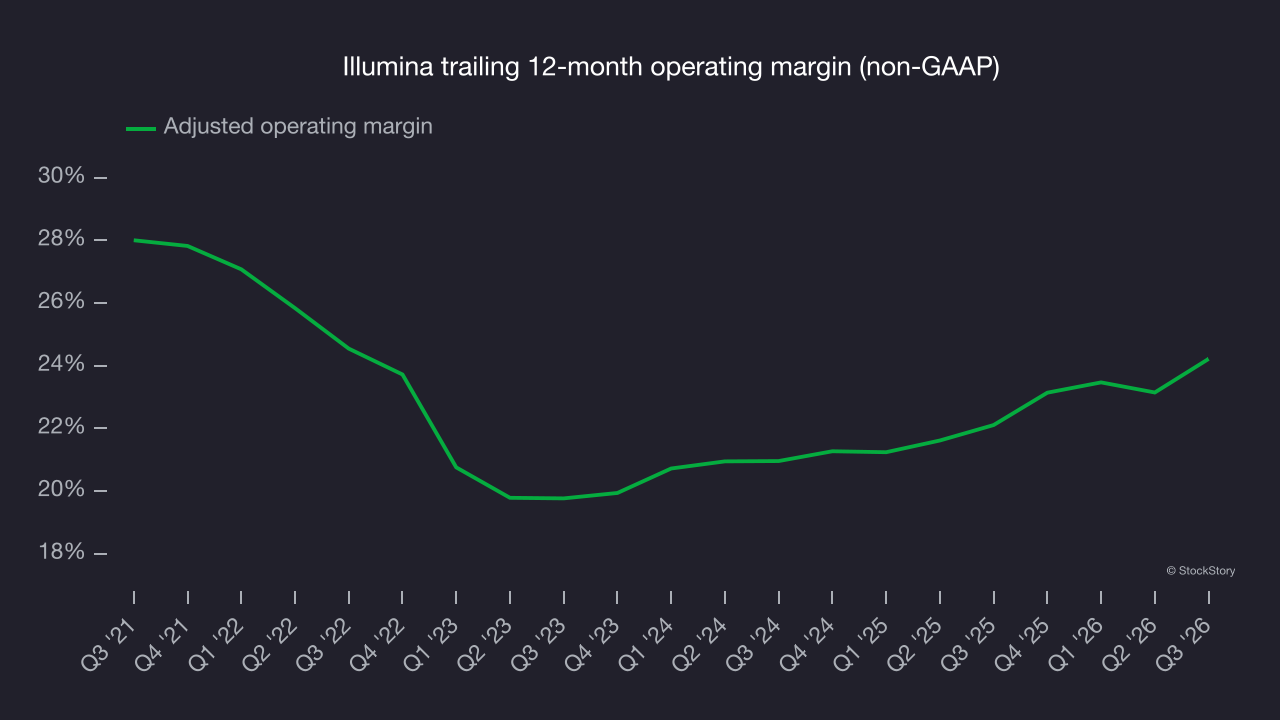
In Q3, Illumina generated an adjusted operating margin of 28.8%, up 4.2 percentage points year on year. The increase was a positive sign of improved efficiency.
Earnings per share
Revenue trends explain a company’s historical growth, but the long-term change in earnings per share (EPS) points to the profitability of that growth. For example, a company could inflate its revenue through excessive spending on advertising and promotions.
Illumina’s EPS declined by 4% annually over the last five years while its revenue grew by 1.2%. However, its adjusted operating margin didn’t change during this time, indicating that non-fundamental factors such as interest and taxes affected its ultimate earnings.
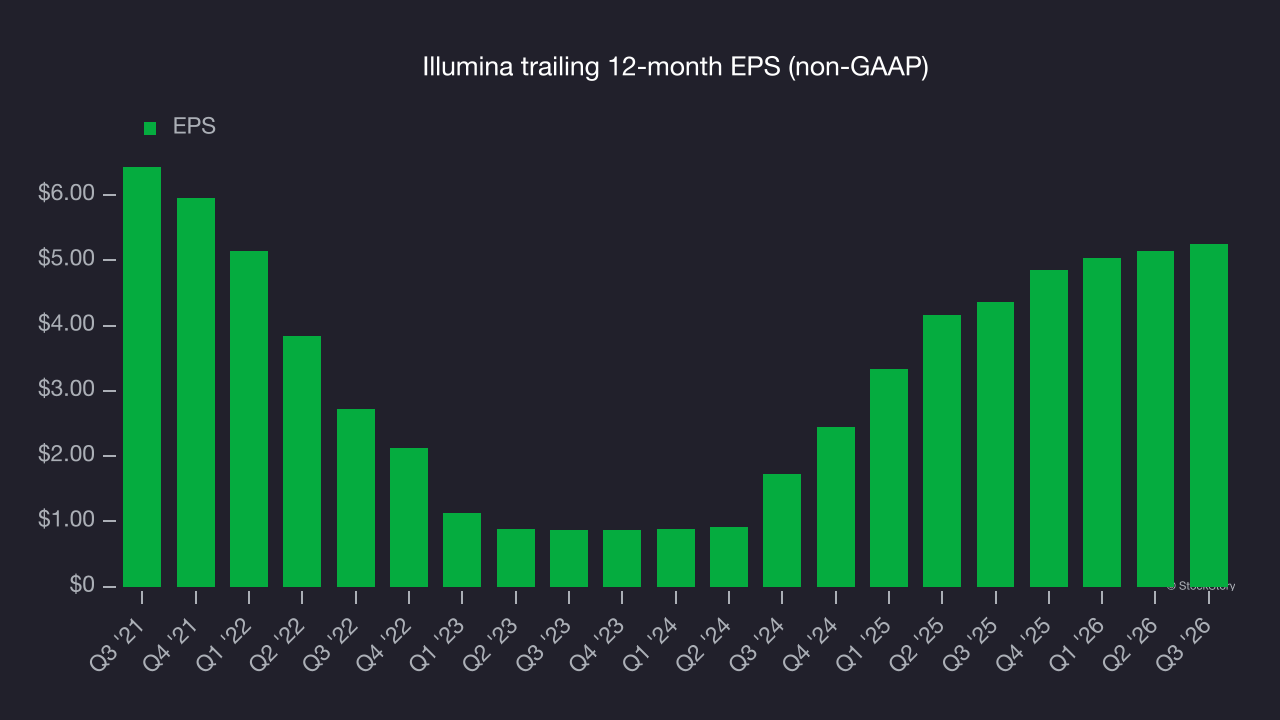
In Q3, Illumina reported adjusted EPS of $1.44, up from $1.34 in the same quarter last year. This result beat analysts’ consensus estimates by 6.1%. Over the next 12 months, Wall Street expects Illumina’s full-year EPS to grow 12.6% from $5.25 to $5.91, according to S&P.
Key takeaways from Illumina’s Q3 results
Illumina’s quarter was softer overall, with revenue missing expectations despite EPS beating Wall Street’s consensus estimates. Full-year EPS guidance also came in narrowly above analysts’ consensus estimates. Shares plunged 16% to $244.87 immediately after the report.
The latest quarter matters, but not nearly as much as longer-term fundamentals and valuation when deciding whether to buy Illumina. For more on Illumina, read our full research report here (it’s free).