Financial services firm Raymond James Financial (NYSE: RJF) beat Wall Street’s revenue expectations in calendar Q3 2026 (fiscal Q4 2026), with revenue up 14.5% year on year to $4.27 billion. Its non-GAAP profit of $3.59 per share was 9.8% above analysts’ consensus estimates.
For more on Raymond James, read our free full research report.
Raymond James (RJF) Q3 CY2026 highlights:
- Assets under management $342.9 billion vs analysts’ consensus estimates of $345 billion (24.7% year-on-year growth, 0.6% miss)
- Revenue $4.27 billion vs S&P analysts’ consensus estimates of $4.21 billion (14.5% year-on-year growth, 1.4% beat)
- Pre-tax profit $862 million (20.2% margin)
- Adjusted EPS $3.59 vs S&P analysts’ consensus estimates of $3.27 (9.8% beat)
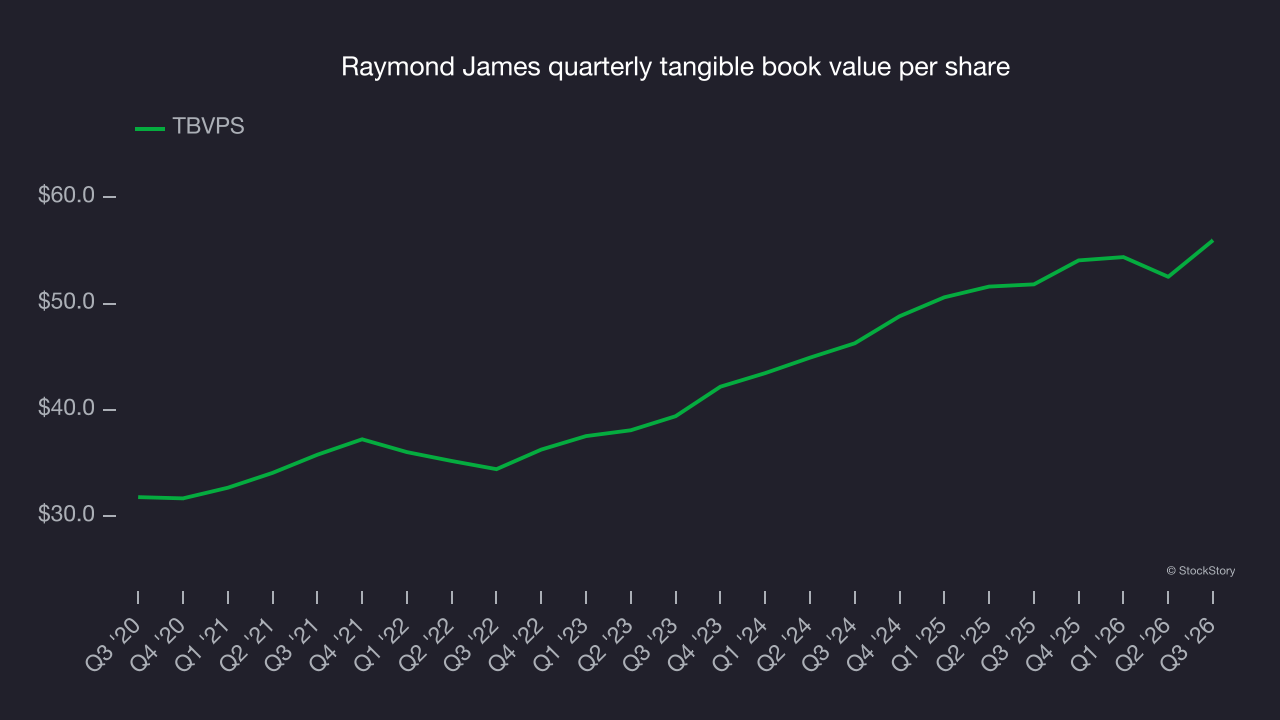
- Tangible book value per share $55.96 vs analysts’ consensus estimates of $54.70 (8% year-on-year growth, 2.3% beat)
- Market capitalization $30.42 billion
Revenue growth
A company’s long-term performance is an indicator of its overall quality. Any business can deliver a good quarter or two, but the best consistently grow over the long term. Raymond James’s 10.1% annualized revenue growth over the last five years was decent. Its growth was slightly above the average financials company and shows its offerings resonate with customers.
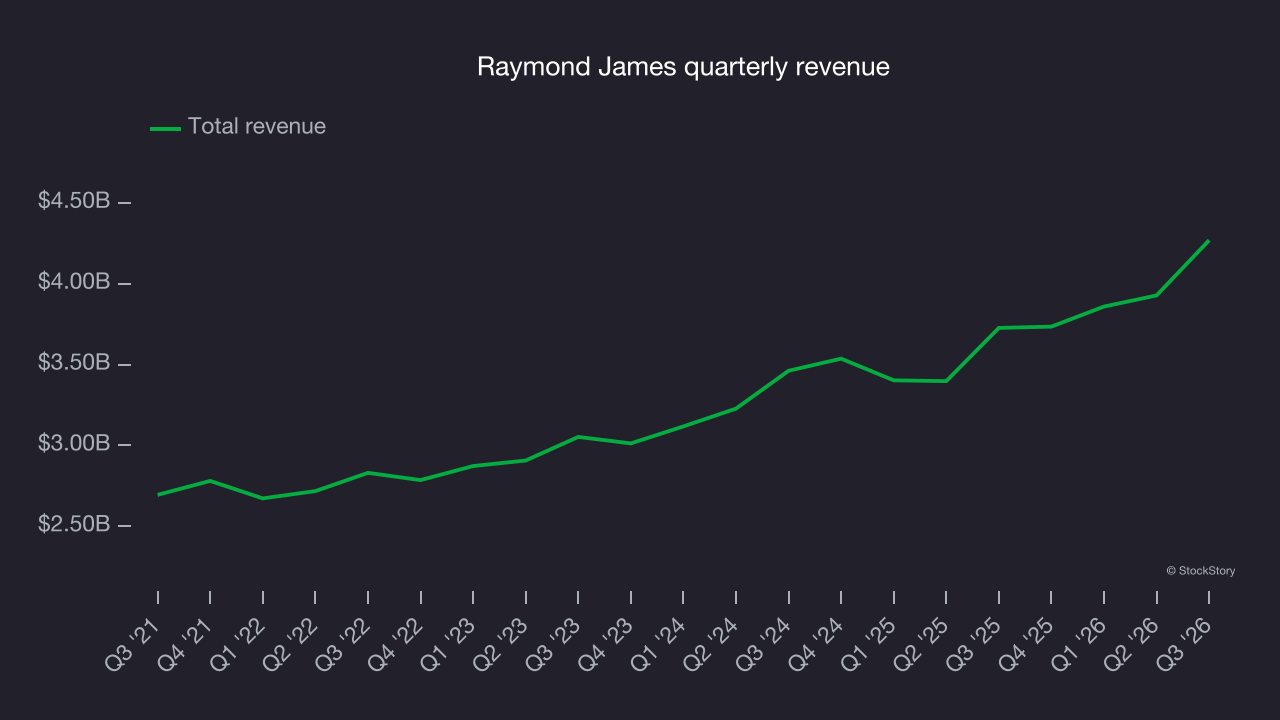
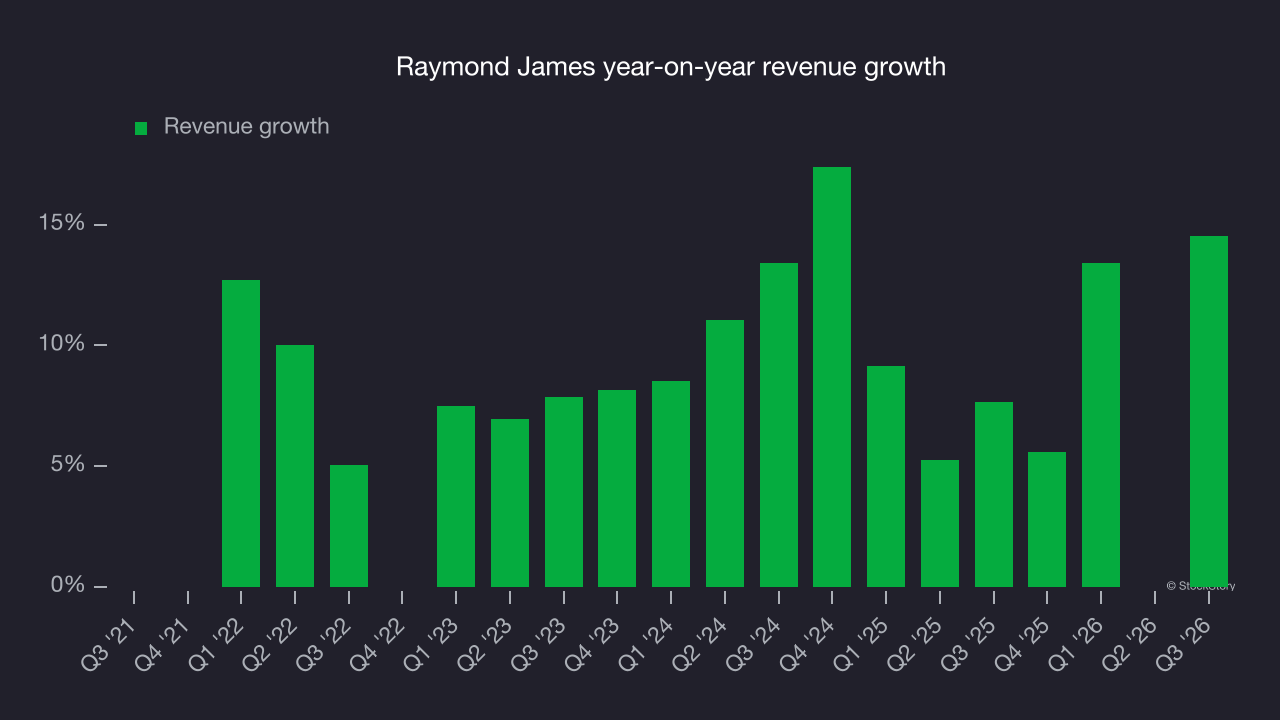
This quarter, Raymond James reported year-on-year revenue growth of 14.5%, and its $4.27 billion of revenue exceeded Wall Street’s consensus estimates by 1.4%.
Tangible book value per share (TBVPS)
Financial institutions manage complex balance sheets spanning various financial activities. Valuations reflect this complexity, emphasizing balance sheet quality and long-term book value compounding across multiple revenue streams.
This makes tangible book value per share (TBVPS) an important metric for the sector. TBVPS represents the real net worth per share across all business segments, providing a clear measure of shareholder equity regardless of the complexity of operations. Traditional metrics like EPS are helpful but face distortion from the complexity of diversified operations, M&A activity and various accounting rules that can obscure true performance across multiple business lines.
Raymond James’s TBVPS grew at a decent 9.4% annual rate over the last five years. The last two years show a similar trajectory as TBVPS grew by 10% annually from $46.27 to $55.96 per share.
Key takeaways from Raymond James’s Q3 results
Raymond James delivered a solid quarter with clear positives: EPS topped analysts’ consensus estimates and revenue narrowly beat Wall Street’s consensus. AUM was the shortfall, coming in slightly below expectations. Shares remained flat at $157.41 immediately after the release.
The latest quarter is only one part of assessing longer-term business quality. Quality, when combined with valuation, can help determine if the stock is a buy. Read the full research report here (it’s free).