Parcel delivery company UPS (NYSE: UPS) reported revenue ahead of Wall Street’s expectations in Q3 2026, with revenue rising 6.9% year on year to $22.9 billion. Guidance for next quarter’s revenue was better than expected at $25.7 billion at the midpoint, 1.1% above analysts’ consensus estimates. Its non-GAAP profit of $1.69 per share was 4% above analysts’ consensus estimates.
For more on United Parcel Service, read the full research report for free.
United Parcel Service (UPS) Q3 2026 highlights:
- Revenue $22.9 billion vs S&P analysts’ consensus estimates of $22.18 billion (6.9% year-on-year growth, 3.3% beat)
- Adjusted EPS $1.69 vs S&P analysts’ consensus estimates of $1.62 (4% beat)
- Revenue guidance $25.7 billion at the midpoint for Q4 2026, above analysts’ consensus estimates of $25.41 billion
- Adjusted EPS guidance Management slightly raised its full-year adjusted EPS guidance to $7.28 at the midpoint
- Operating margin 7.6%, in line with the same quarter last year
- Free cash flow margin 11.6%, up from 7.1% in the same quarter last year
- Market capitalization $85.35 billion
“I want to thank all UPSers for their unwavering commitment to our customers and for delivering another quarter of strong performance,” said Carol Tomé, UPS chief executive officer. “Our third-quarter results demonstrate the continued strengthening of our business fundamentals, driven by premium growth and greater network efficiency. As momentum builds, we are entering the holiday shipping season from a position of strength, with the most automated and efficient network in our history. Given the strength we see in the business, we are raising our full-year financial guidance.”
Revenue growth
Reviewing a company’s long-term revenue performance reveals insights into its quality. Any business can experience short-term success, but top-performing ones sustain growth for years. United Parcel Service struggled to consistently increase demand as its $91.42 billion of revenue for the trailing 12 months was close to its revenue five years ago. This fell short of our standards and suggests it’s a low-quality business.
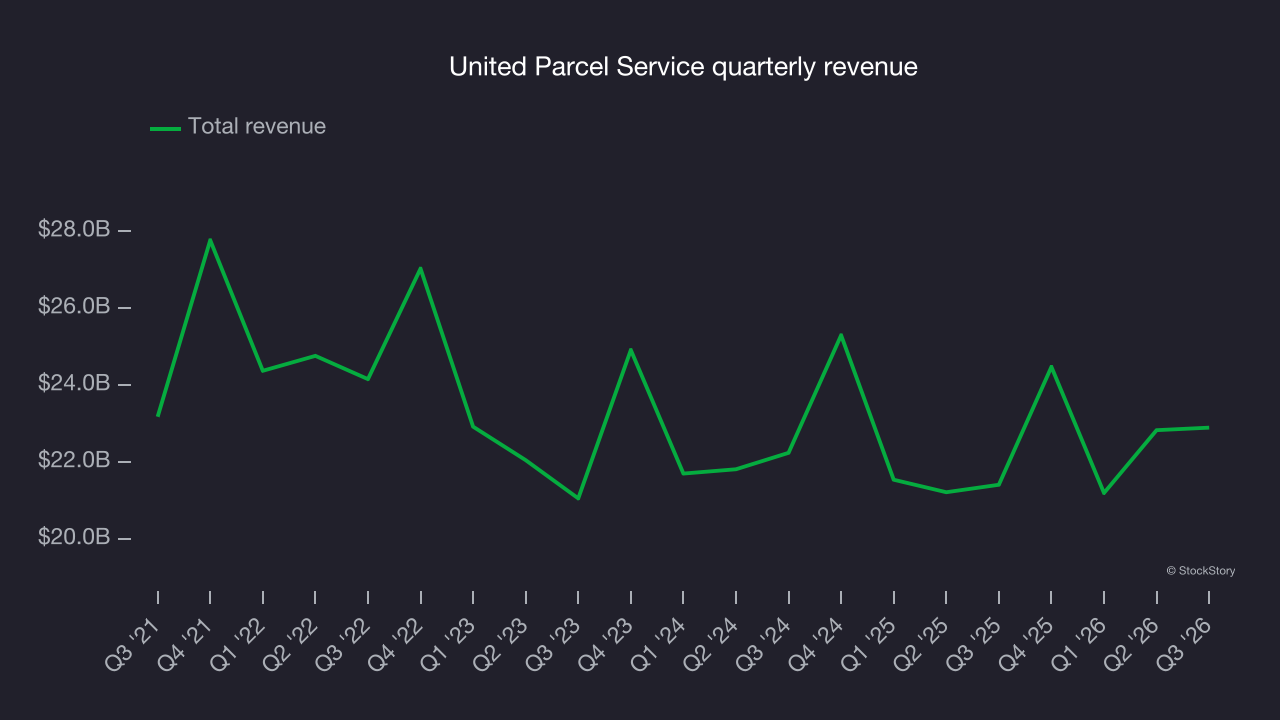
Long-term growth is the most important, but within industrials, a half-decade historical view may miss new industry trends or demand cycles. Just like its five-year trend, United Parcel Service’s revenue over the last two years was flat, suggesting it is in a slump. 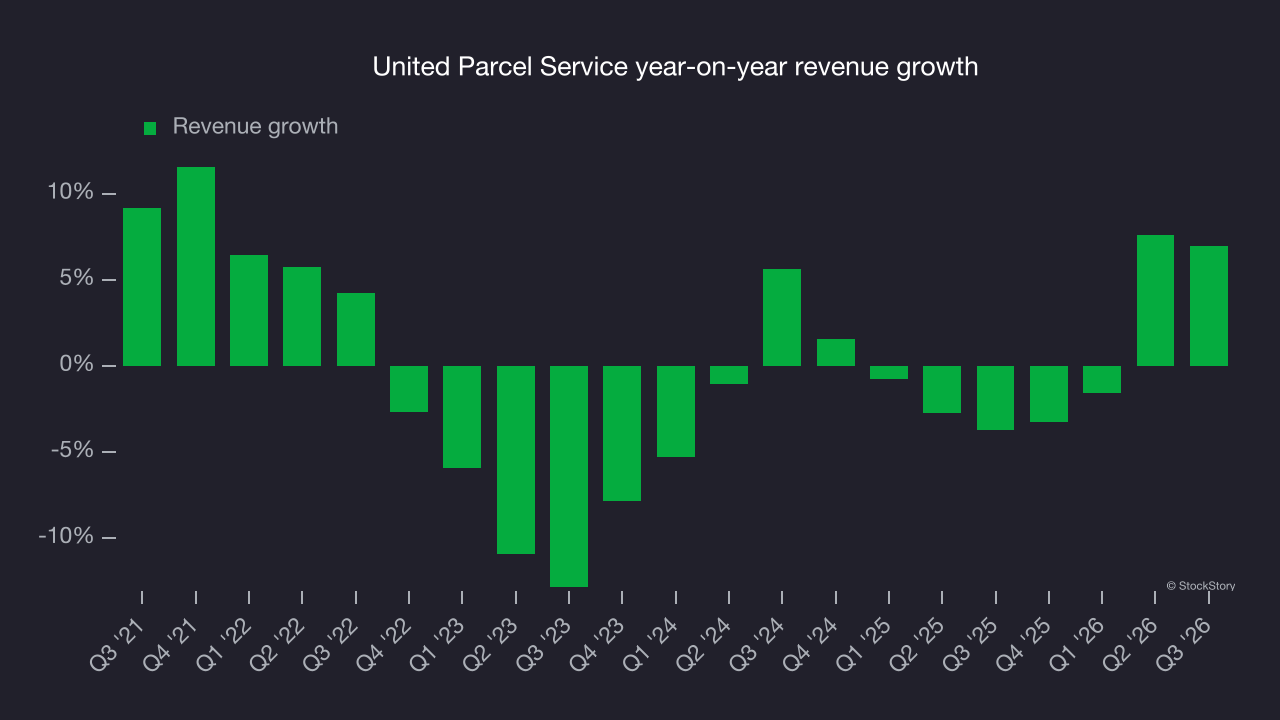
This quarter, United Parcel Service reported year-on-year revenue growth of 6.9%, and its $22.9 billion of revenue exceeded Wall Street’s consensus estimates by 3.3%. Company management is currently guiding for a 5% year-on-year increase in revenue next quarter.
Looking further ahead, sell-side analysts expect revenue to grow 2.7% over the next 12 months, according to S&P. Although this projection suggests its newer products and services will improve revenue performance, it is still below average for the sector.
Operating margin
United Parcel Service has managed its cost base well over the last five years. It demonstrated solid profitability for an industrials business, producing an average operating margin of 10%. This result was particularly impressive because of its low gross margin, which is mostly a factor of what it sells and requires substantial shifts to change meaningfully. Companies have more control over their operating margins, and high operating margins alongside low gross margins indicate well-managed operations.
Looking at the trend in its profitability, United Parcel Service’s operating margin decreased by 6.5 percentage points over the last five years. Even though its historical margin was healthy, shareholders will want to see United Parcel Service become more profitable in the future.
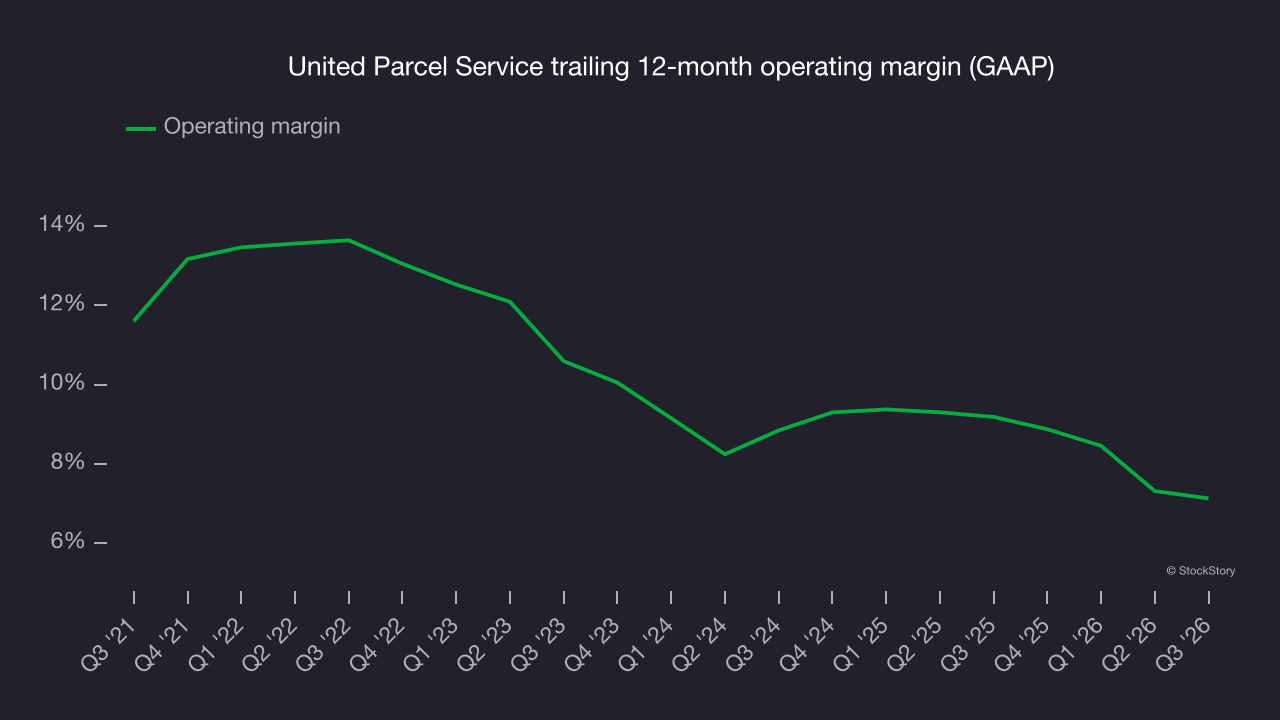
In Q3, United Parcel Service generated an operating margin of 7.6%, in line with the same quarter last year. This indicates the company’s cost structure has recently been stable.
Earnings per share
Revenue trends explain a company’s historical growth, but the long-term change in earnings per share (EPS) points to the profitability of that growth. For example, a company could inflate its revenue through excessive spending on advertising and promotions.
United Parcel Service’s EPS declined by 9.2% annually over the last five years while its revenue was flat. This indicates the company struggled because its fixed cost base made it difficult to adjust to choppy demand.
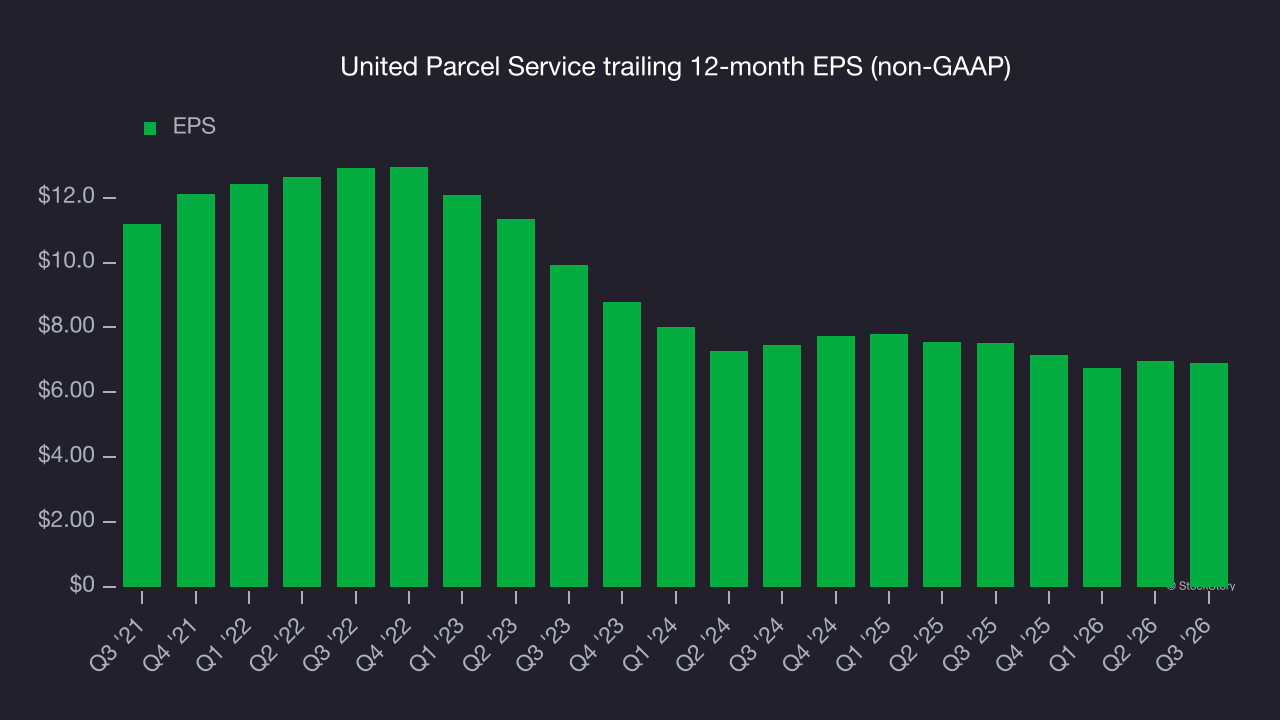
A closer look at United Parcel Service’s earnings helps explain its performance. As noted earlier, United Parcel Service’s operating margin was flat this quarter but declined by 6.5 percentage points over the last five years. This was the most relevant factor (aside from the revenue impact) behind its lower earnings; interest expenses and taxes can also affect EPS but reveal less about a company’s fundamentals.
As with revenue, analyzing EPS over a more recent period can provide insight into an emerging theme or development for the business.
For United Parcel Service, its two-year annual EPS declines of 3.8% show it’s still underperforming. The results were poor across both periods.
In Q3, United Parcel Service reported adjusted EPS of $1.69, down from $1.74 in the same quarter last year. Despite falling year on year, this result beat analysts’ consensus estimates by 4%. Over the next 12 months, Wall Street expects United Parcel Service’s full-year EPS to grow 15.2% from $6.90 to $7.95, according to S&P.
Key takeaways from United Parcel Service’s Q3 results
United Parcel Service delivered a decent quarter, with revenue topping analysts’ consensus estimates and full-year EPS guidance coming in slightly ahead of Wall Street’s consensus. Those were key positives in the results. Shares rose 2.1% to $102.25 immediately after the report.
United Parcel Service had a solid quarter, but one earnings result doesn’t necessarily make the stock a buy. The latest quarter is only one part of assessing longer-term business quality. Quality, combined with valuation, can help determine if the stock is a buy. For more on United Parcel Service, read our full research report here (it’s free).