Automotive technology company Visteon (NYSE: VC) reported Q3 2026 results exceeding the market’s revenue expectations, with sales up 5.8% year on year to $970 million. The company’s full-year revenue guidance of $3.83 billion at the midpoint came in 0.7% above analysts’ estimates. Its non-GAAP profit of $0.19 per share was 91.7% below analysts’ consensus estimates.
Is now the time to buy Visteon? Find out by accessing our full research report, it’s free.
Visteon (VC) Q3 2026 highlights:
- Revenue: $970 million vs analyst estimates of $932.8 million (5.8% year-on-year growth, 4% beat)
- Adjusted EPS: $0.19 vs analyst expectations of $2.28 (91.7% miss)
- Adjusted EBITDA: $46 million, which included $77 million of exceptional warranty charges, vs analyst estimates of $121.4 million (4.7% margin, 62.1% miss)
- EBITDA guidance for the full year is $390 million at the midpoint, below analyst estimates of $470.8 million
- Operating Margin: 0.1%, down from 8.2% in the same quarter last year
- Free Cash Flow was -$4 million, down from $110 million in the same quarter last year
- Market Capitalization: $2.26 billion
"Our third quarter results highlight continued progress toward sustainable sales growth while delivering strong profitability in a challenging supply chain environment," said President and CEO Sachin Lawande. "Our HPC launch with Chery was a significant milestone for Visteon, demonstrating our ongoing position as a key supplier to support the transition to software and AI-defined vehicles."
Company overview
Originally spun off from Ford Motor Company in 2000, Visteon (NYSE: VC) designs and manufactures cockpit electronics for vehicles, including digital instrument clusters, displays, infotainment systems, and battery management systems.
Revenue growth
A company’s long-term sales performance can indicate its overall quality. Any business can experience short-term success, but top-performing ones enjoy sustained growth for years. Unfortunately, Visteon’s 6.7% annualized revenue growth over the last five years was mediocre. This fell short of our benchmark for the industrials sector and is a rough starting point for our analysis.
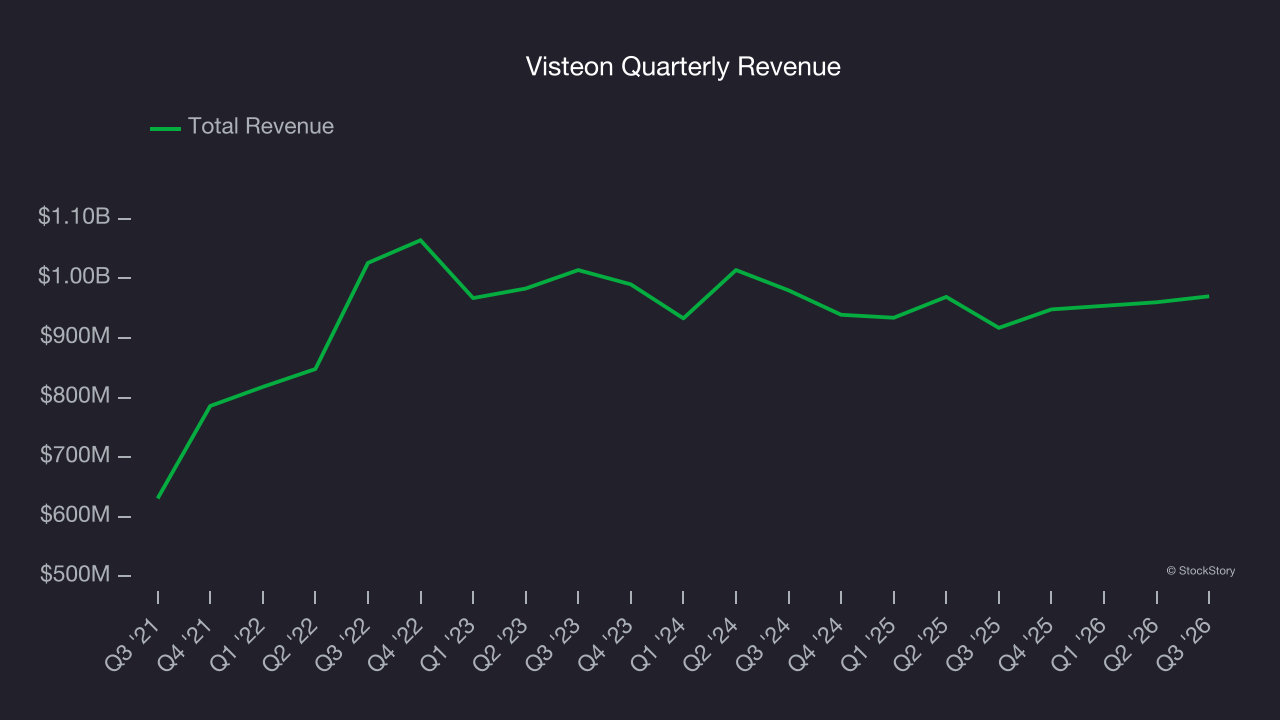
We at StockStory place the most emphasis on long-term growth, but within industrials, a half-decade historical view may miss cycles, industry trends, or a company capitalizing on catalysts such as a new contract win or a successful product line. Visteon’s performance shows it grew in the past but relinquished its gains over the last two years, as its revenue fell by 1.1% annually. 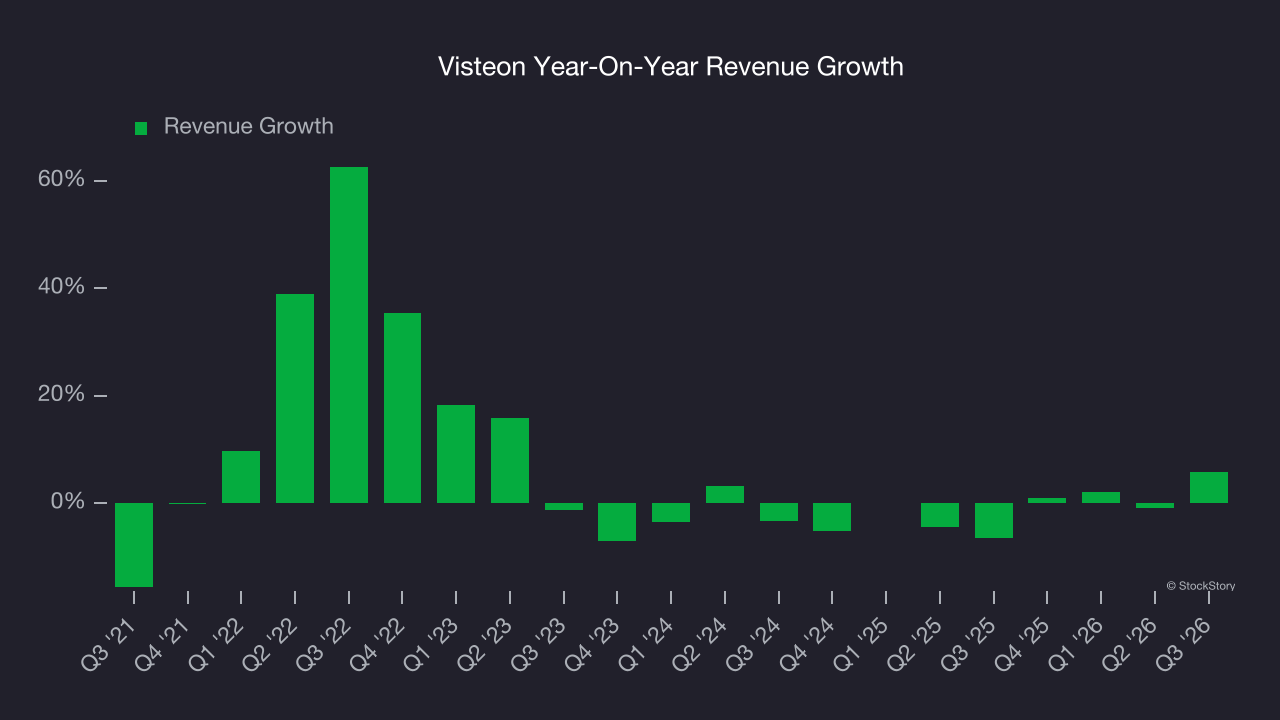
This quarter, Visteon reported year-on-year revenue growth of 5.8%, and its $970 million of revenue exceeded Wall Street’s estimates by 4%.
Looking ahead, sell-side analysts expect revenue to grow 4% over the next 12 months. While this projection suggests its newer products and services will fuel better top-line performance, it is still below the sector average.
WHILE YOU’RE HERE: The Next Palantir? One satellite company captures images of every point on Earth. Every single day. The Pentagon wants it. Hedge funds are using it to beat earnings. You’ve probably never heard of it.
This is what the early days of Palantir looked like before it became a giant. Same playbook. Different technology. If you missed Palantir, you need to see this. Claim The Stock Ticker for Free HERE.
Operating margin
Operating margin is one of the best measures of profitability because it tells us how much money a company takes home after procuring and manufacturing its products, marketing and selling those products, and most importantly, keeping them relevant through research and development.
Visteon’s operating margin has generally stayed the same over the last 12 months, averaging 6.4% over the last five years. This profitability was paltry for an industrials business and caused by its suboptimal cost structureand low gross margin.
Looking at the trend in its profitability, Visteon’s operating margin might have fluctuated slightly but has generally stayed the same over the last five years. This raises questions about the company’s expense base because its revenue growth should have given it leverage on its fixed costs, resulting in better economies of scale and profitability.
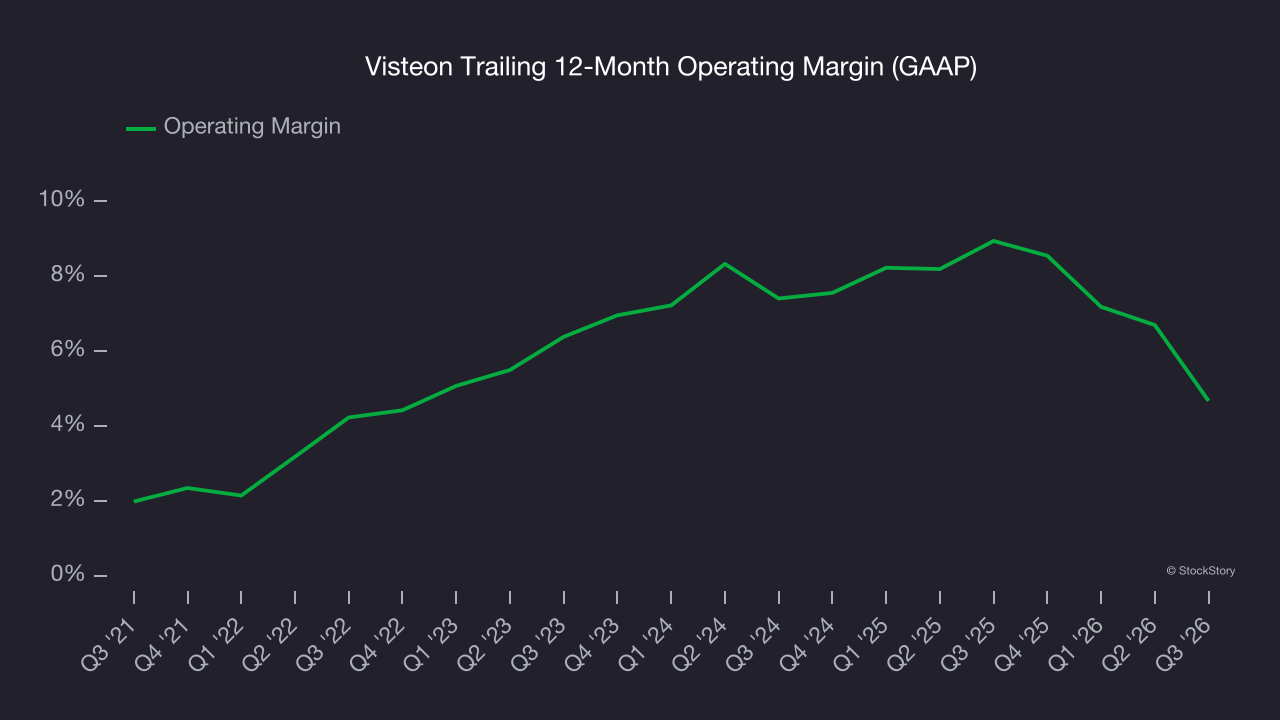
This quarter, Visteon’s breakeven margin was 0.1%, down 8.1 percentage points year on year. Since Visteon’s gross margin decreased more than its operating margin, we can assume its recent inefficiencies were driven more by weaker leverage on its cost of sales rather than increased marketing, R&D, and administrative overhead expenses.
Earnings per share
We track the long-term change in earnings per share (EPS) for the same reason as long-term revenue growth. Compared to revenue, however, EPS highlights whether a company’s growth is profitable.
Visteon’s EPS grew at 35.3% compounded annual growth rate over the last five years, higher than its 6.7% annualized revenue growth. However, this alone doesn’t tell us much about its business quality because its operating margin didn’t improve.
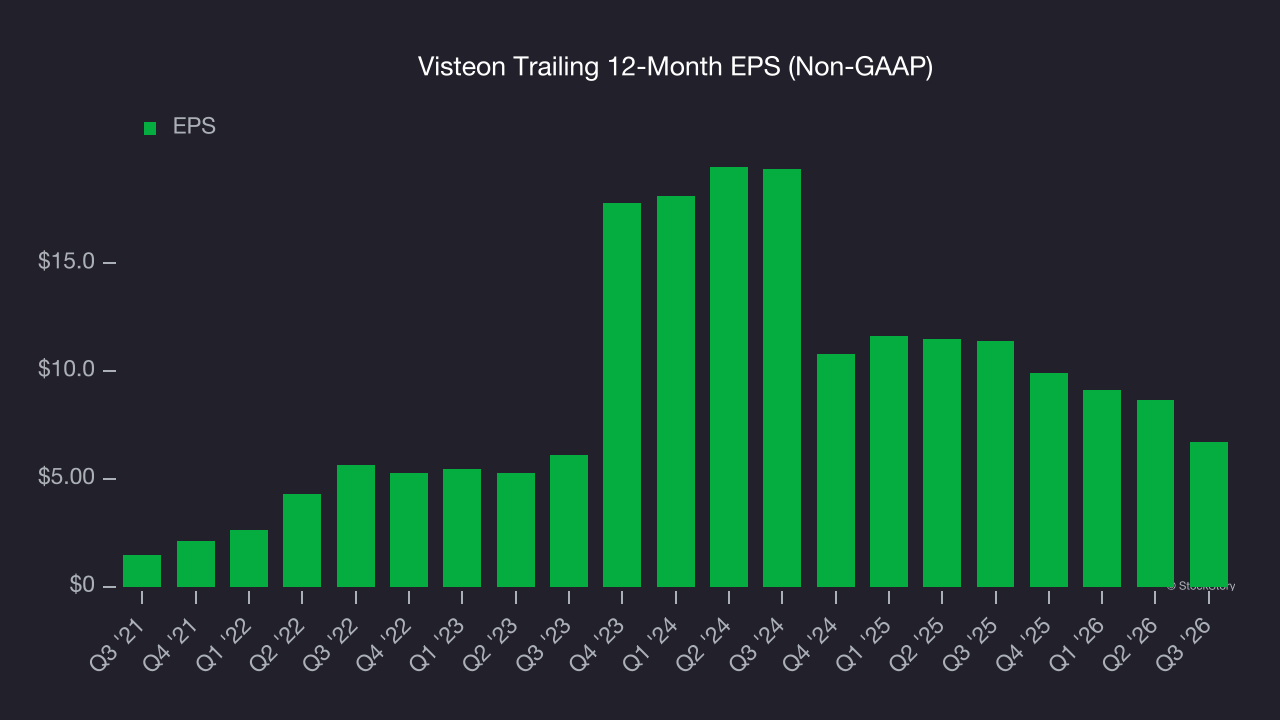
Diving into the nuances of Visteon’s earnings can give us a better understanding of its performance. A five-year view shows that Visteon has repurchased its stock, shrinking its share count by 8.5%. This tells us its EPS outperformed its revenue not because of increased operational efficiency but financial engineering, as buybacks boost per share earnings. 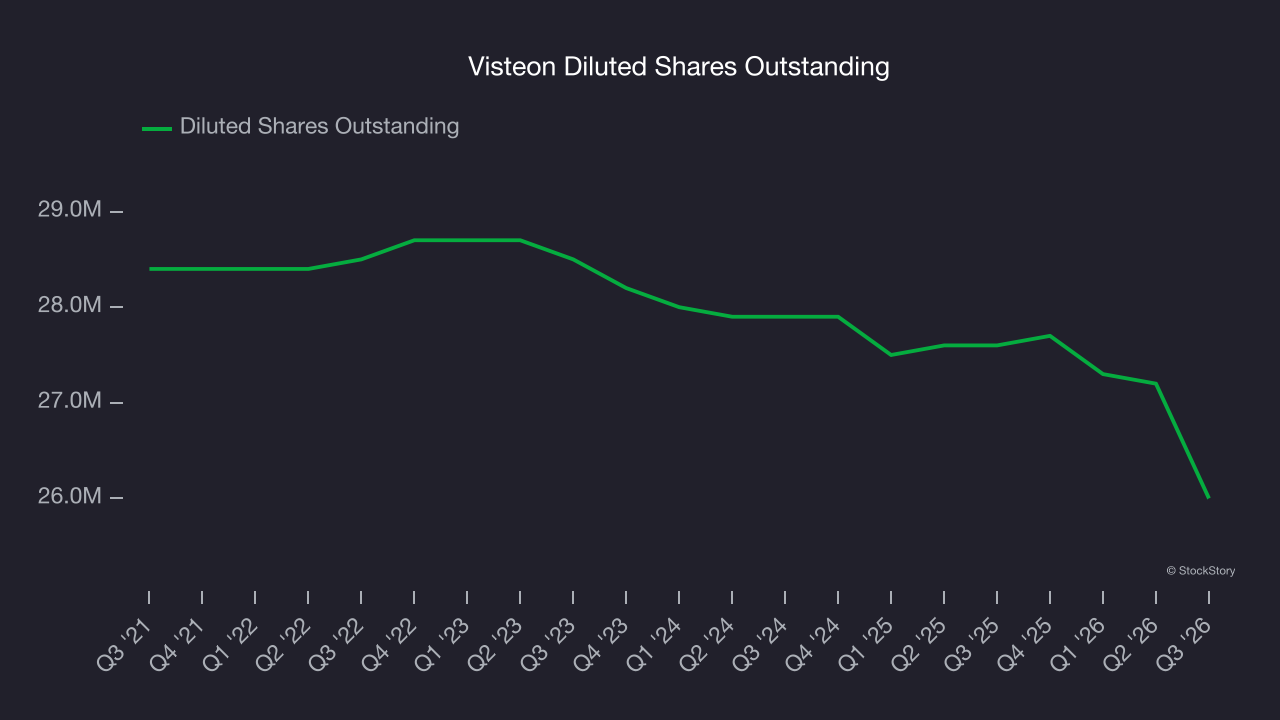
Like with revenue, we analyze EPS over a shorter period to see if we are missing a change in the business.
For Visteon, its two-year annual EPS declines of 41.2% mark a reversal from its (seemingly) healthy five-year trend. We hope Visteon can return to earnings growth in the future.
In Q3, Visteon reported adjusted EPS of $0.19, down from $2.15 in the same quarter last year. This print missed analysts’ estimates, but we care more about long-term adjusted EPS growth than short-term movements. Over the next 12 months, Wall Street expects Visteon’s full-year EPS to grow 46.1% from $6.71 to $9.80.
Key takeaways from Visteon’s Q3 results
We were impressed that Visteon beat analysts’ revenue expectations this quarter. We were also glad its full-year revenue guidance slightly exceeded Wall Street’s estimates. On the other hand, its full-year EBITDA guidance missed and its EBITDA fell short of Wall Street’s estimates. Overall, this quarter could have been better. The stock traded down 4.7% to $80.82 immediately after reporting.
Visteon didn’t show its best hand this quarter, but does that create an opportunity to buy the stock right now? If you’re making that decision, you should consider the bigger picture of valuation, business qualities, as well as the latest earnings. We cover that in our actionable full research report which you can read here (it’s free).