The "Little Market That Could" has finally grown up. As of January 16, 2026, the prediction market landscape looks radically different than it did just eighteen months ago. The most significant shift has not come from the arrival of new crypto-based giants, but from the rebirth of an industry pioneer: PredictIt. Following a grueling three-year legal battle with federal regulators, PredictIt has emerged from its "No-Action" limbo to become a fully regulated exchange and clearinghouse under the Commodity Futures Trading Commission (CFTC).
The transition, finalized in late 2025, has effectively removed the "training wheels" that once held the platform back. With the elimination of the 5,000-trader-per-contract cap and a significant jump in individual wager limits from $850 to $3,500, PredictIt is no longer just an academic curiosity—it is a high-stakes arena for political intelligence. Traders are now pouring millions into markets ranging from the 2026 Midterm control to the next Supreme Court vacancy, testing whether PredictIt’s reputation for "wisdom of the crowd" accuracy holds up when the volume is turned to ten.
The Market: What's Being Predicted
The "New PredictIt" operates under a radically different set of rules than its predecessor. Since late 2025, the platform has transitioned its operations to a Designated Contract Market (DCM) and Derivatives Clearing Organization (DCO) framework, a status it shares with established financial institutions like Interactive Brokers Group (NASDAQ: IBKR) and its ForecastEx exchange.
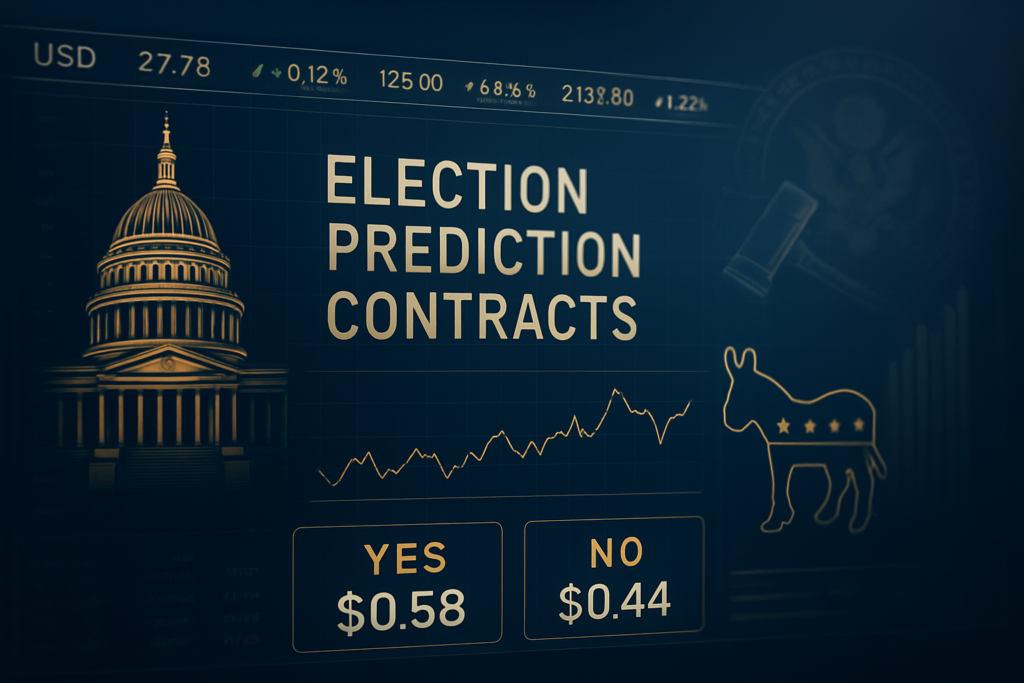
Currently, the primary focus of the market is the 2026 Congressional Midterms. Unlike previous cycles where the 5,000-trader cap led to "bottlenecking"—where a contract would reach its limit and prices would stagnate regardless of new information—the current market for "GOP Control of the House" is seeing unprecedented liquidity. At the time of writing, the odds of Republicans maintaining their majority sit at 58%, while the Democratic path to the Senate gavel is priced at 44 cents (a 44% probability).
Trading volume on PredictIt has surged by over 400% since the removal of the trader cap. Previously, large events like the 2024 Presidential Election were hampered by the $850 limit, which often allowed "fan bias" or low-information retail traders to move the needle. Now, the $3,500 limit—deliberately indexed to match federal individual campaign contribution limits—allows more sophisticated actors to enter the fray, providing a deeper pool of capital and more stable pricing.
Why Traders Are Betting
The move to full regulation has fundamentally changed who is trading. The $3,500 limit is the primary driver. While still modest compared to the uncapped offshore markets like Polymarket, the 4x increase in the wager cap has attracted a new class of "professionalized" political junkies and small-scale hedge fund analysts.
"The old $850 limit was essentially a hobbyist's cap," says one high-volume trader who has been active on the platform since 2016. "With $3,500, you can actually build a meaningful position that rewards the hours of research we put into precinct-level data. It’s enough money to make the signal drown out the noise."
Furthermore, the legal certainty provided by the 2025 settlement—stemming from the Clarke v. CFTC lawsuit—has eliminated the "platform risk" that plagued the exchange for years. Traders no longer fear that their funds will be frozen or that the market will be shuttered by a regulatory whim. This has led to a "flight to quality," where traders who prefer the legal protections of a U.S.-regulated exchange are moving away from decentralized platforms and back to PredictIt’s refined interface.
Broader Context and Implications
PredictIt’s evolution is part of a broader "mainstreaming" of prediction markets that accelerated throughout 2025. The entry of Robinhood Markets (NASDAQ: HOOD) into the event contract space and the growth of CME Group (NASDAQ: CME)'s event derivatives have forced PredictIt to adapt or die. By securing its status as a fully regulated exchange, PredictIt has managed to maintain its niche as the "gold standard" for political data—a reputation built on a decade of providing more accurate forecasts than traditional polling.
The regulatory shift also highlights a major change in the CFTC’s philosophy. After years of resisting election-based betting, the Commission, influenced by court losses and a shifting legislative tide, has pivoted toward a "regulated expansion" model. This model acknowledges that prediction markets provide a public good by aggregating information that polls often miss.
However, this expansion is a double-edged sword for PredictIt's accuracy. Some critics argue that the "wisdom of the crowds" relied on the platform's high density of small-dollar, highly informed academic and political observers. There is a fear that by raising limits to $3,500, the market may become more susceptible to "whales" or manipulative attempts by political campaigns to shift public perception—though supporters argue that higher limits actually make manipulation more expensive and therefore less likely.
What to Watch Next
The immediate test for the New PredictIt will be the upcoming primary season for the 2026 Midterms. Watch for the "liquidity test" in high-profile Senate races in Pennsylvania and Georgia. If these markets can handle tens of thousands of traders and multi-million dollar pools without the price volatility seen in the "old" PredictIt, it will prove that the platform can scale.
Additionally, keep an eye on the competitive response from Cboe Global Markets (NASDAQ: CBOE). While Cboe has traditionally focused on financial indicators, there are rumors that they may partner with data providers to launch their own suite of political contracts to compete with PredictIt’s new DCM status.
Finally, the relationship between PredictIt and the Prediction Market Research Consortium (PMRC)—the non-profit entity now overseeing its research mission—will be critical. How they balance the "for-profit" needs of a regulated exchange with the "pro-social" mission of academic data collection will define the platform's identity in the years to face.
Bottom Line
The transition of PredictIt into a fully regulated, high-capacity exchange marks the end of the "wild west" era of U.S. prediction markets and the beginning of their institutionalization. By removing the 5,000-trader cap and nearly quadrupling wager limits, PredictIt is effectively betting that more money and more people will lead to more truth.
If the 2026 Midterm cycle proves that PredictIt can maintain its "gold standard" accuracy under these new conditions, it will cement the platform's place not just as a betting site, but as a critical piece of the American democratic infrastructure. For the first time in history, the "wisdom of the crowd" has the regulatory backing and the financial depth to truly challenge the dominance of traditional political punditry.
This article is for informational purposes only and does not constitute financial or betting advice. Prediction market participation may be subject to legal restrictions in your jurisdiction.
PredictStreet focuses on covering the latest developments in prediction markets. Visit the PredictStreet website at https://www.predictstreet.ai/.