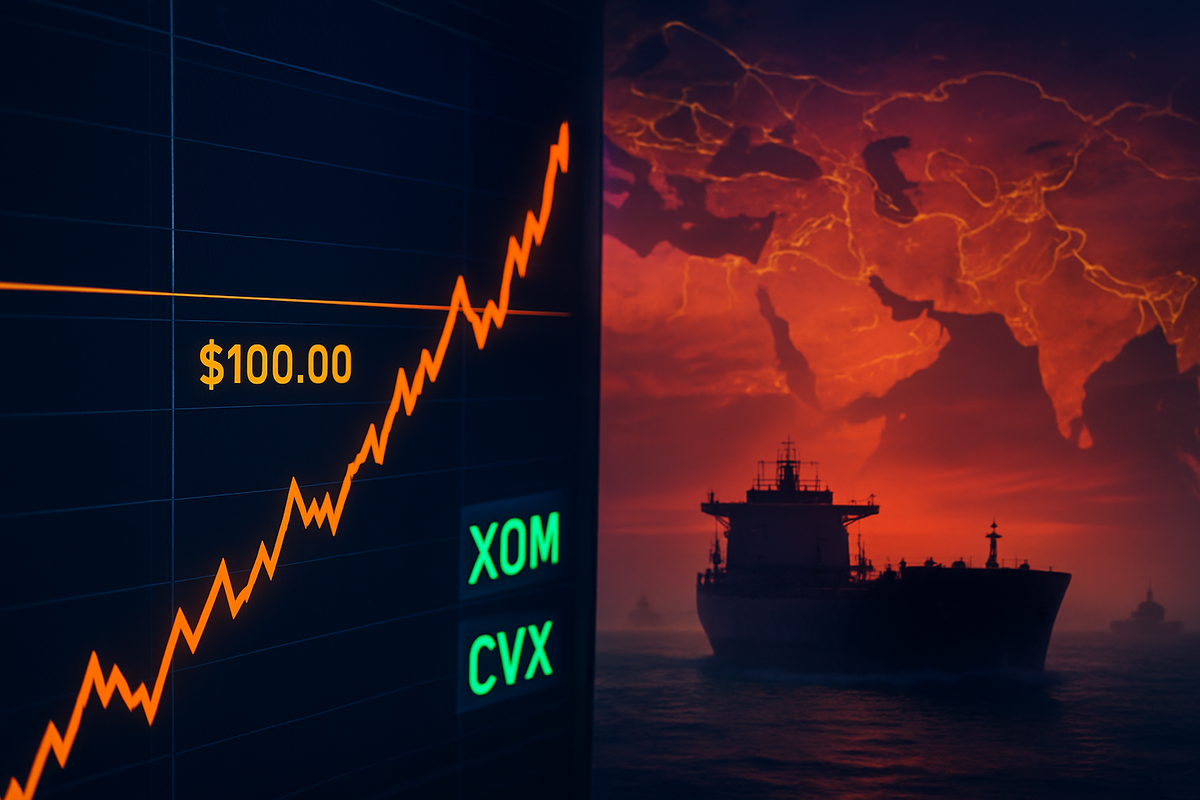
As of April 9, 2026, the global energy landscape remains in a state of high-tension equilibrium following the most significant military confrontation in the Middle East in decades. After a volatile first quarter that saw Brent crude prices skyrocket to nearly $120 per barrel, the market has entered a period of uneasy stabilization around the psychologically critical $100 mark. The "Iran War," as it is now commonly referred to in trading pits from London to Singapore, has fundamentally altered the mechanics of the global oil trade, turning the Strait of Hormuz into a high-risk combat zone and forcing a massive re-evaluation of energy security.
The immediate implications of this stabilization are profound. While the initial panic-buying has subsided, the "geopolitical risk premium"—an extra cost added to every barrel due to the threat of supply disruption—remains at historic highs. For the average consumer, this has translated into a persistent inflationary headache at the pump, while for central banks, it represents a direct challenge to the fragile post-recession recovery. The world is no longer just watching the price of a barrel; it is watching the movement of every naval vessel in the Persian Gulf.
A Timeline of Escalation and the Strait’s Stranglehold
The current crisis did not emerge in a vacuum but followed a multi-year erosion of regional stability. Throughout 2024 and 2025, a series of direct missile exchanges between Iran and regional adversaries laid the groundwork for a larger conflict. Tensions reached a breaking point on February 28, 2026, when the United States and allied forces launched "Operation Epic Fury," a massive targeted strike on Iranian military infrastructure. Iran responded with its most potent asymmetric weapon: a de facto blockade of the Strait of Hormuz. By early March, maritime traffic through the 21-mile-wide waterway, which typically carries 20% of the world’s oil, had plummeted by an estimated 95%.
The closure was not merely a result of physical barriers but of "insurance warfare." As Iranian drone swarms and naval mines began targeting tankers, war-risk insurance premiums for vessels entering the Gulf spiked from 0.2% to over 1% of total ship value. Many major insurers withdrew coverage entirely, effectively grounding the fleet of "Very Large Crude Carriers" (VLCCs) that serve as the lifeblood of the global economy. This "dual chokepoint crisis" was exacerbated by renewed instability in the Red Sea, forcing the global shipping industry into its most expensive logistical pivot in history.
By mid-March 2026, Brent crude peaked at $117 per barrel, a level not seen since the height of the Russia-Ukraine conflict years prior. The current stabilization at $100 per barrel reflects a tenuous ceasefire brokered in early April, but the market remains skeptical. "The physical oil is starting to move again," noted one senior commodities trader, "but the trust is gone. You don't just go back to $70 oil when there are still mines in the water."
Winners and Losers in a Triple-Digit World
The corporate fallout from the conflict has created a stark divide between energy giants based on their geographic footprints. ExxonMobil (NYSE: XOM) has navigated a complex Q1 2026, reporting a 6% hit to its global production due to damaged infrastructure in Qatar and the suspension of joint ventures in the Gulf. However, the company’s massive footprint in the Permian Basin and Guyana has allowed it to capture the $100 price floor on non-impacted barrels, leading to a projected $2.3 billion earnings boost from its Western Hemisphere assets.
Conversely, Shell (NYSE: SHEL) faced a more direct impact. As Europe’s largest natural gas supplier, Shell saw its stock hit record highs due to surging LNG prices, but it simultaneously declared force majeure on several Middle Eastern deliveries after its regional facilities were shuttered for safety. The logistical nightmare has also hit the shipping industry. A.P. Møller - Mærsk (CPH:MAERSK-B) and Hapag-Lloyd (ETR:HLAG) have seen their operational costs explode as they reroute ships around Africa’s Cape of Good Hope, adding 14 days and over $1 million in fuel costs to every voyage between Asia and Europe. While these companies have passed costs to consumers through "Emergency Bunker Surcharges," the long-term strain on global supply chains remains a significant risk.
Chevron (NYSE: CVX) has emerged as perhaps the most resilient of the "Supermajors." With a portfolio heavily weighted toward U.S. shale and Australian LNG, Chevron has been shielded from the direct tactical risks in the Persian Gulf. Investors have flocked to the stock as a "safe haven" play, driving its share price up 12% since the start of the conflict. The divergence in performance highlights a new reality: in 2026, the value of an oil company is determined as much by the location of its wells as by the volume of its reserves.
The Broader Significance: A New Era of Energy Realism
This event marks the definitive end of the era of "cheap and easy" energy that characterized the mid-2020s. The conflict has forced a pivot toward "Energy Realism," where national security concerns override the transition speed toward renewable energy. Policy-makers in Washington and Brussels are now scrambling to authorize new domestic drilling and fast-track nuclear projects to fill the void left by Middle Eastern instability. The U.S. release of its Strategic Petroleum Reserve (SPR) in March provided a temporary cushion, but with the reserve at its lowest levels in decades, that tool is rapidly losing its effectiveness.
Historically, this period will likely be compared to the 1973 oil embargo, but with a modern twist. The integration of global supply chains means that a disruption in the Strait of Hormuz is felt instantly in the price of electronics in San Francisco and grain in Cairo. The "inflationary spike" of April 2026 is not just an energy problem; it is a systemic threat to the global economy. Furthermore, the conflict has accelerated the "de-risking" of global trade, with companies increasingly looking to near-shore their operations to avoid the logistical vulnerabilities of the high seas.
What Lies Ahead: A Tenuous Future
In the short term, the market will remain fixated on the durability of the current ceasefire. If the Strait of Hormuz can be cleared of mines and returned to full capacity by the summer of 2026, we may see oil prices drift back toward the $85–$90 range. However, any "strategic pivot" by Iran or its proxies could easily send prices back toward $120. The most likely scenario for the remainder of the year is a "sideways" market, where $100 acts as a psychological floor that discourages massive consumption while rewarding aggressive domestic production in the U.S. and Brazil.
Long-term, the industry must adapt to a "permanently higher" risk environment. We are likely to see a surge in investment in alternative shipping routes and pipeline infrastructure that bypasses the Strait altogether. Additionally, the role of Saudi Arabia and the UAE as "swing producers" is being re-examined; while they have the capacity, their proximity to the conflict zone makes their supply inherently fragile. The market opportunity now lies in "geographic diversification"—investing in regions that are geographically isolated from the volatile Middle Eastern heartland.
Summary and Investor Outlook
The spring of 2026 will be remembered as the moment the $100 barrel became the "new normal." The conflict with Iran has exposed the extreme vulnerability of the world’s most critical energy artery and forced a massive reallocation of capital. For investors, the key takeaways are clear: geographic exposure is the primary metric of risk, and the shipping industry remains the ultimate "canary in the coal mine" for global trade health.
Moving forward, the market will be hyper-sensitive to any news regarding naval deployments, insurance rate adjustments, and SPR replenishment strategies. While the initial "war shock" has passed, the "war premium" is here to stay. Investors should watch for the Q2 earnings reports of major energy and shipping firms to gauge the true cost of rerouting the world's economy. The era of predictable energy prices has ended; the era of the $100 barrel has begun.
This content is intended for informational purposes only and is not financial advice.