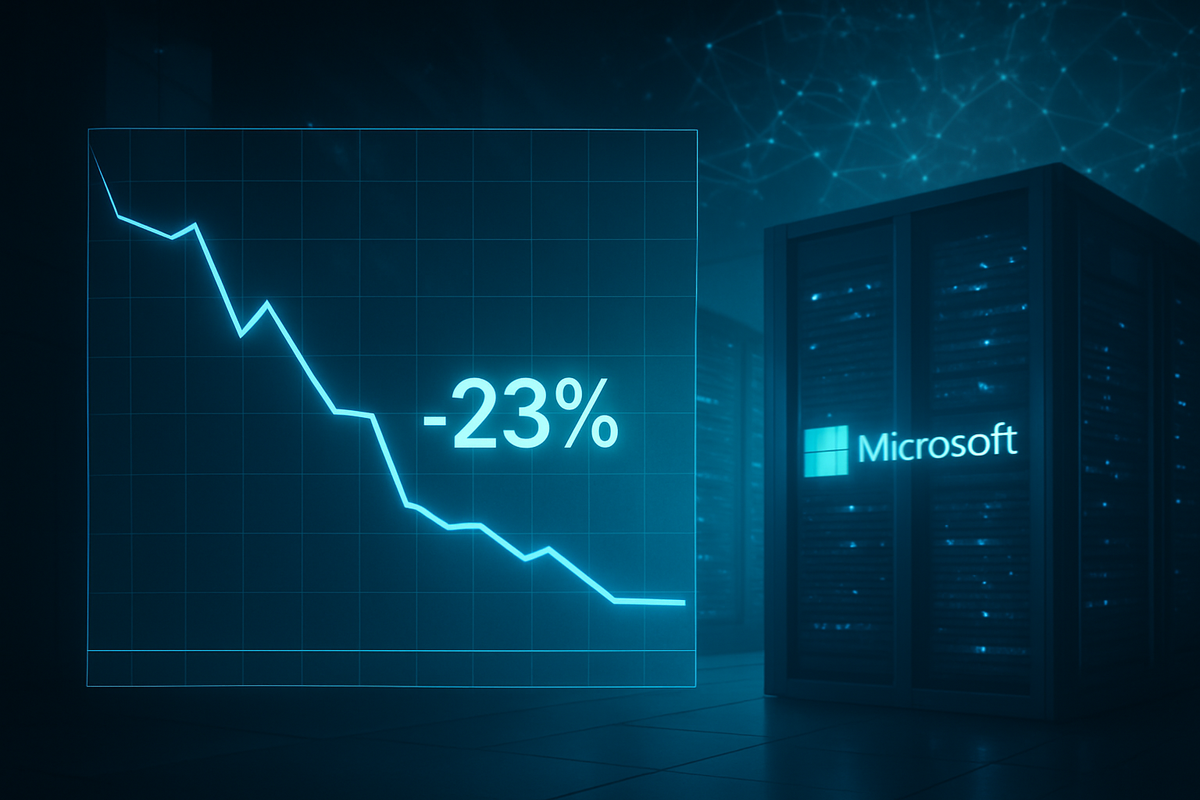
As the first quarter of 2026 draws to a close, a striking disconnect has emerged in the heart of the technology sector. Microsoft Corp. (NASDAQ: MSFT), long considered the bulletproof titan of the cloud era, has seen its stock price crater by 23% year-to-date, tumbling from late-2025 highs near $490 to approximately $374 as of April 9, 2026. This sharp contraction has wiped hundreds of billions in market capitalization, leaving investors to grapple with a fundamental question: Is the artificial intelligence revolution stalling, or has the market simply lost its nerve during a necessary capital-expenditure "digestion" phase?
Despite the double-digit decline in share price, Microsoft’s operational engine remains remarkably robust. The company recently reported a 21% share of the global cloud infrastructure market, with Azure revenue growing at a staggering 39% year-over-year. For large-cap tech investors, the current sell-off has pushed Microsoft's trailing price-to-earnings (P/E) ratio down to approximately 23.4—a level not seen in years and significantly below its five-year average of 32.4. This "valuation reset" is increasingly being viewed by institutional desks as a generational "buy the dip" moment for a company that is fundamentally stronger than its stock chart suggests.
The 'AI Proof' Era: Inside the 2026 Tech Correction
The primary catalyst for the 23% YTD slide is not a lack of revenue, but rather the sheer scale of the costs required to generate it. Leading up to April 2026, Microsoft dramatically increased its capital expenditures, reaching a record $37.5 billion in a single quarter to fund massive "AI superfactories" and next-generation data centers. While Microsoft CEO Satya Nadella has characterized this spending as a "once-in-a-generation land grab" for AI infrastructure, Wall Street has grew weary of the impact on free cash flow. The narrative shifted abruptly in January from "AI potential" to "AI proof," with investors demanding immediate, bottom-line returns on the billions spent on Nvidia Corp. (NASDAQ: NVDA) H200 and B200 GPUs.
This timeline of skepticism reached a boiling point in late February when several high-profile enterprise surveys suggested that the adoption of Microsoft 365 Copilot, while growing, was facing "integration friction" among Fortune 500 companies. Although Copilot reached 15 million paid users by early 2026—a 160% increase over the previous year—the market focused on the slowing pace of expansion compared to the hyper-growth expectations set in 2024. This sentiment was exacerbated by a broader rotation out of high-multiple software stocks, as institutional investors sought "safe havens" in companies with more mature AI profit margins.
Winners, Losers, and the Cloud Dominance Struggle
In this turbulent environment, the competitive landscape of the "Magnificent Seven" is being redrawn. While Microsoft (NASDAQ: MSFT) has taken the hardest hit YTD, Alphabet Inc. (NASDAQ: GOOGL) has emerged as a relative winner, with its stock up 1.5% in the same period. Alphabet’s resilience is largely attributed to its vertical integration; its use of custom Tensor Processing Units (TPUs) has allowed it to scale AI services with lower capital intensity than Microsoft, which remains heavily reliant on third-party silicon.
Amazon.com Inc. (NASDAQ: AMZN) occupies a middle ground, down roughly 4% YTD. Amazon Web Services (AWS) continues to lead the cloud market with a 31% share, but Microsoft’s Azure is closing the gap, maintaining a 21% share and growing faster than AWS in the enterprise AI sector. The "losers" in the current 2026 correction are primarily the secondary AI software players who lack Microsoft’s massive "Commercial Remaining Performance Obligation" (RPO), which currently sits at a record $625 billion. This massive backlog of contracted revenue provides Microsoft with a safety net that smaller competitors simply do not have, making the 23% stock dip look increasingly like a technical correction rather than a structural failure.
Historical Echoes and the Shift to Agentic AI
The current market anxiety mirrors historical precedents where tech giants were punished for aggressive investment cycles. One notable comparison is Microsoft’s own 2013-2014 transition. During the late stages of the Steve Ballmer era, MSFT stock was frequently dismissed as a "dead asset" even as its core commercial businesses were quietly pivoting to the cloud. Once the market recognized the success of the "Cloud-First" strategy under Satya Nadella, the stock entered a decade-long bull run. Similarly, the 2022 tech sell-off, driven by interest rate fears, saw Microsoft decline nearly 30% before the generative AI boom of 2023 sent it to all-time highs.
Today’s trend is defined by the move toward "Agentic AI"—autonomous systems that can execute multi-step workflows rather than just answering prompts. Analysts note that 2026 is the year AI moves from "experimentation" to "production." Gartner predicts that by the end of this year, 40% of enterprise applications will feature integrated AI agents. Microsoft is at the forefront of this shift with its "Agent 365" ecosystem. While the market is currently fixated on the "build-out costs" of this ecosystem, the broader industry trend suggests that these agents will become the primary interface for global business, potentially creating a higher-margin software-as-a-service (SaaS) model than anything seen in the previous decade.
The Road to Recovery: What Comes Next?
Looking toward the second half of 2026, the short-term outlook for Microsoft depends on its ability to demonstrate "margin expansion through automation." Analysts expect the company to focus on optimizing its massive AI infrastructure to reduce the cost-per-query, a move that would alleviate concerns over high CapEx. A strategic pivot toward "Agentic AI" is already underway, and if Microsoft can prove that these autonomous agents are driving tangible productivity gains in its Q3 and Q4 earnings reports, a rapid re-rating of the stock is likely.
The long-term opportunity remains significant. With a forward P/E now hovering around 20-22, Microsoft is trading at its most attractive valuation relative to its growth rate since the early 2020s. Potential scenarios include a "V-shaped" recovery if Azure growth remains near 40% and the company successfully monetizes its agentic APIs. However, the challenge will be navigating a regulatory landscape that is increasingly focused on AI monopolies. Investors should watch for the upcoming "E7" product launch in late 2026, which is rumored to be the first fully agent-integrated version of the Windows operating system.
Summary: A Tactical Reset for the Patient Investor
The 23% decline in Microsoft (NASDAQ: MSFT) shares in 2026 represents a classic "valuation-fundamental decoupling." While the stock price has retreated, the company’s core metrics—21% cloud market share, 39% Azure growth, and a $625 billion revenue backlog—suggest a business that is hitting its stride. The current "AI Winter" in the markets appears to be more of a tactical reset than a fundamental shift away from the technology.
For investors, the key takeaways are clear: the massive CapEx spending that is currently hurting the stock price is the same investment that will likely solidify Microsoft's dominance in the looming Agentic AI era. As the market digests these costs, the current entry point near $374 offers a rare margin of safety for one of the world's most dominant companies. In the coming months, the focus will shift from "how much is Microsoft spending?" to "how much is Microsoft's AI saving its customers?" When that narrative flips, the 2026 dip may be remembered as one of the best buying opportunities of the decade.
This content is intended for informational purposes only and is not financial advice.