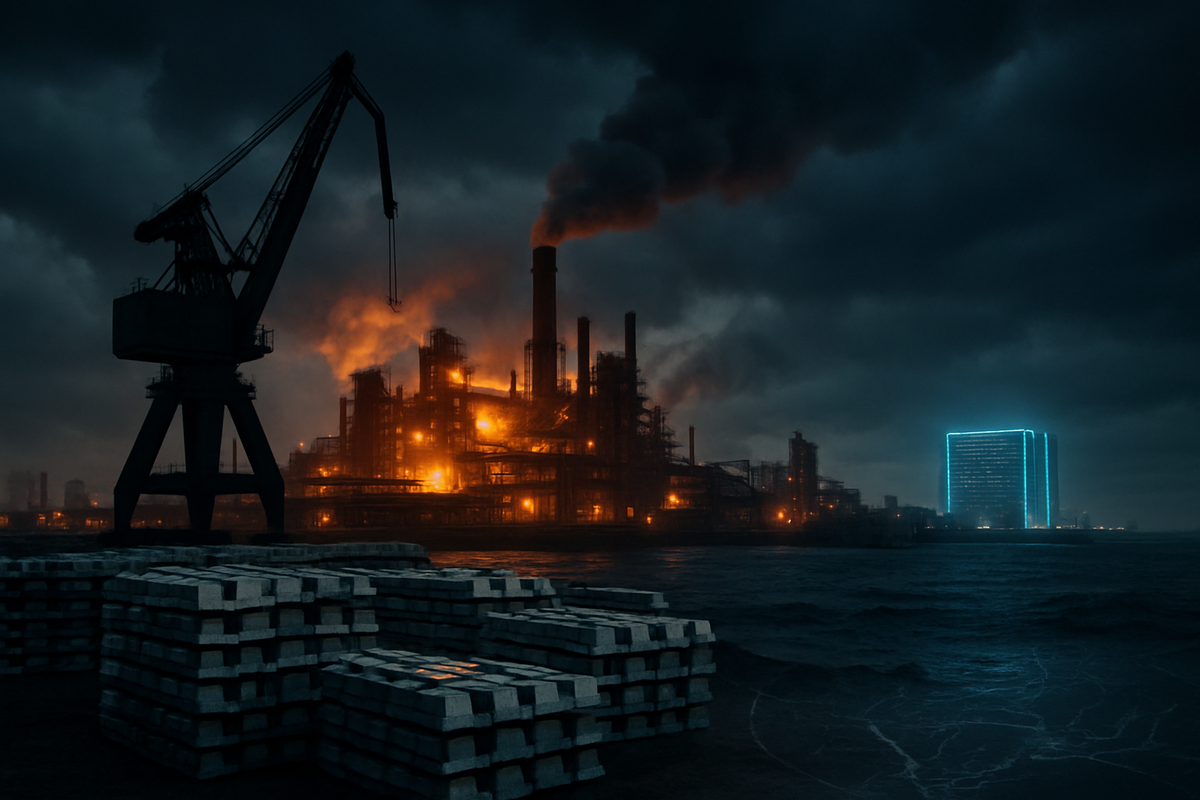
The global industrial metals market has been thrust into a state of high-intensity volatility this April, as a convergence of escalating military conflicts in the Middle East and a structural "power war" between heavy industry and AI data centers sends shockwaves through the supply chain. As of April 9, 2026, the London Metal Exchange (LME) aluminum price has surged past $3,500 per tonne, a level not seen in years, following the de facto closure of the Strait of Hormuz and critical infrastructure damage to some of the world’s largest smelting facilities.
The immediate implications are dire for global manufacturing. With transit times for aluminum shipments from Asia to Europe increasing by up to 21 days due to mandatory rerouting around the Cape of Good Hope, regional premiums have skyrocketed. Manufacturers across the automotive and aerospace sectors are now facing a "supply shock" that is being compounded by the definitive phase of the European Union’s Carbon Border Adjustment Mechanism (CBAM), which launched its financial regime earlier this year, fundamentally altering the economics of metal trade.
A Month of Kinetic Disruptions and Maritime Paralysis
The current crisis traces its roots to late February 2026, when a series of military escalations involving regional powers and international naval task forces led to the effective blockade of the Red Sea and the Strait of Hormuz. For the aluminum market, which relies on the Middle East for approximately 9% of its global primary supply, the impact was instantaneous. Emirates Global Aluminium (EGA), a titan in the sector, reported catastrophic damage to its Al Taweelah power plant in the UAE following a drone strike in late March. The resulting "technical catastrophe"—where molten aluminum froze in the smelting potlines—is expected to sideline a significant portion of their capacity for at least a year.
Simultaneously, Aluminium Bahrain (ALBA.BH) declared force majeure on several long-term contracts after sustained attacks on maritime shipping lanes disrupted its alumina intake. The maritime sector has responded with drastic measures; A.P. Møller - Mærsk A/S (MAERSK-B.CO) has diverted its entire regional fleet, leading to a "yard density" crisis at major European hubs like the Port of Rotterdam. Freight rates on the Asia-to-US corridors have spiked by 50% in just six weeks, while maritime war-risk insurance premiums have surged to an eye-watering 3% of vessel value.
In China, the world's largest producer, the ability to fill this supply vacuum is being hampered by domestic policy. As of April 2026, Beijing is strictly enforcing a 45-million-tonne production cap while simultaneously implementing new environmental mandates requiring 70% of smelter power to come from renewable sources. This has forced a costly and logistically difficult migration of smelting capacity to the hydro-rich southern provinces, limiting China’s export flexibility at the exact moment the world needs it most.
Strategic Winners and Stranded Assets
The upheaval has created a stark divide between producers with secure, green energy and those exposed to geopolitical or power-grid volatility. Rio Tinto (RIO.L) has emerged as a primary beneficiary of the chaos. Its Canadian hydroelectric-powered smelters are currently operating at record margins, insulated from the Middle Eastern energy crisis. The company is reportedly accelerating plans to restart its idled Tiwai Point facility in New Zealand to capitalize on the $3,500+ price environment.
Similarly, Century Aluminum (CENX) is making a strategic comeback. After years of operating at reduced capacity, Century’s Mt. Holly facility in South Carolina reached 100% capacity in early 2026, supported by a new long-term power agreement. Furthermore, the company’s joint venture with EGA to build a massive 750,000-tonne "green" smelter in Oklahoma has gained renewed urgency, backed by a $500 million grant from the US Department of Energy.
Conversely, Alcoa Corporation (AA) faces a more complex landscape. While the high LME price boosts revenue, Alcoa’s US operations are increasingly locked in a "bidding war" for electricity against the burgeoning AI data center industry. In a move that signaled a shift in industrial priorities, Alcoa recently announced plans to divest several idled industrial sites to data center operators, who are willing to pay triple the price for power that a traditional smelter can afford. Norsk Hydro ASA (NHYDY) also remains under pressure; while its Norwegian assets are stable, its significant stake in the Qatalum venture in Qatar has been compromised by natural gas diversions for domestic emergency use.
The Decoupling of the "Green" Metal Market
Beyond the immediate physical disruptions, this event highlights a broader transition in the industrial metals market: the arrival of the "Green Premium." The EU's CBAM, which entered its definitive financial phase on January 1, 2026, has effectively placed a carbon price on every tonne of aluminum entering the European market. Low-carbon products, such as Century’s Natur-Al™ and EGA’s CelestiAL, are now commanding premiums of up to $250 per tonne because they bypass the heavy carbon surcharges applied to coal-fired production from other regions.
The conflict in the Middle East has inadvertently accelerated this trend. As Middle Eastern production (much of which is gas-fired) faces physical disruption, the demand for North American and Scandinavian "hydro-aluminum" has surged, creating a two-tier market. This shift is not just a temporary reaction to war but a structural realignment. The competition for power between AI infrastructure and industrial smelting—a trend that intensified throughout 2025—is now a permanent fixture of the market, forcing a rethink of where heavy industry can realistically exist in a decarbonizing, digital-first economy.
Historical comparisons are already being drawn to the 1973 oil crisis, but with a modern twist. While the '73 crisis was about the availability of fuel, the 2026 crisis is about the availability of "clean" electrons and the security of maritime "choke points." The regulatory landscape is also tightening; the US is maintaining 50% Section 232 tariffs on various imports, and Canada has recently implemented 25% retaliatory duties, further fragmenting what was once a globalized market.
The Road Ahead: Deficits and Strategic Pivots
Looking toward the remainder of 2026, the short-term outlook suggests continued price elevation. Analysts estimate a global aluminum deficit ranging between 140,000 and 600,000 tonnes for the year, depending on how quickly Middle Eastern facilities can be repaired. Market participants are watching for a "Final Investment Decision" on Century Aluminum’s Oklahoma project in the fourth quarter, which could represent the first new US primary smelter in nearly half a century.
Strategic pivots are already underway. Manufacturers are increasingly looking to "near-shoring" and "friend-shoring" to insulate their supply chains from future maritime blockades. We may see a wave of vertical integration, where automotive giants seek direct equity stakes in "green" smelters to guarantee supply, much like the trend seen in the lithium and battery metal sectors during 2023-2024.
Closing Thoughts for the Investor
The industrial metals landscape of April 2026 is one defined by scarcity—not just of the metal itself, but of the energy required to produce it and the safe passage required to transport it. For investors, the takeaway is clear: the era of cheap, globally fungible aluminum is over. The market is now rewarding geographic security and energy independence.
Moving forward, the key metrics to watch will be regional "green premiums," the progress of power negotiations between industrial giants and tech firms, and any signs of de-escalation in the Strait of Hormuz. While the current price spike may temper if a ceasefire is reached, the underlying structural issues—the power competition with AI and the carbon-border regulations—are here to stay. This is no longer just a commodities story; it is a geopolitical and technological one.
This content is intended for informational purposes only and is not financial advice