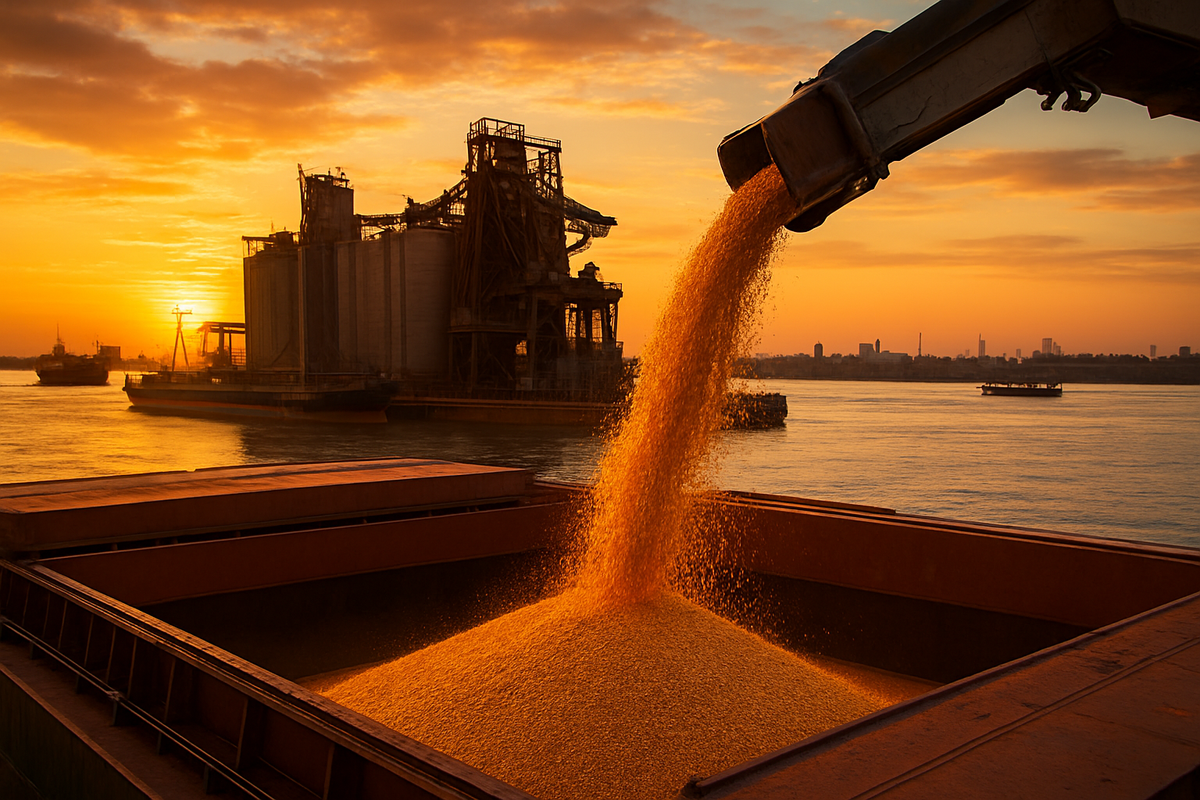
The global agricultural landscape is witnessing a seismic shift this week as Argentina’s corn sector celebrates a historic milestone. For the first time in 15 years, a bulk cargo of Argentinian corn is being loaded for shipment to China, spearheaded by the state-owned Chinese trading giant COFCO. This development, occurring as of April 7, 2026, marks the definitive end of a long-standing hiatus in bulk trade between the two nations and signals Argentina’s aggressive return to the forefront of the global grain market.
The resurgence is fueled by a combination of favorable weather patterns and significant policy shifts under the current administration, which have allowed Argentinian producers to undercut global competitors on price. With March 2026 export figures hitting their highest levels since July 2022, the South American nation is not just recovering; it is actively reclaiming market share from the United States, traditional the world's dominant corn exporter.
A 15-Year Hiatus Ends at Timbúes
The centerpiece of this market transformation is the Timbúes port terminal in Santa Fe, where COFCO International Ltd. is currently overseeing the loading of approximately 34,000 metric tons of corn. While China officially cleared Argentinian corn for import in 2024 following years of sanitary and phytosanitary negotiations, logistical and economic hurdles kept bulk shipments at bay until now. This loading represents the first execution of a large-scale bulk cargo to the Chinese mainland since 2011, providing Beijing with a critical alternative to North American supply.
The timeline leading to this moment has been one of volatile recovery. Following a catastrophic drought in 2023 and a biological crisis in late 2024 caused by the "corn leafhopper" (corn stunt disease), the 2025/26 season has benefitted from near-perfect growing conditions. Data from the Rosario Grain Exchange indicates that March 2026 exports exceeded 4 million metric tons, a volume not seen in nearly four years. This logistics surge was made possible by early harvests and high soil moisture, allowing the "early corn" crop to reach ports ahead of schedule and in peak condition.
Key stakeholders, including the Javier Milei administration, have facilitated this rebound through aggressive deregulation. By late 2025, the government successfully reduced corn export duties from 12% to approximately 8.5%, significantly improving the margins for local farmers and making Argentinian grain the most competitive "origin" in the global market. The initial market reaction has been swift, with Argentinian FOB (Free on Board) prices trending $15 to $20 per ton lower than U.S. Gulf prices, drawing immediate interest from price-sensitive buyers in Vietnam, Malaysia, and now, China.
Winners and Losers in the Global Grain War
The primary beneficiaries of this rebound are the large-scale agricultural producers and infrastructure operators within Argentina. Adecoagro S.A. (NYSE: AGRO), one of the leading agribusinesses in South America, stands to gain significantly as its diversified farming operations benefit from both higher yields and the lowered export tax environment. Similarly, Cresud S.A. (NASDAQ: CRESY), which manages a vast portfolio of Argentinian farmland, is seeing a valuation boost as the liquidity and profitability of corn production reach multi-year highs.
On the other side of the ledger, U.S.-based agricultural powerhouses are facing intensified competition. Archer-Daniels-Midland Company (NYSE: ADM) and Bunge Global SA (NYSE: BG), while possessing global footprints, may see their U.S. export margins pressured as Argentina captures a larger slice of the Asian feed market. While the U.S. is still projected to export a record 84.8 million metric tons in the 2025/26 season, the loss of "top-tier" pricing power to China—a market that is increasingly prioritizing diversification away from U.S. origins—could impact the bottom lines of these American giants.
For Chinese state-owned entities like COFCO, the move is a strategic win, fulfilling a long-term goal of supply chain resilience. By integrating Argentinian corn into their bulk logistics, they reduce dependence on any single geopolitical partner. However, U.S. rail operators and port authorities in the Gulf of Mexico may find the 2026 season more challenging as they compete for the attention of international buyers who are increasingly looking south for more favorable terms.
Geopolitical Shifts and the Decline of U.S. Hegemony
The significance of Argentina’s return to the Chinese market cannot be overstated. It fits into a broader industry trend of "de-risking" grain supplies. For decades, the U.S. held a near-monopoly on the high-quality corn needed for China's massive hog and poultry industries. However, the trade tensions of the late 2010s and early 2020s prompted Beijing to fast-track approval for Brazilian and now Argentinian grain. Argentina is now officially an "active origin," meaning it can be plugged into Chinese supply chains at a moment's notice whenever price spreads favor it.
This event mirrors the historical precedent of the mid-2000s when Brazil first began to challenge U.S. dominance in the soybean market. Today, we are seeing a similar "cornification" of South American trade. The ripple effects are already being felt in the freight markets; the demand for Panamax and Supramax vessels at the Parana River ports has surged, leading to higher charter rates in the South Atlantic while U.S. Gulf rates remain stagnant despite record domestic production.
Furthermore, the regulatory shift in Argentina suggests a permanent change in the "South American Premium." By reducing the "tax wedge" that previously made Argentinian corn more expensive than its peers, the country is moving toward a more liberalized trade model. This forces competitors in the U.S. and Brazil to find new efficiencies or risk losing their standing in the burgeoning markets of Southeast Asia, where Argentina's March export data shows it is already the preferred supplier.
The Road Ahead: 60 Million Tons and Beyond
Looking to the short term, market analysts are closely watching the "late corn" harvest in Argentina, which will hit the markets in June and July. If current weather patterns hold, total production for the 2025/26 season could reach a staggering 62 million metric tons. The immediate challenge will be logistics; the Rosario hub is already operating near capacity, and any further growth will require significant investment in port deepening and rail infrastructure—projects the government is currently hoping to fund through private concessions.
In the long term, the primary risk remains the unpredictable climate. While 2026 has been a "Goldilocks" year for Argentinian farmers, the region remains susceptible to the El Niño-Southern Oscillation (ENSO) cycles. Additionally, the strategic pivot of U.S. exporters will be a key variable. If ADM and Bunge shift more of their capital expenditure toward South American infrastructure to capture these flows, the "nationality" of the grain may matter less to shareholders than the volume handled.
We may also see a tactical shift in U.S. planting intentions for the 2027 season. If Argentinian corn continues to flood the global market at sub-$180 per ton prices, U.S. farmers may opt for more acreage in soybeans or alternative crops, potentially leading to a rebalancing of global grain stocks by the end of the decade.
Wrapping Up the Corn Comeback
The loading of the first bulk cargo to China in 15 years is more than just a successful trade deal; it is a declaration of Argentina’s renewed agricultural potency. The record-breaking export volumes in March and the successful pivot of state-owned COFCO toward Argentinian shores highlight a global market that is becoming increasingly decentralized and competitive.
For investors, the key takeaway is the shifting profitability landscape within the "ABCD" group of grain traders. While Adecoagro (NYSE: AGRO) and Cresud (NASDAQ: CRESY) offer direct exposure to this Argentinian boom, the broader market should prepare for a period of lower global corn prices as supply from the Southern Hemisphere reaches levels not seen in the modern era.
In the coming months, the focus will remain on China’s purchasing pace. If this 34,000-ton cargo is followed by a steady stream of "Capesize" and "Panamax" orders, the U.S. corn export machine will have to fight harder than ever to maintain its relevance in the world's most important market.
This content is intended for informational purposes only and is not financial advice.