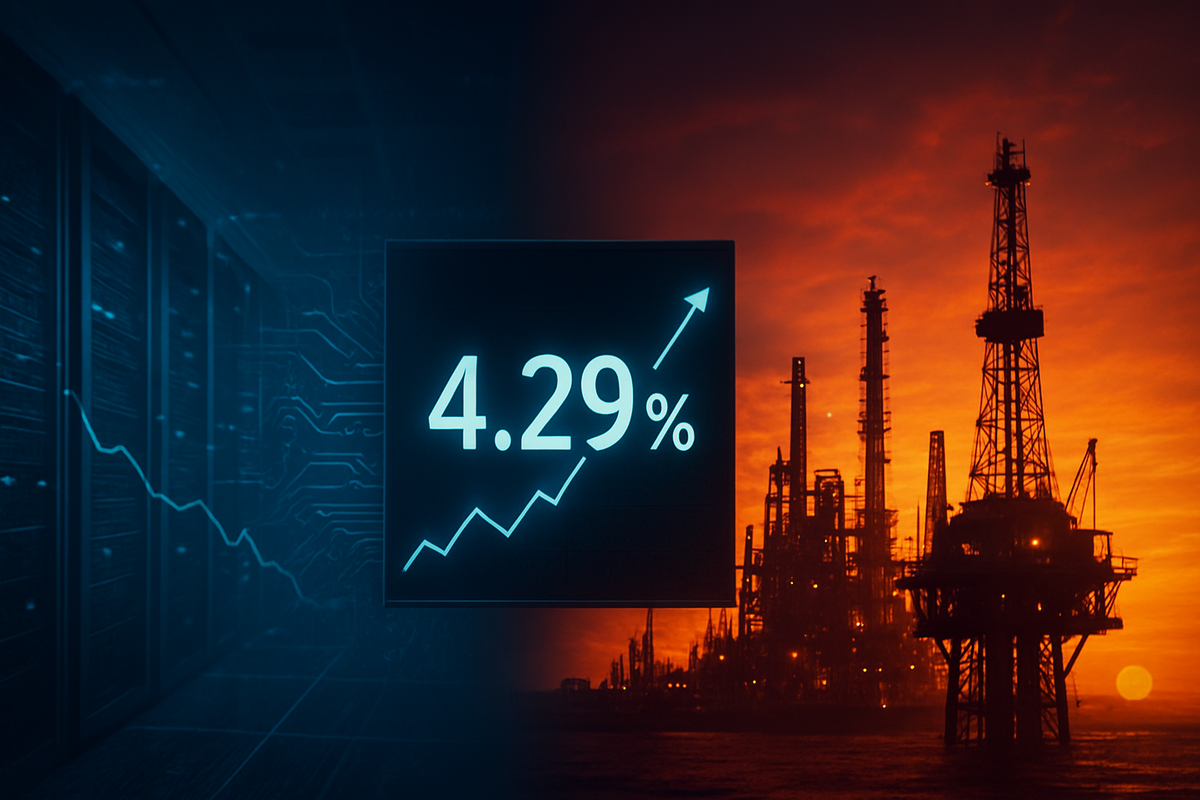
The U.S. 10-year Treasury yield surged to 4.29% this week, marking a pivotal moment in the 2026 financial landscape as persistent inflation concerns and a new era of "higher-for-longer" interest rates take hold. This surge, up from 3.95% just two months ago, serves as a "valuation gravity" event, fundamentally altering the discount rates used to price risky assets and sending shockwaves through the broader market.
The primary driver of this yield spike is a dual threat of geopolitical instability in the Middle East and a hawkish leadership transition at the Federal Reserve. As energy prices climb due to supply disruptions, the market is bracing for a sustained period of elevated consumer prices, forcing investors to demand higher returns on long-term government debt and creating a challenging environment for growth-oriented sectors.
The Convergence of Conflict and Capital Costs
The ascent to the 4.29% threshold was catalyzed by the escalating military conflict involving Iran and Israel, which led to a partial blockade of the Strait of Hormuz in late February 2026. This geopolitical flashpoint sent crude oil prices soaring past $115 per barrel, directly feeding into a headline Consumer Price Index (CPI) that has remained stubbornly high at 3.6%. The "war premium" on energy has revived fears of a 1970s-style stagflationary environment, where rising costs and slowing growth coexist.
Adding to the volatility is the leadership transition at the Federal Reserve. With Jerome Powell’s term concluding, incoming Chair Kevin Warsh has signaled a "hawkish hold," maintaining the federal funds rate between 3.50% and 3.75%. This stance, combined with the Fed's refusal to cut rates in the face of energy-driven inflation, has effectively priced out any hope for monetary easing in the second half of 2026. Market participants are now grappling with the realization that the "cheap money" era is not merely over, but is being replaced by a structural floor in borrowing costs.
The immediate reaction across trading desks was a "duration dump." Investors sold off long-dated Treasuries, pushing yields higher to compensate for the eroded purchasing power of future interest payments. This move has pushed the 10-year yield past the critical psychological barrier of 4.25%, a level last seen during the peak of the 2023-2024 tightening cycle, but this time supported by a more complex inflationary backdrop.
Sector Divergence: Energy Giants Rise While Silicon Valley Re-calculates
The current macro environment has created a sharp divide between "old economy" energy stalwarts and the high-flying technology sector. Energy companies have emerged as the primary beneficiaries and a natural hedge against the ongoing crisis. ExxonMobil (NYSE: XOM) has reached all-time highs near $176 per share, while Chevron (NYSE: CVX) and Occidental Petroleum (NYSE: OXY) have seen double-digit gains as they capitalize on the disruption of Middle Eastern oil flows. Marathon Petroleum (NYSE: MPC) has also thrived, benefiting from widening "crack spreads" as refined fuel margins expand in a supply-constrained market.
Conversely, growth-oriented technology stocks—the "long-duration" assets of the equity world—are under intense pressure. Nvidia (NASDAQ: NVDA), the poster child for the 2025 AI boom, has seen its shares retreat by over 15% from recent highs. The logic is twofold: rising interest rates decrease the present value of the company's future cash flows, and rising energy costs are significantly increasing the operating expenses for the massive data centers required to run AI models.
Big Tech giants like Microsoft (NASDAQ: MSFT) and Alphabet (NASDAQ: GOOGL) are facing similar scrutiny. Microsoft recently reported a staggering 66% surge in quarterly AI capital expenditures, a figure that is now viewed through a more critical lens as the cost of capital hits 4.29%. Meanwhile, Amazon (NASDAQ: AMZN) and Apple (NASDAQ: AAPL) are feeling the squeeze from two sides: higher logistical and manufacturing costs due to energy prices, and a potential pullback in consumer discretionary spending as gasoline prices average 30% higher than last year.
Broader Significance and Historical Precedents
This event signifies a major shift in the "AI Productivity" narrative that has dominated the markets for the past three years. The massive capital expenditures required for the artificial intelligence revolution are now being stress-tested by a high-interest-rate environment. In previous cycles, such as the dot-com era or the post-2008 recovery, growth sectors could rely on falling or near-zero rates to fund expansion. In 2026, the "hurdle rate" for new projects has shifted permanently higher, forcing companies to prove immediate profitability rather than distant potential.
Historically, the current situation mirrors the energy shocks of 1973 and 1979, where geopolitical events triggered a feedback loop of inflation and rising yields. However, the modern twist is the economy's extreme reliance on high-power-consumption computing. The "energy-push" inflation of 2026 is not just affecting the pump; it is affecting the server rack, creating a unique inflationary pressure that bridges the physical and digital economies.
From a regulatory perspective, the surge in yields is likely to embolden fiscal conservatives in Washington who are calling for reduced government spending to combat the deficit—a primary driver of the long-term yield curve. The Biden-era industrial policies, which relied on low-cost financing for green energy and semiconductor transitions, may face a "funding cliff" as the 10-year yield stabilizes above 4%.
Looking Ahead: Strategic Pivots and Market Scenarios
In the short term, investors should expect continued volatility as the market searches for an "equilibrium yield." If the 10-year Treasury yield climbs toward 4.5%, we could see a broader sell-off in equities as the equity risk premium shrinks to unattractive levels. Technology companies will likely need to pivot toward "AI efficiency" rather than "AI expansion," focusing on software optimization and low-power hardware to mitigate rising energy and capital costs.
Long-term, the focus will shift to whether the U.S. economy can achieve a "soft landing" or if the 4.29% yield is the catalyst for a 2027 recession. A potential strategic adaptation for tech firms could be a massive move toward self-owned renewable energy infrastructure—such as small modular reactors (SMRs) or dedicated solar farms—to decouple their operations from the volatile energy grid.
The "Higher-for-Longer" scenario is no longer a forecast; it is the current reality. Market opportunities may emerge in "value-tech" companies that maintain strong balance sheets and low debt-to-equity ratios, as well as in the domestic energy sector, which is increasingly viewed as a pillar of national security.
Conclusion and Investor Takeaways
The climb of the U.S. 10-year Treasury yield to 4.29% is a clear signal that the inflationary genie is not yet back in the bottle. Driven by the "twin engines" of geopolitical energy shocks and a shifting Federal Reserve, the market is undergoing a painful but necessary recalibration of asset values. For technology investors, the period of unchecked valuation expansion is giving way to a era where the cost of power and the cost of capital are the two most critical metrics.
Moving forward, the market will remain hyper-sensitive to any updates from the Strait of Hormuz and the initial policy speeches of Kevin Warsh. Investors should maintain a diversified stance, balancing growth exposure with "inflation-proof" assets in the energy and materials sectors.
The lasting impact of this 4.29% yield level will be defined by how quickly the private sector can adapt to a world where capital is no longer free. Watch for the Q3 2026 earnings season as a litmus test for corporate resilience in this high-rate, high-cost environment.
This content is intended for informational purposes only and is not financial advice.