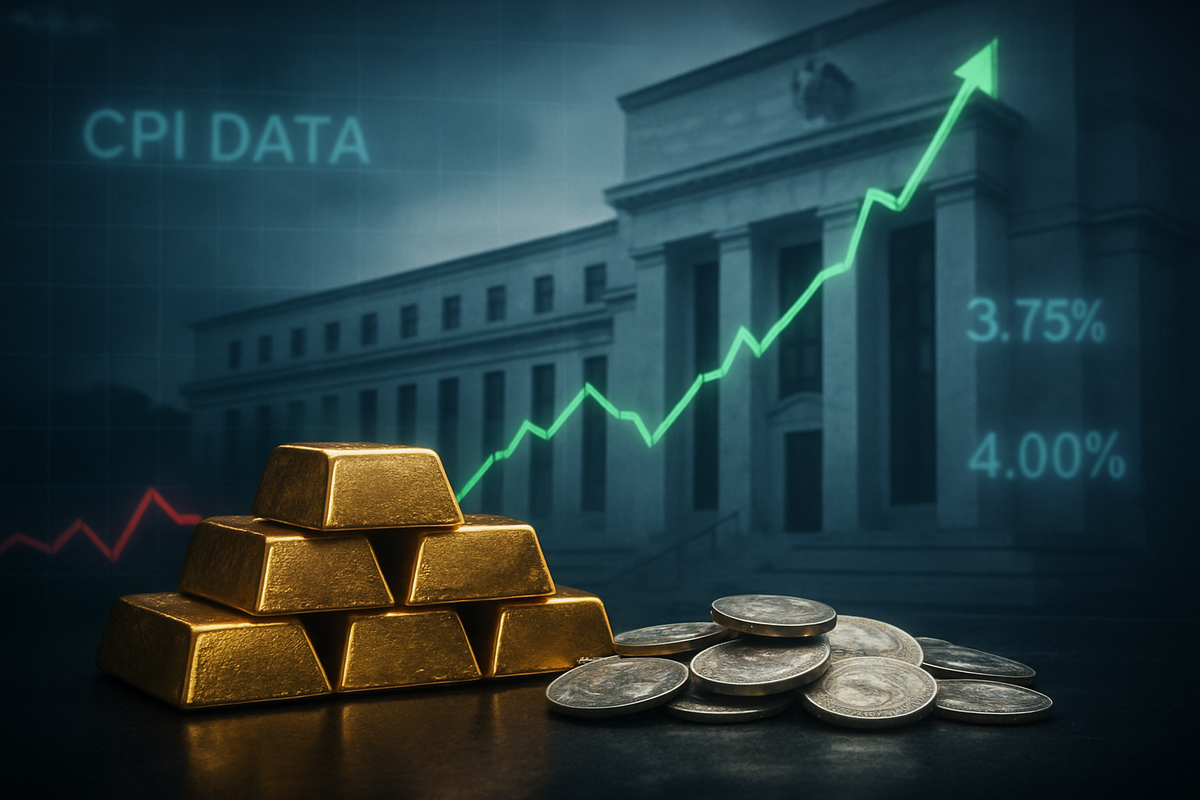
WASHINGTON, D.C. — As the sun rises on April 10, 2026, the global financial landscape finds itself at a historic crossroads. The precious metals market, once the undisputed champion of the early 2020s, is currently locked in a tense standoff with a revitalized U.S. Dollar. Investors are holding their breath ahead of tomorrow’s Consumer Price Index (CPI) release, which many expect will reveal a stubborn inflation floor that could further embolden the Federal Reserve’s new "Sound Money" crusade. With spot gold hovering near $4,750 per ounce and silver struggling to maintain its $75 support level, the era of easy money is being systematically dismantled by a hawkish shift in central bank leadership.
The immediate pressure on non-yielding assets comes from a relentless surge in the U.S. Dollar Index (DXY), which has comfortably cleared the 100 mark this week. This "Greenback Resurgence" is largely a reaction to the nomination of Kevin Warsh as the next Chair of the Federal Reserve. Warsh, a known advocate for fiscal discipline and a rules-based monetary policy, has signaled a radical departure from the discretionary "data-dependent" path of the previous decade. As the market prices in a tighter liquidity environment, the premium on gold and silver is being tested by the reality of higher-for-longer real yields.
A Regime Change at the Fed: The Road to the Warsh Nomination
The current market volatility traces back to January 30, 2026, when the White House officially nominated Kevin Warsh to succeed Jerome Powell, whose term is set to expire on May 15, 2026. The announcement sent shockwaves through the commodities complex, triggering what traders have dubbed the "Warsh Shock." Before the nomination, gold had reached a staggering all-time high of $5,589 per ounce, fueled by geopolitical instability and concerns over a bloated Fed balance sheet. However, Warsh’s proposed "Sound Money" doctrine—centered on shrinking the Fed’s $6.5 trillion balance sheet through aggressive Quantitative Tightening (QT)—saw gold plummet nearly $1,000 in a matter of days.
The transition, however, is far from smooth. Current Chair Jerome Powell has become embroiled in a high-stakes standoff, refusing to vacate his post until a Department of Justice investigation into headquarters renovation cost overruns is completed. This administrative gridlock, coupled with Senator Thom Tillis (R-NC) threatening to block Warsh’s confirmation until the investigation is dropped, has created an unprecedented vacuum of certainty. Recent FOMC minutes revealed a committee deeply divided between the "old guard" focusing on labor market stability and a rising "hawkish wing" that fears the disinflationary benefits of Artificial Intelligence (AI) are being offset by runaway government spending.
Mining Titans Caught Between Record Margins and Currency Headwinds
For the world’s largest gold producer, Newmont (NYSE: NEM), the current environment is a double-edged sword. At $4,750 per ounce, Newmont is enjoying record-breaking free cash flow, with All-In Sustaining Costs (AISC) sitting near $1,680. However, the company recently paused its massive $6 billion share buyback program, citing the need to preserve liquidity against a soaring U.S. Dollar that makes international operations more expensive and a global energy shock that has inflated the cost of diesel and power.
Similarly, Agnico Eagle Mines (NYSE: AEM) has emerged as a relative winner due to its focus on low-risk jurisdictions like Canada and Finland. While its peers grapple with jurisdictional risk, Agnico’s high-margin operations allow it to remain profitable even if gold were to retreat further toward the $4,500 level. Conversely, Barrick Gold Corporation (NYSE: GOLD) is navigating a complex strategic pivot. Under the ticker (NYSE: B) following a 2025 rebrand, the company is aggressively shifting toward copper production, aiming for a 40% copper mix by 2030 to hedge against the volatility of the gold market.
In the silver space, Pan American Silver (NYSE: PAAS) remains the primary vehicle for investors seeking leverage. With silver trading near $75, PAAS is reaping the rewards of an extremely low silver AISC of approximately $18.25. However, silver’s 40% crash from its January highs serves as a stark reminder of its sensitivity to the U.S. Dollar Index. If the DXY continues its march above 100, the industrial demand for silver may not be enough to offset the liquidations from institutional portfolios shifting back into high-yielding Treasury notes.
The Broader Significance: Deflationary Tech vs. Inflationary Policy
The current market dynamic represents a fundamental shift in how the Fed views the economy. Kevin Warsh has argued that the productivity gains from generative AI are a massive disinflationary force that allows the Fed to keep the "neutral rate" higher without stifling growth. This "Productive Dovishness" theory suggests that the "Fed Put"—the long-standing expectation that the central bank will rescue markets at the first sign of trouble—is effectively dead. This shift toward a rules-based approach, similar to the Taylor Rule, aims to restore the "scarcity value" of the U.S. Dollar.
The wider significance of this shift cannot be overstated. For years, gold and silver acted as the primary hedge against currency debasement. If the Warsh-led Fed successfully "restores the dollar," the decade-long bull run in precious metals may face its most significant structural challenge since the early 1980s. This has massive ripple effects on emerging markets, which are currently struggling to service dollar-denominated debt as the DXY climbs, potentially leading to a wave of sovereign defaults that could, ironically, spark a flight back to gold as a safe haven.
The Path Ahead: CPI Data and the May 15 Deadline
As we look toward the immediate future, tomorrow’s CPI data will be the ultimate litmus test. If inflation remains sticky above the 3% target, the market will likely price in an even more aggressive QT schedule from the incoming Warsh administration, potentially pushing gold down to its $4,500 support floor. Conversely, a cooler-than-expected reading could provide the "relief rally" that precious metals bulls have been waiting for, allowing silver to retest the $80 psychological barrier.
Beyond the data, the May 15 deadline for the Fed Chair transition remains the most critical date on the calendar. A botched transition or a prolonged legal battle between Powell and the DOJ would introduce a level of institutional instability that typically favors gold. However, if Kevin Warsh is confirmed and takes the reins with a clear mandate for "Sound Money," the precious metals market may enter a period of consolidation where only the most efficient miners—those with the lowest AISC and strongest balance sheets—will thrive.
Conclusion: A New Era for Hard Assets
The events of early 2026 have redefined the relationship between the Federal Reserve and the hard assets market. The transition from the "data-dependent" era of Jerome Powell to the "Sound Money" framework of Kevin Warsh marks the end of a period of extraordinary liquidity. While gold at $4,750 and silver at $75 remain at historically high levels, the momentum has clearly shifted in favor of the U.S. Dollar.
Investors should watch the DXY and the Senate confirmation hearings with equal intensity. The era of "gold at any price" appears to be over, replaced by a market that demands fiscal discipline and real productivity. Moving forward, the resilience of the $4,500 gold floor will likely determine the direction of the metals market for the rest of the decade. In this high-stakes game of monetary chicken, the only certainty is that the volatility is far from over.
This content is intended for informational purposes only and is not financial advice