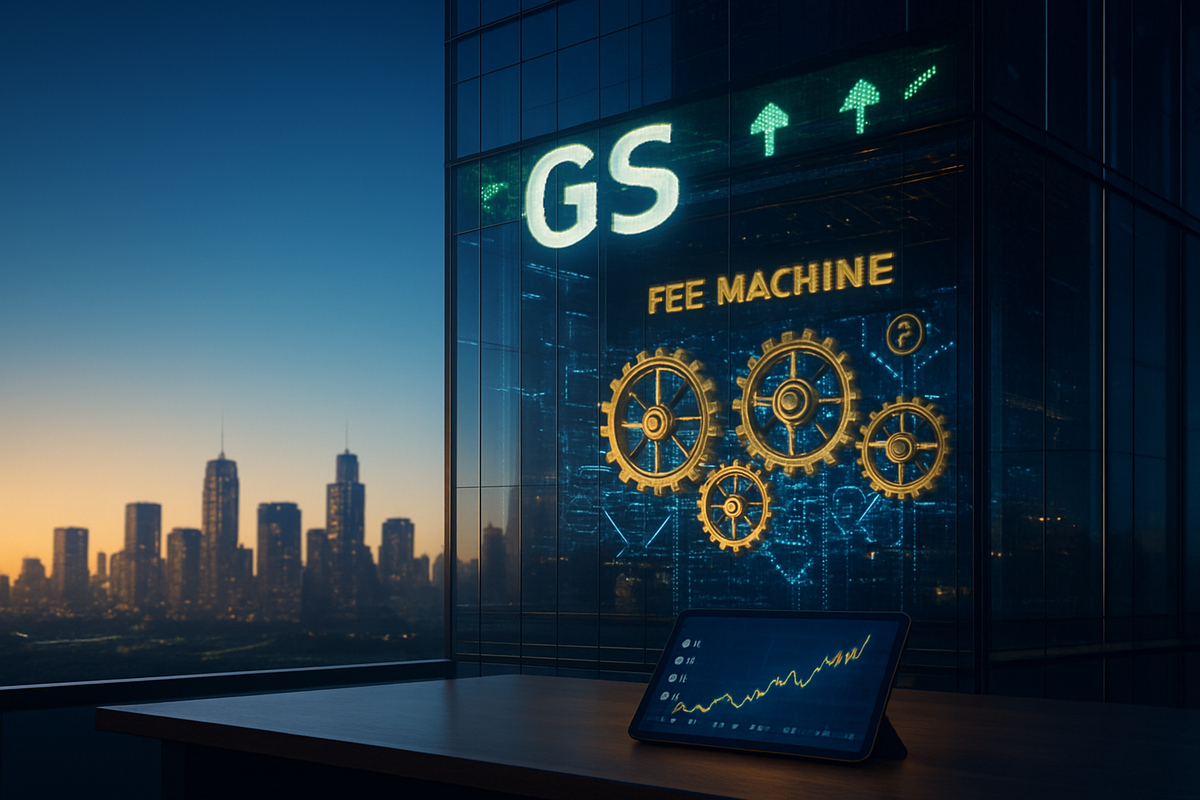
As Wall Street prepares for the unofficial kickoff of the spring earnings season, all eyes are fixed on Goldman Sachs (NYSE: GS), which is scheduled to report its first-quarter 2026 results on Monday, April 13. Investors are bracing for a high-stakes reveal, with analysts projecting a massive earnings-per-share (EPS) range of $16.14 to $16.48. This target represents a significant year-over-year leap, signaling that the firm’s strategic pivot back to its core identity as a "pure-play" investment banking powerhouse—a model internally dubbed the "Fee Machine"—is firing on all cylinders.
The upcoming report is more than just a quarterly update; it is a referendum on CEO David Solomon’s multi-year effort to dismantle the bank's ill-fated foray into consumer lending and refocus capital on high-margin advisory and trading. With the "liquidity logjam" of the past two years finally breaking, Goldman is positioned to capitalize on a massive backlog of deals. If the firm hits the upper end of its $16.48 projection, it will provide the strongest evidence yet that the investment banking giant has reclaimed its throne at the top of the financial hierarchy.
The 'Fee Machine' Replaces the Retail Dream
The narrative heading into April 13 is defined by the successful execution of the "Fee Machine" strategy. Over the last 18 months, Goldman Sachs has systematically offloaded its retail-oriented assets, including the Marcus personal loan portfolio and its high-profile partnership with Apple (NASDAQ: AAPL) for the Apple Card. This retreat from the consumer space was initially viewed as a tactical defeat, but the early 2026 data suggests it was a masterclass in capital reallocation. By shedding these balance-sheet-heavy and credit-sensitive businesses, Goldman has freed up billions in capital to support its Global Banking & Markets segment.
This strategic shift coincided with a "Strategic Renaissance" in investment banking. As of April 10, 2026, Goldman’s investment banking backlog sits at a four-year high, driven by a global surge in corporate activity. The firm is expected to report a 26% year-over-year increase in advisory and underwriting fees, potentially reaching $2.42 billion for the quarter alone. This resurgence is particularly critical as it arrives at a time when the bank's Platform Solutions segment—the remnant of its consumer experiment—is expected to see revenue plummet by nearly 48% as the final assets are wound down or sold off.
Winners and Losers in a K-Shaped Market
While Goldman Sachs (NYSE: GS) stands as the primary beneficiary of the current market environment, the landscape is creating a clear divide between "winners" and "losers." The resurgence in activity is heavily concentrated in mega-cap deals and "supercycle" IPOs. Goldman’s primary rivals, JPMorgan Chase (NYSE: JPM) and Morgan Stanley (NYSE: MS), are also expected to post robust numbers, with JPMorgan benefiting from its integration of AI-driven trading platforms and Morgan Stanley seeing a boost in its wealth management fees.
However, the "cooling" in mid-market M&A—deals ranging from $100 million to $1 billion—is casting a shadow over boutique investment firms. Firms like Lazard (NYSE: LAZ) and Evercore (NYSE: EVR), which traditionally thrive on mid-market volume, may find the current environment challenging. Regulatory scrutiny on smaller, non-strategic acquisitions has slowed deal flow in this segment, while higher financing costs for mid-tier companies have made transactions less attractive. In this "K-shaped" recovery, the "bulge bracket" banks are capturing the lions' share of value, leaving smaller players to fight over a shrinking pool of mid-market fees.
The IPO Supercycle and the AI Infrastructure Boom
The wider significance of Goldman's projected $16+ EPS lies in the broader health of the capital markets. Early 2026 has witnessed over 120 global IPO filings, the most active start to a year since the record-breaking 2021. This "supercycle" is being fueled by two primary engines: a $3 trillion mountain of private equity "dry powder" that must be deployed or returned, and the insatiable capital needs of the AI infrastructure sector. With major filings expected from the likes of SpaceX and OpenAI, the market is entering a phase where "innovation supercycle" deals are overriding macroeconomic concerns.
This trend fits into a larger industry shift toward capital-light, fee-based revenue. After years of being weighed down by "higher for longer" interest rates and a stagnant deal-making environment, the financial sector is witnessing a "liquidity thaw." For Goldman, this is a return to a historical precedent where the firm thrives during periods of high volatility and rapid technological shifts. The resurgence in trading revenue—projected to hit $10 billion for GS this quarter—is being driven by extreme movements in commodities like gold and silver, as well as high-frequency, AI-driven algorithmic trading that benefits from the current geopolitical instability.
Looking Ahead: Sustainability and Geopolitical Headwinds
The short-term outlook for Goldman Sachs is undeniably bullish, but the long-term sustainability of the $16 EPS level remains a subject of debate. The primary question for investors post-April 13 will be whether the "Fee Machine" can maintain its momentum if the IPO window begins to close or if geopolitical tensions, particularly in the Middle East, escalate further. A significant disruption in global energy markets could quickly dampen the appetite for new equity offerings and strategic M&A, forcing a pivot back to defensive positioning.
Furthermore, Goldman must navigate the "credit normalization" cycle. While the bank has exited much of its consumer risk, its corporate loan book is not immune to the pressures of a persistent inflationary environment. In the coming months, market participants should watch for any signs of rising net charge-offs or increased provisions for credit losses. The bank's ability to maintain its lean operating structure while scaling its advisory business will determine if it can keep its return on equity (ROE) above the 15% target that has eluded it during the consumer-banking years.
Closing Thoughts on the Goldman Sachs Rebound
The April 13 earnings report is poised to be a watershed moment for Goldman Sachs (NYSE: GS). A result within the $16.14 to $16.48 range would validate the "Fee Machine" model and silence critics who argued the bank had lost its way during its retail banking expansion. By successfully timing the resurgence of the IPO market and dominating the high-value M&A landscape, Goldman appears to have successfully navigated a difficult transition period.
For the broader market, Goldman’s performance will serve as a bellwether for institutional sentiment and the health of global capital flows. Investors should look beyond the headline EPS number and focus on the sustainability of the investment banking backlog and the firm's ability to capture trading volatility. If the "Fee Machine" delivers as expected, it will signal that the era of the pure-play investment bank is back, and Goldman Sachs is once again leading the charge into a new cycle of financial expansion.
This content is intended for informational purposes only and is not financial advice.