Wall Street opened Friday, April 10, 2026, with a palpable sense of relief as the latest Consumer Price Index (CPI) report came in largely as expected, fueling a morning rally for the major indices. The S&P 500 and the Nasdaq Composite both surged in early trading after investors found comfort in the news that inflation, while elevated, is not accelerating as sharply as many had feared following recent spikes in global energy prices.
The Dow Jones Industrial Average (INDEXDJX:.DJI) notched a modest gain of 13.6 points at the opening bell, trailing the tech-heavy Nasdaq which benefited most from the stabilization of interest rate expectations. Despite a backdrop of persistent geopolitical volatility in the Middle East that has kept Brent crude hovering near $100 per barrel, the market appears to be embracing a "no surprises is good news" mentality, allowing for a strategic rebound in high-growth sectors.
Stability in Numbers: A Detailed Look at the March CPI Release
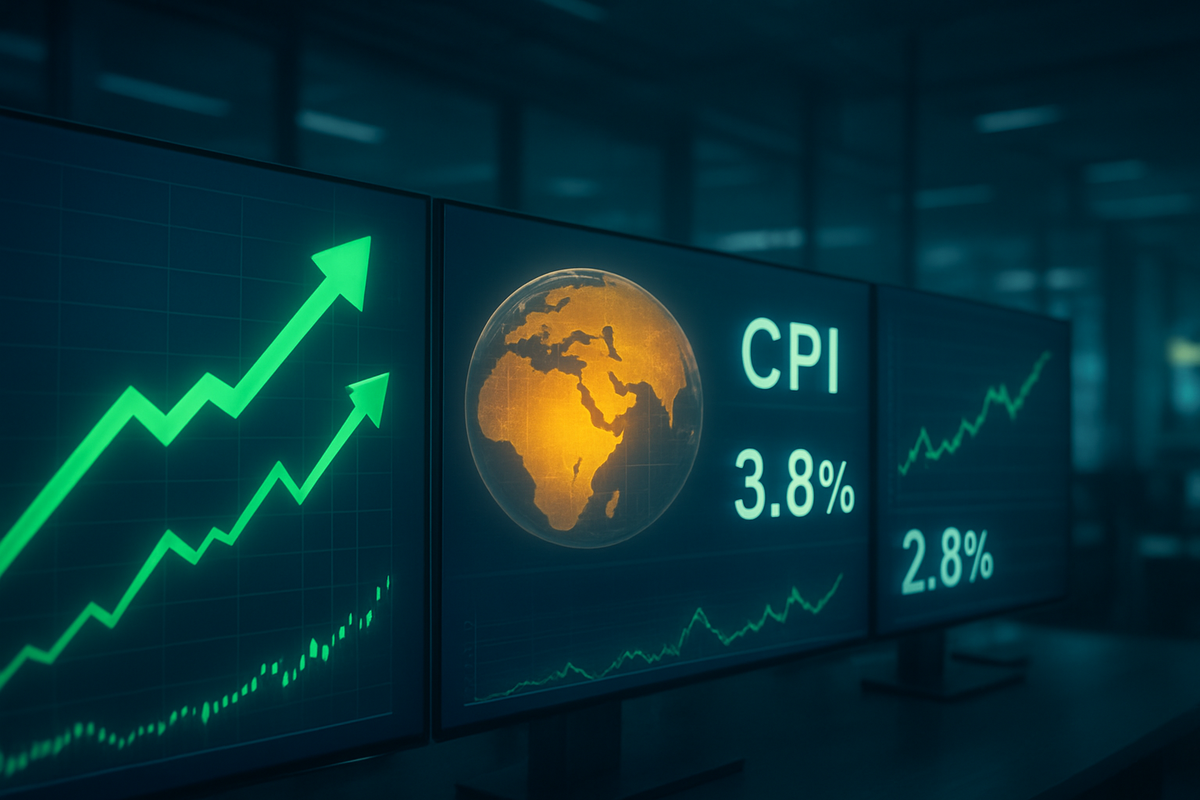
The Bureau of Labor Statistics reported this morning that the Headline CPI for March rose 3.8% on an annual basis, while the Core CPI, which strips out volatile food and energy costs, came in at 2.8%. Both figures were exactly in line with consensus forecasts from economists at major financial institutions. This "bullseye" print was a significant victory for a market that had spent the last two weeks bracing for an upside surprise, driven by the recent disruption of shipping lanes in the Strait of Hormuz and a subsequent 15% jump in gasoline prices.
The timeline leading up to this moment has been one of extreme anxiety. Following a relatively calm 2025, the first quarter of 2026 saw a resurgence of "energy-push" inflation. After a series of military escalations between regional powers in the Middle East in late February, speculators began betting that headline inflation would easily breach the 4.0% mark in March. The fact that the print held at 3.8% suggests that the disinflationary trends in shelter and medical services, which the Federal Reserve has been tracking since 2024, are providing a sufficient "cushion" to absorb the current energy shock.
Key stakeholders, including the Federal Reserve's Board of Governors and major asset managers, have been locked in a "wait-and-see" mode. This morning’s data has led several analysts to recalibrate their expectations for the upcoming Fed meeting in May. While a rate cut remains unlikely given the 2.8% core reading—still above the Fed’s 2% long-term target—the fear of an immediate "emergency" rate hike to combat the oil spike has effectively been taken off the table.
Sector Winners and Losers: Tech Bounces While Airlines Struggle
The immediate beneficiaries of the CPI relief rally are the "Hyperscalers" and semiconductor giants. Nvidia (NASDAQ: NVDA) and Microsoft (NASDAQ: MSFT) both saw early gains of over 1.5% as the 10-year Treasury yield retreated from its recent highs, easing the pressure on growth stock valuations. Apple (NASDAQ: AAPL) also trended higher, as the core inflation data suggested that consumer purchasing power for high-end electronics is not being eroded as fast as the headline energy prices might suggest.
On the other side of the ledger, the energy sector is seeing a mix of profit-taking and strategic positioning. ExxonMobil (NYSE: XOM) and Chevron (NYSE: CVX) remained steady near 52-week highs, though their momentum slowed as the "inflation scare" trade cooled. Investors are currently weighing the benefits of $100-per-barrel oil against the potential for demand destruction if the global economy slows. Defense contractors like Lockheed Martin (NYSE: LMT) continue to see sustained interest, acting as a hedge against the ongoing geopolitical instability that remains the primary risk to the 2026 outlook.
Conversely, the transport and leisure sectors are facing a difficult environment. Delta Air Lines (NYSE: DAL) and FedEx (NYSE: FDX) opened slightly lower as the 3.8% headline inflation reflects the heavy burden of rising jet fuel and diesel costs. While the "alignment" with expectations provided a broad market lift, these companies are still grappling with a massive increase in input costs that will likely squeeze margins in their upcoming quarterly earnings reports.
Broader Significance: The "Energy Echo" and Fed Policy in 2026
This morning’s market movement highlights a critical shift in the 2026 economic narrative. The current environment, often dubbed the "Energy Echo," mirrors the supply-side shocks of the mid-20th century rather than the demand-driven inflation of the post-pandemic era (2021-2023). By meeting expectations at 3.8%, the economy is demonstrating a level of resilience that many analysts didn't expect. It suggests that the structural changes made in 2024 and 2025—including increased domestic energy production and more diversified supply chains—are functioning as a buffer against external shocks.
The regulatory and policy implications are profound. If CPI had come in at 4.0% or higher, the Fed would have been forced to abandon its "soft landing" goal and pivot back toward aggressive tightening. Today's data allows for a continued "Pause and Pray" strategy, giving the central bank time to see if Middle East tensions de-escalate before they make their next move. This has a ripple effect on global markets, as a stable U.S. dollar (trading relative to the 3.8% CPI) prevents further capital flight from emerging markets that are also struggling with energy costs.
Historically, this period may be compared to the late 1970s, but with a crucial difference: the "Core" inflation remains surprisingly anchored. In previous energy crises, core inflation followed headline prices upward almost immediately. In 2026, the 2.8% core print indicates that the "wage-price spiral" that haunted previous generations has not yet taken hold, likely due to increased automation and the cooling of the post-pandemic labor market.
The Road Ahead: Earnings Season and Geopolitical "Wild Cards"
Looking forward, the short-term focus will shift from macro data to micro fundamentals. The Q1 2026 earnings season kicks off in earnest next week, and the primary question will be how many companies can successfully pass on the "3.8% headline costs" to consumers without sacrificing volume. We expect a strategic pivot from consumer-facing brands toward more aggressive "value-tier" offerings to protect market share in an environment where gasoline remains above $4.00 a gallon.
The long-term challenge remains the Middle East. While today’s market is celebrating a "lack of bad news," any further escalation in the Persian Gulf could easily send oil toward $120, making the 3.8% CPI look like a distant memory. Market participants should be prepared for high volatility and consider "defensive growth" strategies—focusing on companies with high cash reserves and essential products that can withstand a sustained period of higher-than-target inflation.
Potential scenarios for the summer of 2026 include a "Goldilocks" cooling if a ceasefire is reached, or a "Stagflation Lite" scenario where energy prices remain sticky while economic growth slows to a crawl. Investors will be watching the next two Fed meetings with eagle eyes for any change in rhetoric regarding the 2% inflation target, which some are starting to whisper may need to be revised to 3% in a more volatile world.
Summary and Investor Outlook
Today’s market opening on April 10, 2026, represents a rare moment of clarity in a turbulent year. The S&P 500 and Nasdaq’s relief rally, fueled by a 3.8% headline and 2.8% core CPI print, proves that the market's greatest fear is currently uncertainty, rather than the absolute level of inflation. The Dow’s modest 13.6-point gain reflects a cautious optimism that the U.S. economy can weather the current energy shock without falling into a recessionary tailspin.
Moving forward, the market is likely to remain in a "K-shaped" recovery pattern. Technology and energy will continue to dominate the leaderboards, while transport and consumer staples face headwinds from input-cost inflation. The resilience of the core CPI at 2.8% is the "silver lining" that investors should keep in their sights; as long as that number remains stable, the Federal Reserve has the luxury of time.
In the coming months, investors should watch for two major indicators: the April jobs report and any shifts in the diplomatic landscape in the Middle East. For now, the "relief rally" of April 10 provides a much-needed breath of fresh air, but in 2026, the market has learned that the wind can change direction at any moment.
This content is intended for informational purposes only and is not financial advice