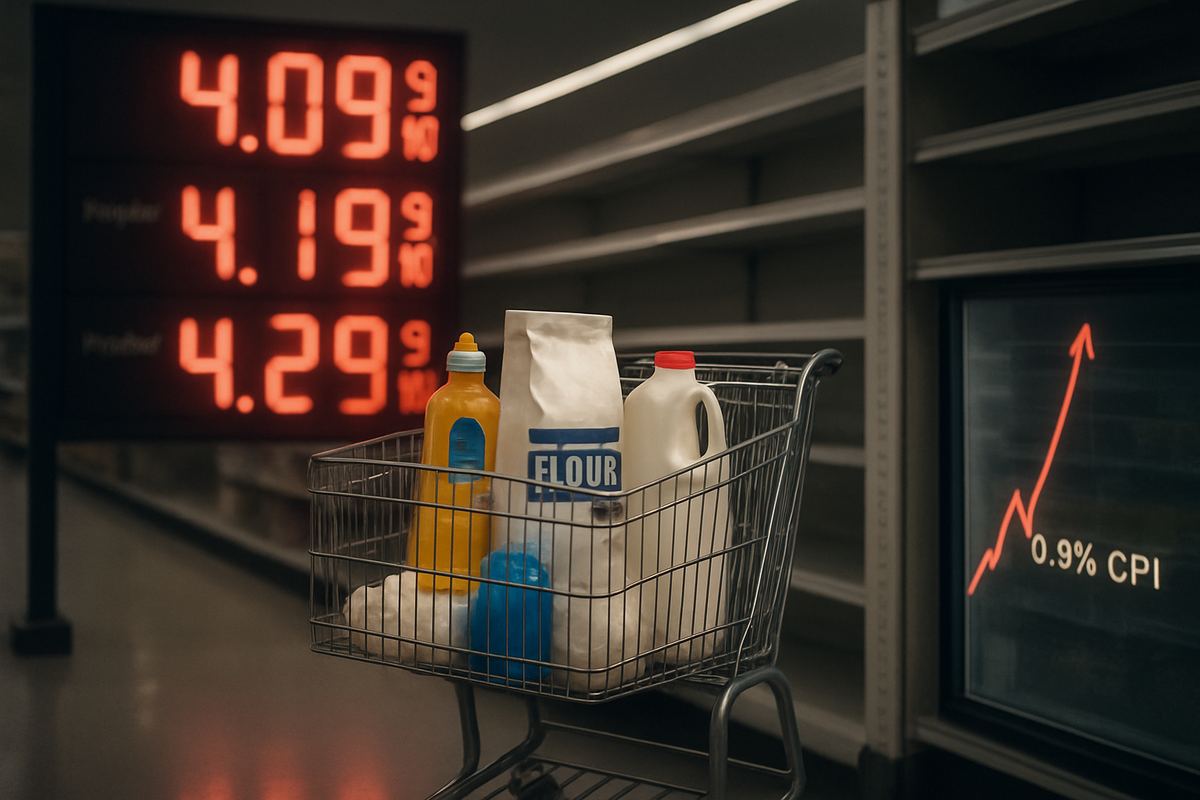
The U.S. economy received a jolting wake-up call on April 10, 2026, as the Bureau of Labor Statistics released March inflation data that far exceeded even the most pessimistic forecasts. The Consumer Price Index (CPI) recorded a blistering 0.9% monthly increase—the largest single-month jump since the height of the post-pandemic surge in 2022—driven primarily by a massive spike in energy costs and stubbornly high shelter prices. This "inflationary thermal" has sent shockwaves through the equity markets, fundamentally altering the landscape for retail and consumer stocks as the first quarter draws to a close.
The immediate implications are stark: the "energy tax" at the gas pump is effectively draining the discretionary budgets of American households, forcing a rapid "K-shaped" divergence in the retail sector. While the broader market grapples with the reality of higher-for-longer interest rates to combat this new wave of price pressure, investors are fleeing high-growth consumer discretionary names in favor of the safety and scale offered by consumer staples.
The Anatomy of a March Spike: Energy and Housing Collide
The March 2026 CPI reading caught Wall Street off-guard, accelerating the annual inflation rate to 3.3%, a significant leap from the 2.4% seen in February. The primary catalyst for this volatility was a geopolitical firestorm in the Middle East. Tensions in the Strait of Hormuz led to a 10.9% surge in overall energy prices within a single month, with gasoline prices skyrocketing by a historic 21.2%. This sudden disruption turned what many hoped would be a "disinflationary spring" into a renewed battle against the rising cost of living.
Timeline of the spike began in late February when supply chain anxieties first emerged, but the full weight of the energy shock was not realized until the March data was tallied. Beyond the pump, the "shelter" component of the CPI—which accounts for a third of the index—rose another 0.3% despite predictions of a cooling housing market. With mortgage rates hovering near 6.5%, the combination of high rents and expensive fuel has left the average consumer with little room for error. The initial market reaction saw the Consumer Discretionary Select Sector SPDR Fund (NYSE: XLY) retreat over 5% as traders priced in a lean summer for non-essential goods.
Winners and Losers: The Battle Between Value and Vanity
In this high-inflation environment, the retail sector is being bifurcated by "need" versus "want." Walmart Inc. (NYSE: WMT) has emerged as the primary beneficiary of the current climate. With shares up approximately 12% year-to-date, the retail giant is aggressively "eating the lunch" of its more discretionary-focused competitors. Walmart’s "Every Day Low Price" model is proving irresistible not just to its core base, but to upper-middle-class shoppers who are "trading down" to save on groceries. The company’s U.S. e-commerce growth of 27% suggests that its logistical dominance is shielding it from the worst of the inflationary headwinds.
Conversely, Target Corporation (NYSE: TGT) is facing significant headwinds. As a retailer more heavily weighted toward apparel, home decor, and electronics, Target saw its same-store sales dip 2.5% in March. The company has been forced to announce price cuts on over 3,000 items in a desperate bid to retain price-sensitive customers who are prioritizing milk and gas over new throw pillows. Meanwhile, Costco Wholesale Corporation (NASDAQ: COST) continues to serve as a "safe haven." Despite its high valuation, a membership renewal rate of over 92% highlights the consumer's desire to hedge against inflation through bulk-buying. Investors have rewarded the stock with a 9% gain this year, viewing its warehouse model as a rational choice for families looking to lock in prices.
The tech-retail hybrid Amazon.com, Inc. (NASDAQ: AMZN) is attempting a different strategy to preserve margins. To combat the rising transportation costs spurred by the energy shock, Amazon announced it would implement a 3.5% fuel and logistics surcharge for third-party sellers starting April 17, 2026. While this move protects Amazon's bottom line, it places additional pressure on the small businesses that make up its marketplace, potentially leading to even higher prices for the end consumer and further dampening discretionary demand.
Broader Significance: The Return of the K-Shaped Consumer
The current inflationary surge is more than just a temporary blip; it represents a significant pivot in the post-2024 economic cycle. The 0.9% monthly jump mirrors the volatile periods of 1979 and 2022, reminding policymakers that inflation is rarely a linear descent. The "energy tax" phenomenon is particularly damaging because it acts as a regressive tax, hitting low-to-middle-income earners the hardest. This creates a ripple effect where spending on travel, entertainment, and luxury goods—once the darlings of the market—stagnates while "defensive" staples command a premium.
This event also complicates the Federal Reserve's path forward. Before the March CPI report, there was a growing consensus that rate cuts were imminent. Now, the central bank faces a "stagflationary" specter: rising prices coupled with signs of cooling consumer demand in non-essential sectors. Historically, similar energy shocks have led to a period of "retrenchment," where corporations prioritize efficiency and cost-cutting over expansion, a trend we are already seeing as retail carriers like UPS and the USPS mull their own fuel surcharges to mirror Amazon’s move.
Looking Ahead: Strategic Pivots and Market Realities
In the short term, expect more retailers to follow Target's lead in aggressive "price rollbacks" to clear inventory that consumers are suddenly ignoring. The long-term challenge will be the "stickiness" of housing and service costs. Even if the geopolitical tensions in the Middle East subside and gas prices retreat from their $4.30 per gallon peaks, the structural costs of rent and labor remain elevated. Retailers will need to lean heavily into private-label brands—which offer higher margins for the store and lower prices for the consumer—to survive this squeeze.
Market opportunities may emerge in "value" tech and automation firms that help retailers reduce their labor and logistics costs. However, the immediate scenario suggests a defensive posture is warranted. Scenarios where inflation remains above 3% throughout 2026 could see a prolonged outperformance of the staples sector, while any further escalation in the energy market would likely trigger a broader sell-off in discretionary stocks as the "holiday season" of 2026 already begins to look at risk.
Navigating the Inflationary Fog
The March CPI report has redefined the investment thesis for the retail sector in 2026. The key takeaway is clear: the consumer is not "broken," but they are becoming extremely discerning. The massive jump in gas and housing costs has created a vacuum, sucking the life out of discretionary spending and funneling it toward essential goods. For investors, this means the safety of Walmart (NYSE: WMT) and Costco (NASDAQ: COST) is no longer just a defensive play—it is a growth strategy in an era of scarcity.
Moving forward, the market will be hyper-focused on two things: the duration of the energy shock and the resilience of the labor market. If employment stays strong, the consumer may weather this storm, albeit with a leaner shopping cart. However, if the "energy tax" persists, the retail landscape will undergo a structural shift toward value that could last for years. Investors should keep a close eye on the May CPI release and quarterly earnings calls from the "Big Box" retailers to see if the April surcharges and price cuts are successfully stabilizing the ship or merely delaying the inevitable.
This content is intended for informational purposes only and is not financial advice.