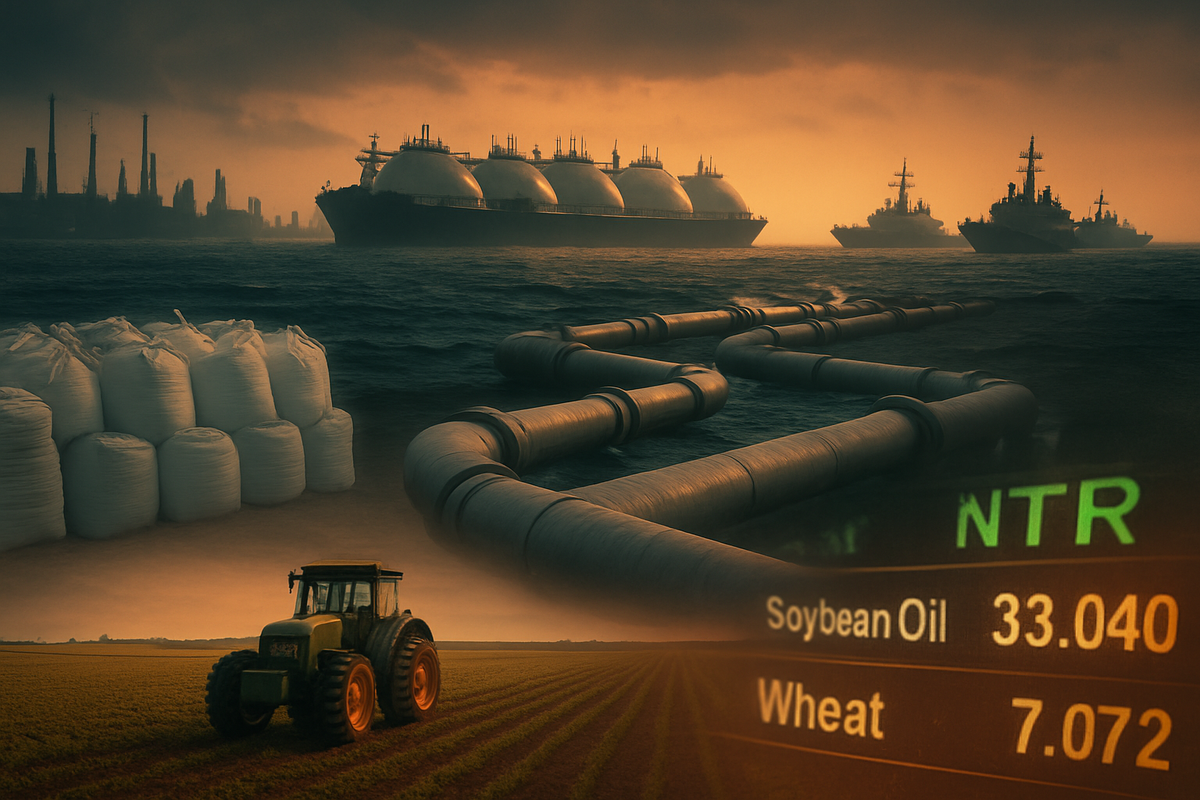
As of April 10, 2026, the global economy is grappling with a dual-edged crisis that began in the energy sector but has rapidly metastasized into a looming food security catastrophe. Following the escalation of the conflict in the Middle East and the subsequent closure of the Strait of Hormuz in early March, the sudden evaporation of roughly 20% of the world’s Liquefied Natural Gas (LNG) supply has sent shockwaves through the agricultural supply chain. The immediate implication is a staggering rise in the cost of nitrogen-based fertilizers, which rely heavily on natural gas as a primary feedstock, forcing massive production halts across Europe and Asia.
This energy-induced supply squeeze is already reflected at the dinner table. With fertilizer prices skyrocketing and availability plummeting, farmers are being forced to make impossible choices during the critical Northern Hemisphere spring planting season. The result has been a violent rally in crop prices, with soybean oil and wheat leading the charge. As energy costs remain elevated and the "biofuel pull" intensifies, the link between the heat of the Middle East conflict and the price of a loaf of bread has never been more direct or more dangerous.
The Strait of Hormuz: A Chokepoint for the World’s Pantry
The seeds of the current crisis were sown in late 2025 as domestic instability in Iran collided with rising geopolitical tensions between Tehran and a U.S.-led coalition. On February 28, 2026, the situation reached a breaking point with the launch of "Operation Epic Fury," a series of targeted strikes aimed at neutralizing regional threats. Iran’s retaliation was swift and economically devastating: the deployment of naval mines and drone swarms effectively shuttered the Strait of Hormuz, the world’s most vital artery for energy transit. By mid-March, targeted strikes on the Ras Laffan Industrial City in Qatar—the world’s premier LNG export hub—damaged critical liquefaction trains, removing nearly 17% of Qatar’s export capacity for what engineers estimate will be a three-to-five-year repair period.
The reaction in the energy markets was instantaneous and historic. In Europe, the Title Transfer Facility (TTF) benchmark nearly doubled to over €60/MWh within two weeks, while Asian spot prices (JKM) surged over 140%, peaking at $25/mmbtu. This made the production of ammonia—the building block of nitrogen fertilizer—economically unviable for dozens of plants across the globe. By late March, the industry reported that over 40% of European ammonia capacity had been curtailed, including major facilities operated by Yara International (OSE:YAR) in France and Italy.
Key stakeholders, including the UN Food and Agriculture Organization (FAO) and various G20 trade ministers, have sounded the alarm as the crisis moved from energy terminals to fertilizer depots. In India and Pakistan, where LNG imports are the lifeblood of the domestic urea industry, production has fallen by as much as 40%, leaving millions of hectares of farmland under-fertilized. The initial market reaction has been a flight to "safe-haven" agricultural commodities, as traders anticipate significantly lower yields for the 2026 harvest season.
Winners and Losers: The Agribusiness Divide
In this environment of scarcity, North American producers have emerged as the clear winners, buoyed by their access to relatively cheap, domestic natural gas. CF Industries (NYSE: CF) has seen its stock price surge nearly 40% since the conflict began, as it operates a low-cost production footprint in the United States, where Henry Hub gas prices have remained insulated from the global spike. Similarly, Nutrien (NYSE: NTR) has capitalized on the supply vacuum, utilizing its massive retail and production network to capture higher margins as global urea prices climbed from under $500 to over $700 per ton in a matter of weeks. These companies are effectively exporting the benefit of American energy independence in the form of high-priced agricultural inputs.
Conversely, the losers are concentrated in regions dependent on LNG imports and energy-intensive manufacturing. European fertilizer giants and chemical conglomerates are facing a "margin crush," where the cost of inputs exceeds the market value of the finished product, leading to the aforementioned shutdowns. For these firms, the 2026 fiscal year is shaping up to be a fight for survival, characterized by government subsidies and desperate searches for alternative feedstock.
The agribusiness giants that sit between the farm and the consumer, such as Archer-Daniels-Midland (NYSE: ADM) and Bunge Global (NYSE: BG), are navigating a complex landscape. While high crop prices generally benefit their trading desks, the volatility and rising logistical costs create significant headwinds. However, ADM and Bunge have both seen an unexpected boost in their oilseed processing segments. As crude oil prices (NYSE: XOM) (NYSE: SHEL) hover at multi-year highs due to the conflict, the demand for soybean oil as a feedstock for renewable diesel has intensified. This "biofuel pull" has kept soybean oil prices elevated at around $66/lb, providing a silver lining for processors who can pass through the costs of high-priced soy to energy-hungry transport sectors.
Strategic Shifts and the Decoupling of Food from Gas
The current crisis highlights a structural vulnerability in the global food system: its absolute dependence on the Haber-Bosch process, which converts natural gas into life-sustaining nitrogen fertilizer. This event fits into a broader trend of "energy-food convergence," where the boundaries between the two sectors are blurring. As we saw during the 2022 energy crisis following the invasion of Ukraine, any disruption in gas flows eventually manifests as a spike in the Consumer Price Index (CPI) for food. However, the 2026 crisis is more severe due to the direct impact on the Strait of Hormuz, a chokepoint far more central to global LNG than the pipelines of Eastern Europe.
The ripple effects are already being felt by competitors and partners in the agricultural technology space. There is a renewed, frantic interest in biological nitrogen fixation and "green ammonia" projects that use electrolysis rather than natural gas. While these technologies are not yet at the scale needed to replace conventional fertilizers, the 2026 price shock is acting as a massive regulatory and capital catalyst. Policymakers in the EU and North America are likely to accelerate subsidies for these alternatives to decouple food security from Middle Eastern geopolitics.
Historically, this event draws parallels to the 1970s oil shocks, but with the added complexity of modern biofuel mandates. Today, when energy prices rise, we don't just pay more to transport food; we also "burn" more food in our engines to offset high petroleum costs. This creates a feedback loop that exacerbates hunger in developing nations. The UN FAO warns that if the disruption persists through the summer of 2026, an additional 45 million people could fall into acute food insecurity, marking a significant regression in global development goals.
The Road Ahead: Adaptation and Scarcity
Looking ahead, the short-term outlook remains grim as the Northern Hemisphere moves into the peak of the growing season. Farmers are already shifting acreage away from nitrogen-hungry crops like corn and toward soybeans, which can fix their own nitrogen from the atmosphere. This shift is expected to cause a supply glut in soybeans by late 2026, while corn and wheat prices remain structurally high. Strategic pivots are already underway, with major agricultural buyers looking to secure multi-year supply contracts to bypass the volatile spot markets.
Long-term, this crisis will likely force a permanent restructuring of the global fertilizer industry. We can expect a "near-shoring" of production to regions with stable, domestic energy sources, such as the U.S. Gulf Coast and parts of North Africa. The challenge will be the 3-5 year lead time required to build new capacity. In the interim, market opportunities will emerge for companies specializing in precision agriculture and fertilizer efficiency, as farmers seek to make every pound of expensive nitrogen count. The scenario of a prolonged "Cold War" in the Middle East could keep energy and food prices on a "higher-for-longer" trajectory well into 2027.
Conclusion: Watching the Ticker and the Tanker
The link between the LNG tankers stalled in the Persian Gulf and the rising price of soybean oil in Chicago is a stark reminder of the interconnectedness of modern markets. The key takeaways for investors are clear: energy security is food security. The dominance of North American fertilizer producers like CF Industries and Nutrien is likely to persist as long as the Strait of Hormuz remains a flashpoint. Meanwhile, the agribusiness sector is being redefined by its role in the energy transition, as soybean oil becomes as much a fuel as it is a food.
Moving forward, the market will be characterized by extreme volatility tied to geopolitical headlines. Investors should watch for the spring acreage reports and any signs of a de-escalation in the Middle East, though the structural damage to Qatar’s LNG infrastructure means that "normal" supply is years away. The lasting impact of 2026 may be the end of the era of cheap, globalized inputs, ushering in a new age of localized, energy-independent agriculture. What happens in the waters of the Middle East will continue to dictate the menu for the rest of the world for the foreseeable future.
This content is intended for informational purposes only and is not financial advice