In a week that has redefined the landscape of high-performance computing (HPC) infrastructure, Applied Digital Corporation (Nasdaq: APLD) has solidified its position as a primary architect of the artificial intelligence era. Reporting its fiscal third-quarter 2026 results on April 8, the company announced a staggering 139% year-over-year revenue surge to $126.6 million, driven by the aggressive activation of its next-generation data center assets. This financial milestone was punctuated by the official groundbreaking of "Delta Forge 1," a massive 430 MW AI Factory campus designed to meet the insatiable power demands of hyperscale generative AI models.
The implications of these developments are profound. As the industry moves away from general-purpose data centers toward power-dense, liquid-cooled "factories," Applied Digital’s transition to a pure-play infrastructure platform marks a strategic pivot that many analysts believe will set the blueprint for the sector. By offloading its cloud services to focus entirely on the physical and power layers of the AI stack, Applied Digital is positioning itself as the indispensable landlord of the silicon-based economy, securing long-term, high-visibility revenue streams while mitigating the operational risks of the volatile cloud compute market.
Financial Inflection: Breaking Down the Q3 Surge
The fiscal third quarter, which ended February 28, 2026, represented an inflection point for Applied Digital’s balance sheet. The $126.6 million in revenue was largely bolstered by the HPC Hosting division, which alone contributed $71.0 million. This performance was underpinned by substantial base rent from key anchor tenants like CoreWeave (Private), as well as lucrative tenant fit-out services. While the company reported a GAAP net loss of $100.9 million—primarily due to a $59.7 million non-cash write-down related to the restructuring of its cloud business—the underlying operations showed significant strength. Adjusted EBITDA climbed to $44.1 million, a nearly seven-fold increase from the $6.3 million reported in the same period a year prior.
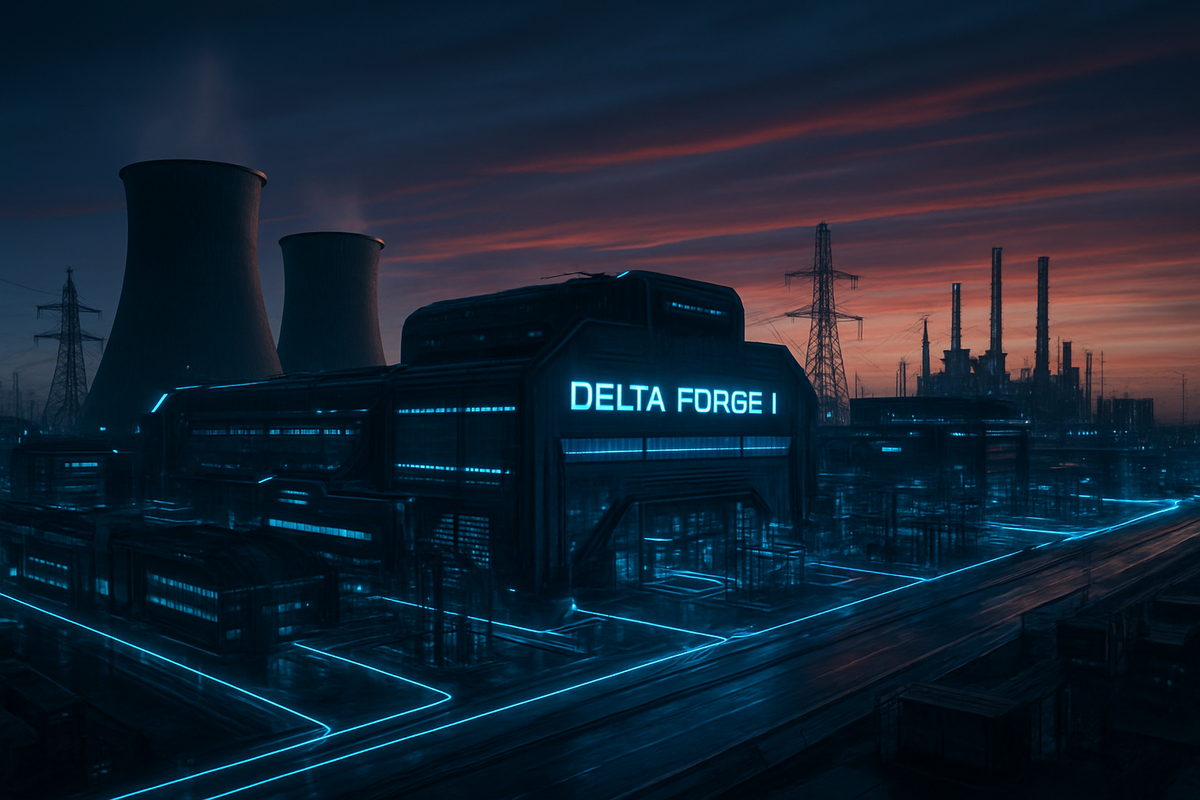
Central to the news cycle is the commencement of "Delta Forge 1," a 500-acre campus engineered for 430 MW of utility power. Unlike traditional facilities, Delta Forge 1 is built for extreme density, supporting rack configurations exceeding 100kW+ to accommodate the latest liquid-cooled GPU clusters. The project is being developed in a strategic southern U.S. market, with construction already underway as of early 2026. Management confirmed that they are in advanced negotiations with an investment-grade hyperscale customer for the majority of the site’s capacity, highlighting the premium value placed on "ready-to-plug" power in a market currently constrained by grid limitations.
The market reaction has been a study in volatility. Following the April 8 announcement, shares of APLD experienced significant trading volume as institutional investors digested the widening GAAP losses against the backdrop of record-breaking revenue growth. However, by April 10, 2026, the narrative had largely shifted toward the company’s massive $16 billion contracted lease backlog. Analysts from major firms have maintained bullish price targets, viewing the company’s capital-intensive expansion as a necessary land grab in the AI arms race.
Winners and Losers in the Infrastructure Shift
The immediate winner of this expansion is Applied Digital (Nasdaq: APLD) itself, which has successfully rebranded from a diversified digital assets firm to a focused AI infrastructure leader. However, the secondary winners include their construction and power partners. Babcock & Wilcox (NYSE: BW), which recently received a notice to proceed on a $2.4 billion project to build 1.2 GW of dedicated natural gas-fired generation for Applied Digital’s campuses, stands to benefit immensely from this long-term partnership. By building its own power supply through the "Base Electron" initiative, Applied Digital is bypassing utility bottlenecks, a move that could provide a massive competitive advantage.
On the other side of the ledger, traditional data center REITs like Equinix (Nasdaq: EQIX) and Digital Realty (NYSE: DLR) are facing a new breed of competition. While these giants still dominate the retail and interconnection markets, they are now forced to compete for hyperscale AI workloads against more nimble, specialized "factory" builders like Applied Digital and the private-equity-backed Vantage Data Centers. Furthermore, the spin-off of Applied Digital’s cloud business into ChronoScale Corporation (Nasdaq: CHRN) creates a new public competitor in the cloud compute space, potentially pressuring margins for smaller "neocloud" providers who do not have the same direct access to physical data center capacity.
The "losers" in this scenario may be those firms still heavily reliant on traditional air-cooled infrastructure. As NVIDIA (Nasdaq: NVDA) and other chipmakers push the thermal limits of hardware, data centers without advanced liquid cooling capabilities—like those being pioneered at Delta Forge 1—risk becoming obsolete or relegated to lower-margin legacy workloads. Investors are increasingly penalizing infrastructure companies that lack a clear roadmap for 50kW+ rack densities.
The Broader Context: Power as the New Gold
Applied Digital’s performance is a microcosm of the broader shift in the technology sector where power, not just silicon, has become the primary constraint on growth. The industry is currently witnessing a transition from "Cloud First" to "AI First" infrastructure. Historical precedents, such as the build-out of the fiber optic network in the late 1990s or the shift to mobile-centric data centers in the 2010s, suggest that those who control the bottleneck—in this case, power and high-density cooling—capture the lion's share of the value.
The regulatory environment is also beginning to react. As massive projects like Delta Forge 1 come online, local and federal authorities are scrutinizing the energy consumption of AI factories. Applied Digital’s "Base Electron" strategy of using on-site natural gas generation to supplement the grid is a response to these pressures, but it may also invite future environmental regulatory hurdles. By becoming an independent power producer, the company is effectively merging the utility and real estate sectors, a move that reflects the "full-stack" nature of modern AI infrastructure.
This event also highlights the divergence between "Compute Providers" and "Infrastructure Providers." By spinning off its cloud services, Applied Digital is signaling that the market now values the predictability of infrastructure (the "picks and shovels") over the high-growth but high-capex risk of the cloud services layer. This mirror’s trends seen in the energy sector decades ago, where the owners of pipelines and storage facilities often achieved more stable valuations than the drillers themselves.
The Path Forward: What Comes Next for APLD?
Looking ahead, the primary challenge for Applied Digital will be the execution of its massive capital projects. With a debt load of approximately $2.7 billion and a continuous need for liquidity to fund the Delta Forge campus, the company’s ability to tap into the credit markets will be critical. The market will be watching closely for the formal signing of a hyperscale tenant for Delta Forge 1, as an investment-grade contract would likely trigger a massive de-risking event and potential credit rating upgrades.
In the short term, the integration of "Base Electron" power generation will be a major operational milestone. If Applied Digital can successfully bring its own power online ahead of local utility schedules, it will likely see a surge in demand from customers like CoreWeave who are desperate to deploy GPUs. Long-term, the company’s success will depend on whether its "AI Factory" blueprint remains the industry standard or if new cooling technologies or chip architectures shift the requirements of the data center once again.
The upcoming merger and spin-off of the cloud business into ChronoScale also creates a strategic opportunity. By separating these two distinct business models, management can offer investors a "pure-play" choice: the steady, asset-heavy infrastructure play of APLD, or the high-beta, high-reward cloud services play of CHRN. This clarity is expected to reduce the "conglomerate discount" that has historically weighed on the stock.
Closing Summary and Investor Outlook
Applied Digital’s fiscal Q3 2026 results and the groundbreaking of Delta Forge 1 represent a watershed moment for the company and the AI infrastructure sector at large. The 139% revenue surge is a clear signal that the demand for high-density compute space has transitioned from theoretical projection to realized revenue. As the company sheds its cloud services to focus on its "AI Factory" model, it is betting everything on the continued scarcity of high-power data center capacity.
For investors, the coming months will be defined by three key metrics: the announcement of hyperscale lease signatures, the progress of the $2.4 billion power generation partnership with Babcock & Wilcox, and the successful completion of the ChronoScale spin-off. While the company’s widening losses and rising debt remain a concern for the risk-averse, the massive $16 billion backlog and the fundamental pivot to a pure-play infrastructure model suggest that Applied Digital is no longer just a crypto-adjacent experiment, but a cornerstone of the AI economy.
The market for AI infrastructure is currently in a state of hyper-expansion, and Applied Digital has positioned itself at the vanguard. As Delta Forge 1 rises, it will serve as a physical testament to the scale of the AI revolution and the massive capital required to sustain it.
This content is intended for informational purposes only and is not financial advice.