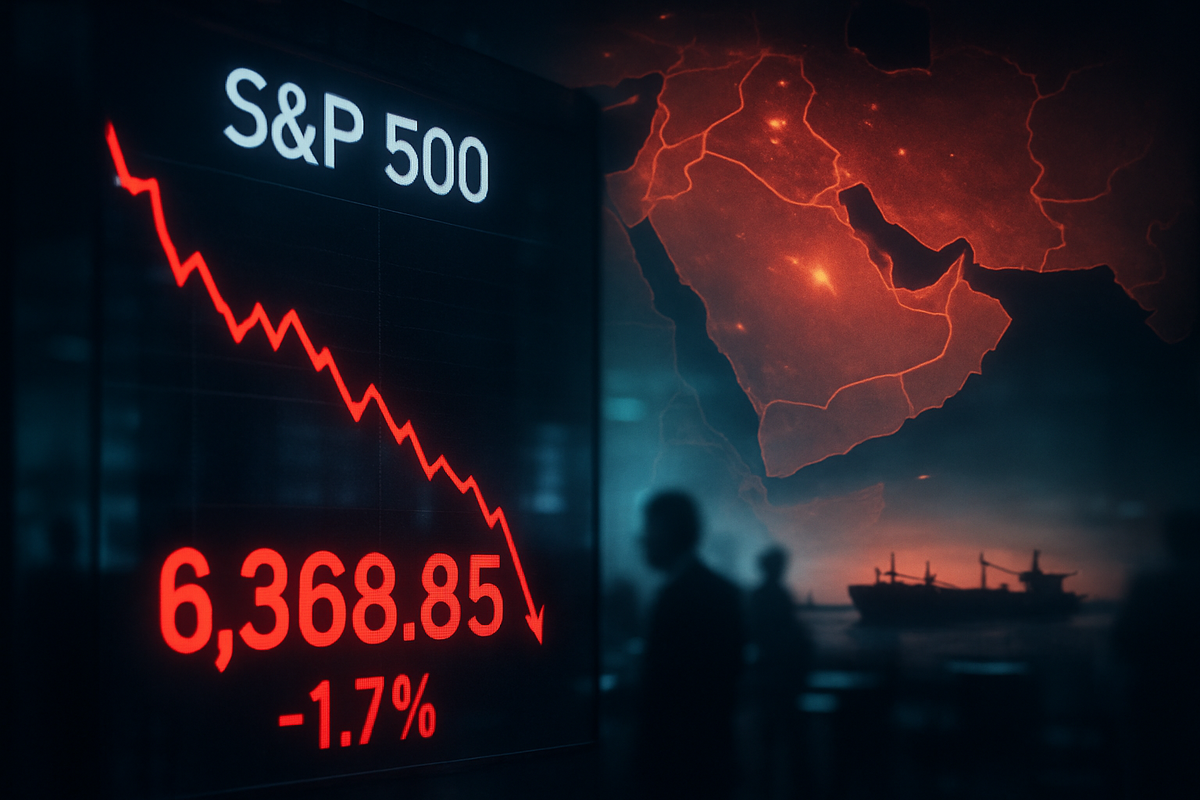
The S&P 500 (INDEXSP: .INX) suffered a bruising session on Monday, March 30, 2026, as intensifying military escalations in the Middle East sent investors fleeing for safety. The benchmark index plummeted 108.31 points, or 1.7%, to close at 6,368.85. The sell-off marks the index's lowest level since August 2025, effectively wiping out nearly all gains made during the first quarter of the year and signaling a stark shift in market regime from AI-driven optimism to geopolitical survivalism.
The decline was characterized by a classic "risk-off" flight, with capital exiting high-growth sectors and pouring into traditional safe havens like gold and U.S. Treasuries. As Brent Crude surged past $115 per barrel following reports of further disruptions in the Strait of Hormuz, the specter of "stagflation"—low growth coupled with high inflation—has returned to haunt Wall Street, leaving analysts questioning the sustainability of the multi-year bull market that characterized much of 2024 and 2025.
A Black Monday for the 2026 Market
The downward spiral on March 30 was the culmination of a tense weekend that saw a significant escalation in what regional experts are now calling the "Gulf Flashpoint." Following the initiation of Operation Epic Fury earlier in the month, the conflict reached a critical juncture over the last 48 hours as retaliatory drone strikes targeted energy infrastructure in the Gulf Cooperation Council (GCC) states. The tipping point for Monday’s trade came during the pre-market hours when Iran reaffirmed its commitment to a blockade of the Strait of Hormuz, a move that threatens nearly 20% of the world's daily oil and liquefied natural gas (LNG) supply.
The trading day began with a gap down of 1.1% at the opening bell, and volatility remained elevated throughout the session. By mid-afternoon, selling pressure intensified as the VIX, often referred to as the market's "fear gauge," spiked above 30 for the first time in over a year. Key stakeholders, including the Federal Reserve and the International Energy Agency (IEA), issued cautious statements, with the IEA warning of "extraordinary pressure" on global supply chains if the maritime blockade persists beyond the week. The S&P 500’s descent to 6,368.85 represents a 8.7% correction from the all-time high of 6,978.59 reached in late January, placing the index firmly in a technical correction phase.
Winners and Losers: Defense Rises as Tech and Travel Retrench
In a bifurcated market, the defense and energy sectors were the sole outposts of growth. Defense titans like Lockheed Martin (NYSE: LMT) and RTX Corporation (NYSE: RTX) saw their shares climb 3.8% and 4.2% respectively, as the market priced in an inevitable surge in Pentagon spending and munitions replenishment. Similarly, integrated oil majors such as ExxonMobil (NYSE: XOM) and Chevron (NYSE: CVX) trended higher alongside crude prices, though their gains were capped by fears that $120 oil might eventually lead to global demand destruction.
Conversely, the "Magnificent Seven" tech giants, which led the 2025 rally, bore the brunt of the liquidation. Apple Inc. (NASDAQ: AAPL) and Nvidia (NASDAQ: NVDA) both fell more than 2.5%, as higher discount rates—driven by rising bond yields—lowered the present value of future earnings. The travel sector was particularly devastated; Delta Air Lines (NYSE: DAL) and United Airlines (NASDAQ: UAL) plummeted 6% and 7.1% respectively, as investors anticipated a double-whammy of skyrocketing jet fuel costs and a collapse in consumer discretionary spending due to high energy prices at the pump.
Macro Implications and the End of the "AI Supercycle" Rally
This pivot marks a dramatic shift in the broader industry trend. For the past 18 months, the market narrative was dominated by the "AI supercycle," with companies like Microsoft (NASDAQ: MSFT) and Alphabet (NASDAQ: GOOGL) reaching trillion-dollar valuations on the back of productivity promises. However, the events of March 30 suggest that geopolitical reality has reasserted itself over technological speculation. The ripple effects are already being felt in the semiconductor industry, as concerns mount regarding the stability of global shipping routes essential for the distribution of high-end hardware.
Historically, the 1.7% drop on Monday mirrors the market reactions seen during the 1990 invasion of Kuwait and the 1973 oil embargo. While the 2026 economy is more energy-efficient than in decades past, the fragility of the "just-in-time" global supply chain remains a systemic risk. Regulatory bodies in the U.S. and Europe are already discussing emergency energy conservation measures, and the Federal Reserve now faces a policy nightmare: whether to raise rates to fight energy-induced inflation or cut them to support a wobbling economy.
The Road Ahead: Scenarios for Q2 2026
As we look toward the remainder of the second quarter, two primary scenarios emerge. In the first "De-escalation Case," a successful diplomatic intervention or a limited military resolution could lead to a relief rally, pushing the S&P 500 back toward the 6,600 level as short-sellers cover their positions. In this scenario, the current dip may be viewed as a "generational buying opportunity" for long-term investors looking to pick up premium tech stocks at a discount.
In the more somber "Prolonged Conflict" scenario, if the Strait of Hormuz remains closed for more than 30 days, analysts at firms like JPMorgan and Goldman Sachs have warned that the S&P 500 could test the 6,000 psychological floor. This would require a strategic pivot for institutional investors, moving away from growth-oriented portfolios toward "hard assets" and commodities. Market participants should also watch for potential emergency liquidity injections from central banks if the volatility begins to threaten the stability of the credit markets.
Summary: A New Era of Volatility
The S&P 500's close at 6,368.85 on March 30, 2026, serves as a stark reminder that even the most robust bull markets are susceptible to the tides of history. The key takeaway for investors is that the "Goldilocks" environment of 2025—low inflation and high tech growth—has officially ended. The market has entered a period of price discovery where geopolitical risk is now the primary variable in every valuation model.
Moving forward, the market will remain hypersensitive to every headline coming out of the Middle East. Investors should closely monitor the price of Brent Crude and the 10-year Treasury yield as indicators of the "war premium" currently baked into stocks. While the long-term fundamentals of many American companies remain strong, the path to year-end targets of 7,000+ now looks considerably more treacherous. For now, caution is the order of the day as the world waits to see if the "Gulf Flashpoint" will be a short-term shock or a long-term economic drain.
This content is intended for informational purposes only and is not financial advice.