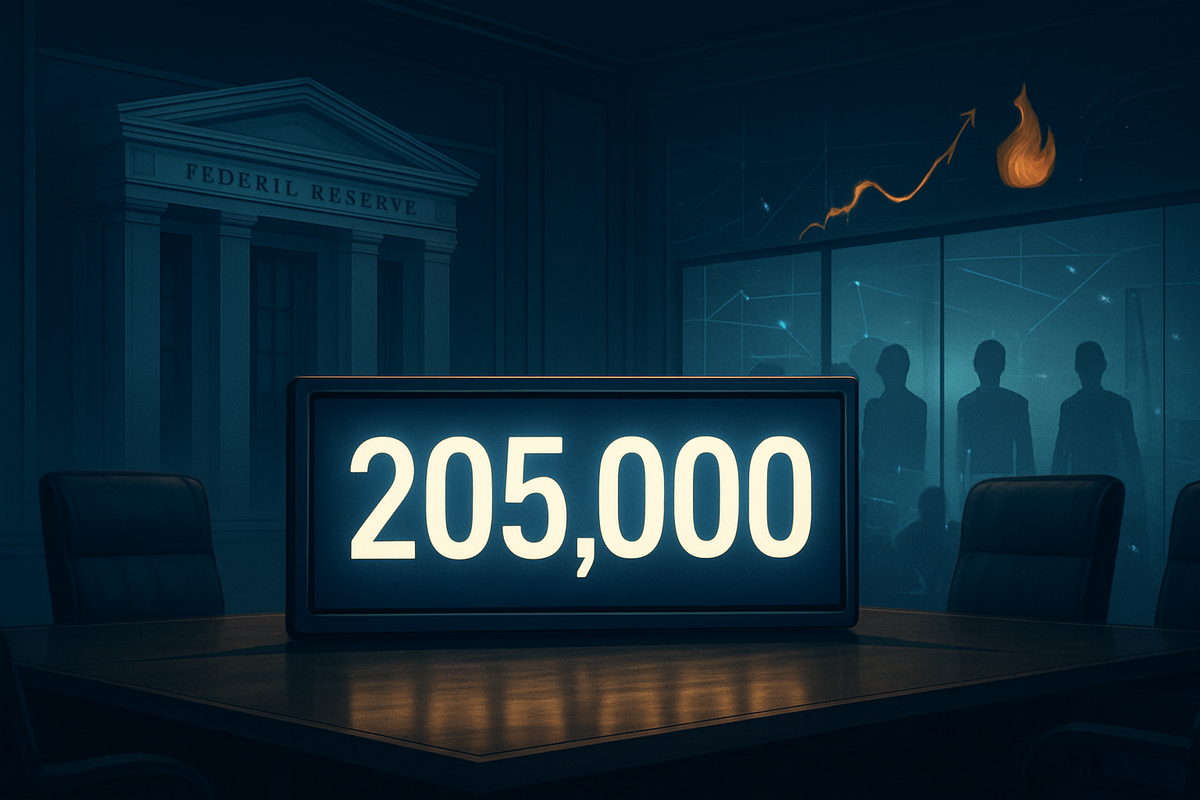
The U.S. labor market continues to defy gravity, or at least the gravity of high interest rates, as initial jobless claims fell to a surprising 205,000 for the mid-March reporting period. This figure, significantly lower than the 215,000 expected by Wall Street, has sent a clear message to the Federal Reserve: the "floor" of the American economy is far sturdier than many bears anticipated. However, this resilience comes with a sharp edge, as it provides Fed Chair Jerome Powell with the ammunition needed to maintain a "hawkish hold" on interest rates, further delaying the relief that high-growth sectors have been craving.
The immediate fallout of this data is a market caught in "statistical dissonance." While the labor market appears robust based on low layoff numbers, underlying job creation has stagnated, creating a "low-hire, low-fire" environment that is complicating the Fed's dual mandate. For investors, the takeaway is clear: the era of 3.5% interest rates is here to stay longer than expected, and the path to a "soft landing" has become a narrow tightrope walk over the twin peaks of sticky inflation and geopolitical volatility.
For the week ending March 14, 2026, the Department of Labor reported that initial jobless claims dropped by 8,000 to a seasonally adjusted 205,000. While the data released today, March 26, showed a slight uptick to 210,000—matching consensus—the shock of the 205,000 print from the previous week continues to reverberate through the halls of the Eccles Building. This trend indicates that despite a cooling economy, American businesses are engaging in "labor hoarding," a strategic reluctance to let go of skilled workers even as they freeze new hiring initiatives.
This movement toward the "Big Stay"—where employees remain in their current roles and employers refuse to cut staff—follows a volatile 2025. Last year saw the unemployment rate peak at 4.5% in November, leading to fears of a looming recession. However, by the end of Q1 2026, those fears have been replaced by a strange stability. The four-week moving average now sits at 210,750, a level that would historically signal a healthy economy, yet it stands in stark contrast to February’s unexpected loss of 92,000 payroll jobs.
Key stakeholders, including Fed Governor Stephen Miran and Chair Jerome Powell, remain divided on what this means for policy. At the March 17–18 FOMC meeting, the Fed held the benchmark federal funds rate steady at 3.50% to 3.75%. While Miran argued for an immediate 0.25 percentage point cut to head off the payroll contraction, the 205,000 jobless claim figure gave the majority of the committee pause. The updated "dot plot" now suggests only one rate cut for the remainder of 2026, a hawkish pivot from the two cuts projected in late 2025.
The divergence in the labor market and the Fed’s stubborn stance on rates have created a landscape of distinct winners and losers. Among the primary beneficiaries is JPMorgan Chase & Co. (NYSE: JPM). The banking giant continues to see robust net interest margins as the yield curve "bear steepens," allowing it to capitalize on high lending rates while its fortress balance sheet keeps deposit costs manageable. Similarly, Exxon Mobil Corp. (NYSE: XOM) has emerged as a defensive powerhouse. With Brent crude surpassing $100 per barrel due to escalating tensions in the Middle East, Exxon's shares have surged over 55% since mid-2025, serving as a hedge against both inflation and geopolitical risk.
On the other side of the ledger, high-growth technology firms are feeling the squeeze of compressed valuation multiples. Microsoft Corp. (NASDAQ: MSFT) has seen its shares pull back roughly 31% from its 2025 highs, as investors grow wary of its $37.5 billion quarterly capital expenditure cycle in an environment where capital is no longer cheap. Amazon.com, Inc. (NASDAQ: AMZN) is also under pressure, as "choiceful" consumers pull back on discretionary spending in the face of stagnant wage growth and a freeze in the hiring market.
Surprisingly, the "low-fire" trend has been a boon for human resources technology. ADP (NASDAQ: ADP) and Paychex, Inc. (NASDAQ: PAYX) have seen increased demand for their "Retention AI" suites, as companies shift their focus from recruitment to workforce stability and internal mobility. Meanwhile, Nvidia Corp. (NASDAQ: NVDA) remains a volatile outlier. While its shares have pulled back from record peaks to around $179, its GPUs remain the essential infrastructure for companies looking to use AI to replace the need for new white-collar hires—a trend that the 205,000 jobless claim figure effectively validates.
The resilience of the labor market cannot be viewed in isolation from the broader inflationary environment. As of March 2026, the Personal Consumption Expenditures (PCE) price index remains stuck at 2.7%, well above the Fed's 2.0% target. This "sticky" inflation is being driven by a perfect storm of supply-side shocks, including new global tariffs introduced earlier this year and a spike in energy costs following military conflicts in the Middle East.
Historically, such shocks would have triggered immediate layoffs as companies sought to protect margins. However, the current "low-hire, low-fire" trend suggests a fundamental shift in corporate psychology. After the labor shortages of the early 2020s, businesses are terrified of being caught short-handed when the economy eventually rebounds. This has led to a policy paradox for the Federal Reserve: they want to cool the economy to fight inflation, but the labor market's refusal to break is keeping service-sector inflation uncomfortably high.
This situation echoes the "stagflation" scares of the late 1970s, though with a modern twist. Today’s workforce is increasingly augmented by AI, which may explain why companies can afford to stop hiring without seeing an immediate drop in productivity. This "efficiency-led stagnation" could potentially keep jobless claims low for the foreseeable future, even as the broader GDP growth remains tepid.
Looking forward, the market is bracing for a "second-half showdown." If initial jobless claims remain near the 205,000 to 210,000 range through the summer, the Federal Reserve will likely keep rates at 3.5% through the end of the year. For corporations, this means a continued focus on internal efficiency rather than expansion. We expect to see a surge in "Agentic AI" deployments—software that can autonomously perform complex tasks—as companies look for ways to grow without increasing their headcount.
However, a risk remains that the "low-fire" dam could eventually break. If the negative payroll numbers seen in February persist into the second quarter, the "labor hoarding" strategy may become too expensive to maintain. In such a scenario, the Fed might be forced into an emergency "pivot," cutting rates aggressively to prevent a rapid spike in unemployment. This would likely trigger a massive rotation out of defensive plays like Chevron Corp. (NYSE: CVX) and back into battered growth stocks and small-caps.
In the short term, the market will remain hyper-focused on the April payroll report. If job creation returns to positive territory while claims stay low, the "soft landing" narrative will regain its footing. If, however, payrolls continue to shrink while claims stay at 205,000, it will confirm that the U.S. has entered a new economic era characterized by a static, high-rate equilibrium.
The March jobless claims data has confirmed that the U.S. labor market is in a state of suspended animation. The drop to 205,000 claims was a victory for economic stability but a defeat for those hoping for imminent interest rate cuts. The Fed’s "Hawkish Hold" is now the dominant theme for 2026, supported by a workforce that is staying put and a corporate sector that is holding its breath.
Moving forward, the S&P 500 and Nasdaq are likely to remain range-bound as they digest the reality of "higher for longer" borrowing costs. Investors should pay close attention to the 10-year Treasury yield and Brent crude prices, as these will be the primary drivers of Fed sentiment in the coming months. The labor market has proven it can survive high rates; the next test is whether it can continue to do so as the "low-hire" freeze begins to impact consumer confidence.
Key indicators to watch include:
- Monthly Payroll Data: Look for a reversal of February's -92,000 print.
- Core PCE Inflation: Any movement toward 2.0% could trigger a Fed pivot.
- Geopolitical Oil Spikes: Crude prices above $110 could force the Fed to stay hawkish regardless of labor weakness.
This content is intended for informational purposes only and is not financial advice.