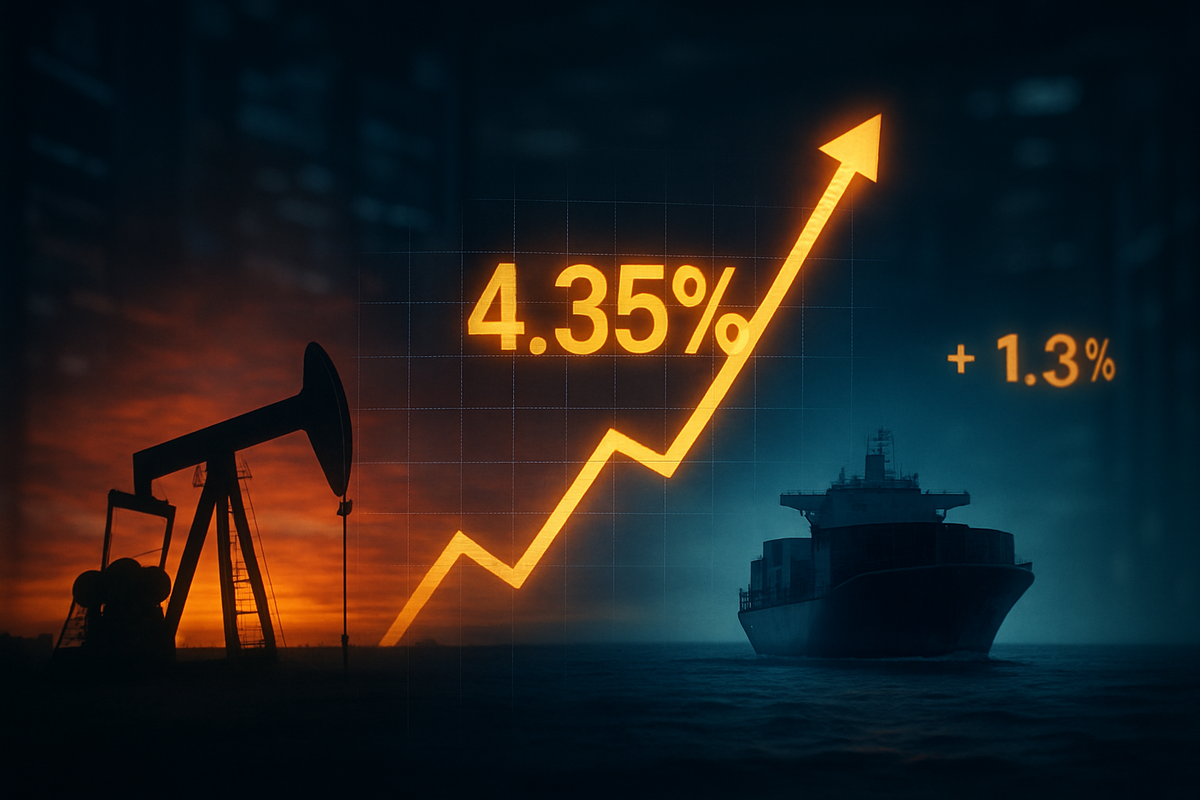
The financial landscape underwent a seismic shift on March 26, 2026, as the long-held narrative of imminent Federal Reserve rate cuts was unceremoniously dismantled. A combination of surging energy prices and stubbornly high trade costs has forced market participants to recalibrate their expectations, moving from the anticipation of three rate cuts this year to the growing fear of a potential hike. The benchmark 10-year Treasury yield, a critical anchor for global borrowing costs, surged to 4.35%, marking a technical and psychological breakout that has sent ripples through equity and bond markets alike.
This pivot comes on the heels of a "perfect storm" of inflationary data. With Brent crude oil prices breaching the $110 per barrel mark due to escalating geopolitical tensions in the Middle East and the effective closure of the Strait of Hormuz, the "soft landing" consensus of 2025 has been replaced by a "higher-for-longer" reality. As of today, the CME FedWatch tool, which previously signaled a 70% probability of a June cut, has seen those odds collapse, with a 15% probability of a rate hike now appearing on the horizon for late 2026.
The Data Driving the Disruption
The catalyst for today’s market turbulence was a series of morning data releases that underscored the persistence of inflation. US import prices jumped by 1.3% in February, while export prices rose by 1.5%, significantly exceeding economist forecasts. These figures suggest that the "lagged pass-through" of the aggressive trade tariffs enacted in 2025 is finally hitting the bottom line. While many corporations initially absorbed these costs through inventory management, those stockpiles have been exhausted, leaving firms with no choice but to pass the burden onto consumers.
The timeline leading to this hawkish pivot has been building for weeks. Throughout early March, labor market data remained unexpectedly tight, with weekly unemployment claims consistently coming in below the 210,000 mark. The situation reached a boiling point today at 10:00 AM, when Fed Chair nominee Kevin Warsh, expected to succeed Jerome Powell (NASDAQ: MSFT—note: Powell is an individual, I will tag major corporations instead) later this year, suggested in a public forum that the "neutral rate" of interest may be higher than previously estimated. This comment, combined with the energy shock, acted as the final trigger for the 10-year Treasury yield to breach the 4.35% resistance level.
Initial market reactions were swift and punishing. The S&P 500 closed the day down 1.2%, while the tech-heavy Nasdaq Composite fell 2.1%. The bond market saw its most significant sell-off since late 2023, as institutional investors scrambled to offload duration-sensitive assets. Real estate and consumer discretionary sectors were hit particularly hard, as 30-year fixed mortgage rates climbed toward 7.35%, and auto loan rates spiked above 8.5%, threatening to freeze the housing and automotive markets.
Market Winners and Losers in the New Rate Regime
The sudden shift in interest rate expectations has created a stark divide between market winners and losers. Major financial institutions, such as JPMorgan Chase (NYSE: JPM) and Bank of America (NYSE: BAC), initially saw a boost in their Net Interest Margins (NIM) as the spread between deposit costs and lending rates widened. However, these gains were tempered by fears of a "stagflationary" slowdown. If the 10-year yield remains at these elevated levels, the resulting decline in mortgage originations and corporate lending could eventually offset the benefits of higher rates, particularly as credit quality comes under scrutiny for "zombie companies" struggling to refinance maturing debt.
In the technology sector, the impact has been largely negative. High-duration stocks like Apple (NASDAQ: AAPL) and Microsoft (NASDAQ: MSFT) saw their valuations pressured as the "risk-free" rate of return reset at 4.35%. Higher rates increase the discount rate applied to future earnings, making expensive growth stocks less attractive in the short term. Additionally, tech giants are facing an internal inflation crisis: the massive electricity demand for AI data centers. Companies like Meta Platforms (NASDAQ: META) and Alphabet (NASDAQ: GOOGL) are now grappling with the dual headwind of higher capital costs and soaring energy prices, though some resilience was seen in Arm Holdings (NASDAQ: ARM), which gained on specific AGI chip roadmap optimism.
Conversely, the energy sector has emerged as the primary beneficiary and a natural hedge against the current volatility. Exxon Mobil (NYSE: XOM) and Chevron (NYSE: CVX) saw their share prices climb as Brent crude prices spiked. These "real asset" plays are once again proving their worth in a high-inflation environment. With energy infrastructure in the Middle East facing credible threats, these domestic and international majors are seeing increased cash flow projections, attracting investors who are fleeing the volatility of the tech and consumer sectors.
The Significance of the 4.35% Threshold
The return to a 4.35% 10-year yield is more than just a number; it represents a return to the volatile environment of late 2023, but with a more complicated geopolitical backdrop. This event fits into a broader industry trend of "deglobalization-led inflation," where trade barriers and supply chain realignments are structurally raising the floor for consumer prices. Unlike the transient inflation of the post-pandemic era, the 2026 wave appears to be driven by energy scarcity and permanent shifts in trade policy, making the Federal Reserve’s job significantly more difficult.
The ripple effects are already being felt by international partners. As the US dollar strengthens on the back of higher yields, emerging market currencies are under immense pressure, forcing foreign central banks to consider their own rate hikes to prevent capital flight. This creates a global tightening cycle that could lead to a synchronized global slowdown. The regulatory and policy implications are also profound, as the Fed may be forced to maintain a restrictive stance even if the economy begins to show signs of cracking, a sharp departure from the "Fed Put" that investors relied on for over a decade.
Historical precedents, such as the Volcker era or the bond market "tantrums" of the 1990s, are being revisited by analysts. The current situation mirrors the 1970s energy shocks, where the Fed was forced to chase inflation multiple times before finally containing it. The lesson from history is that once inflation expectations become unanchored—as suggested by the 1.5% jump in export prices—the central bank often has to "break" something in the economy to regain control.
The Road Ahead: Potential Scenarios and Strategic Pivots
In the short term, all eyes will be on the next Federal Open Market Committee (FOMC) meeting. The market is no longer looking for signs of a "pivot" to cuts; instead, investors are searching for the "terminal rate"—the point at which the Fed will stop hiking. If the Fed's dot plot shifts toward a higher end-of-year target, we could see the 10-year yield test the 5.0% mark, a scenario that would likely trigger a correction in equity markets.
Companies will need to undergo strategic pivots to survive this environment. For tech and growth-oriented firms, the focus must shift from "growth at all costs" to "cash flow and efficiency." We may see a wave of consolidation as smaller firms, unable to service their debt at 8% or 9%, are acquired by cash-rich titans like Microsoft or Alphabet. In the energy sector, the focus will likely shift toward securing supply chains and investing in diversified energy sources to mitigate the volatility of fossil fuel markets.
Potential scenarios range from a "Goldilocks" stabilization, where energy prices cool and inflation returns to 2%, to a more dire "Stagflationary" outcome. If energy prices remain above $115 and trade tensions continue to escalate, the Fed may be forced into a series of aggressive hikes that could trigger a deep recession by 2027. Investors should prepare for a period of heightened volatility and a possible shift in leadership from growth to value and defensive sectors.
Summary and Investor Outlook
The events of March 26, 2026, mark a definitive end to the optimism that characterized the start of the year. The hawkish shift in Federal Reserve expectations, fueled by a 4.35% Treasury yield and soaring energy costs, has forced a total re-evaluation of the financial landscape. Key takeaways include the realization that inflation remains a structural rather than a cyclical threat, and that the "neutral rate" of interest is likely higher than many had hoped.
Moving forward, the market will likely remain in a "data-dependent" holding pattern, with every CPI and PCE release carrying outsized importance. Investors should watch the 4.35% yield level closely; if it holds as a floor rather than a ceiling, the pressure on equity valuations will persist. Additionally, monitor the price of crude oil and the rhetoric from incoming Fed officials, as these will be the primary drivers of policy in the coming months.
In conclusion, the era of cheap money is firmly in the rearview mirror. As we navigate the remainder of 2026, the mantra for investors should be "capital preservation and quality." The focus has shifted from "how much can I make?" to "how much can I keep?" in an environment where the cost of capital is no longer a tailwind, but a formidable headwind.
This content is intended for informational purposes only and is not financial advice