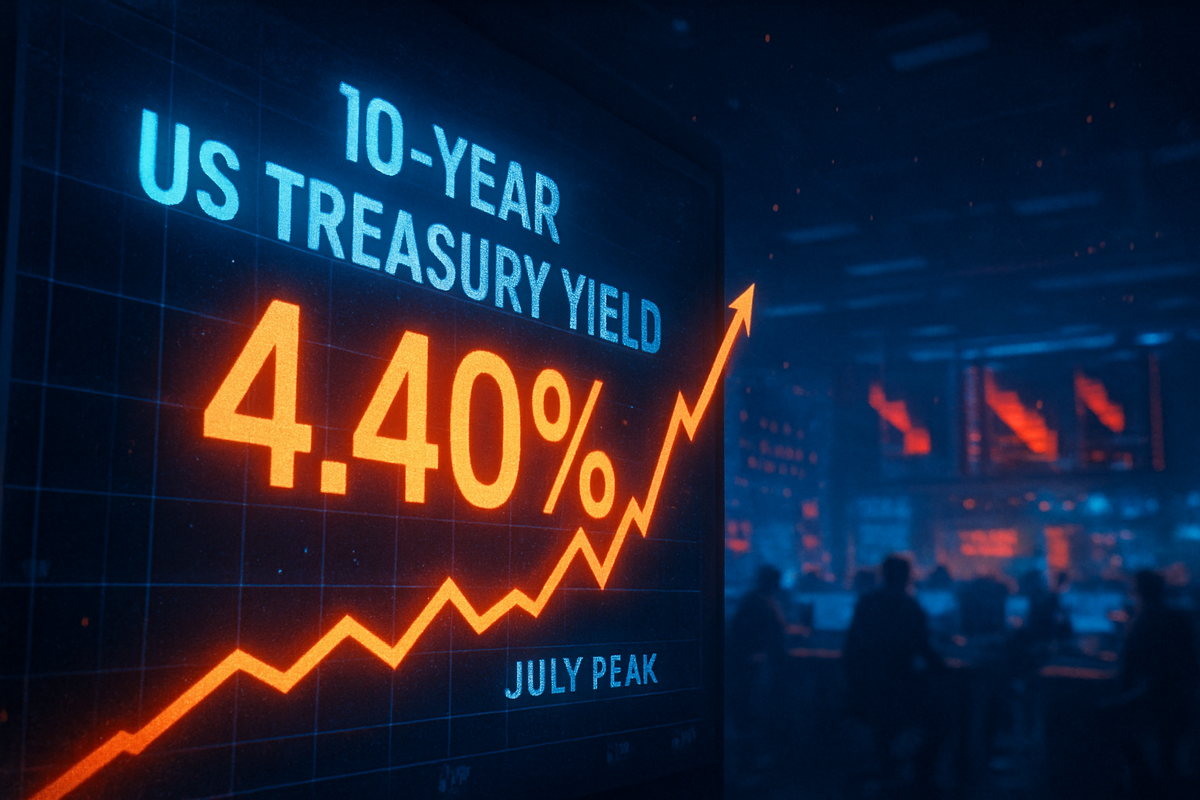
The fixed-income market sent a shockwave through Wall Street this morning as the yield on the benchmark 10-year US Treasury note surged to 4.40%, marking its highest level since July 2025. This rapid ascent in the "risk-free" rate of return has fundamentally altered the calculus for equity investors, who are now grappling with a more expensive borrowing environment and a significant shift in the valuation models that have supported the recent bull market.
The immediate implications of this move are being felt across the board, particularly within high-growth sectors that are most sensitive to interest rate fluctuations. As the 10-year yield crossed the psychologically significant 4.40% threshold, the broader markets showed signs of strain, with the tech-heavy Nasdaq and interest-rate-sensitive real estate sectors seeing initial sell-offs. For the average consumer, this surge signals that the era of "higher-for-longer" rates is far from over, likely leading to a continued squeeze on mortgage affordability and corporate expansion plans.
The climb to 4.40% was not a sudden fluke but the culmination of several weeks of persistent upward pressure. After a brief cooling period in late 2025, where the 10-year yield hovered near 3.80%, a series of robust economic data releases throughout the first quarter of 2026 forced a major market "re-pricing." Specifically, March retail sales and consumer sentiment figures exceeded even the most optimistic forecasts, suggesting that the US economy is operating in a "no landing" scenario—where growth remains too strong for inflation to fully retreat to the Federal Reserve’s 2% target.
Leading up to this moment, the narrative shifted from "when will the Fed cut?" to "will the Fed hold?" Federal Reserve Chair Jerome Powell recently signaled a cautious stance, noting that the central bank is in no rush to lower the federal funds rate given the labor market's resilience. This hawkish tilt was the primary catalyst that pushed the 10-year yield from 4.15% in early March to the 4.40% handle seen today. Market participants, including institutional giants and sovereign wealth funds, have been forced to adjust their portfolios, leading to a massive "bond-vigilante" style sell-off that drove prices down and yields up.
The initial reaction from the floor of the New York Stock Exchange was one of guarded anxiety. While the S&P 500 initially tried to shrug off the move, the momentum stalled as the yield held steady at 4.40% during the midday session. Analysts at major firms have noted that this level acts as a "valuation ceiling," where the earnings yield of the stock market begins to look increasingly unattractive compared to the safety of government debt.
The surge in yields has created a stark divide between sectors capable of weathering high rates and those that are fundamentally undermined by them. The most visible casualties are the "Magnificent Seven" and other high-growth tech firms. Companies like Nvidia (NASDAQ: NVDA), Microsoft (NASDAQ: MSFT), and Apple (NASDAQ: AAPL) saw immediate pressure on their share prices. Because these companies trade at high price-to-earnings (P/E) multiples based on future cash flows, a higher discount rate—derived from the 10-year yield—mathematically lowers their current market valuation.
The real estate and utility sectors are also facing a significant headwind. Real Estate Investment Trusts (REITs) such as American Tower (NYSE: AMT) and Realty Income (NYSE: O) are particularly vulnerable; they rely heavily on debt to fund property acquisitions and must compete for "income-seeking" investors who might now prefer a 4.40% Treasury yield over a risky 5% dividend yield from a REIT. Similarly, utilities like NextEra Energy (NYSE: NEE) have historically underperformed during periods of rising yields, as their heavy capital expenditure requirements become more expensive to finance.
Conversely, some pockets of the financial sector are finding a silver lining. Major commercial banks like JPMorgan Chase (NYSE: JPM) and Bank of America (NYSE: BAC) typically benefit from a "steepening" yield curve. As long-term rates rise faster than short-term deposit rates, these institutions can expand their Net Interest Margin (NIM)—the difference between what they earn on loans and what they pay to depositors. However, even this "win" is tempered by the risk that 4.40% yields will eventually stifle loan demand, particularly in the mortgage and small-business sectors.
The breach of 4.40% is more than just a technical milestone; it reflects a broader shift in the global financial landscape. In the context of the last decade, a 4.40% yield is high, but it remains below the 5% peaks seen in late 2023. However, the speed of the ascent is what has the market concerned. This trend mirrors the "Great Bond Rout" of 2022 and late 2023, where rapid yield increases preceded significant market corrections. It suggests that "bond vigilantes"—investors who sell bonds to protest perceived inflationary fiscal policy—are back in the driver's seat.
Furthermore, this event highlights a growing concern over the US fiscal deficit. With the national debt continuing to climb, the Treasury Department must issue more bonds to fund government spending. When the market is flooded with new supply, bond prices fall, and yields rise unless there is a corresponding increase in demand. At 4.40%, the market is effectively demanding a higher "term premium" to compensate for the perceived risk of holding long-term US debt in an environment of high spending and sticky inflation.
This ripple effect extends to international partners as well. A higher US 10-year yield often leads to a stronger US Dollar, as global investors seek out the higher returns available in American fixed income. This can put immense pressure on emerging markets that hold debt denominated in dollars, potentially leading to a tightening of global liquidity that extends far beyond the borders of the United States.
In the short term, all eyes will be on the upcoming Consumer Price Index (CPI) report and the next Federal Open Market Committee (FOMC) meeting. If inflation data remains hot, market strategists anticipate that the 10-year yield could quickly test the 4.50% to 4.60% range, a level that has historically triggered broader "risk-off" sentiment in the equity markets. Investors should watch for a "flight to quality" if the 4.50% mark is breached, as institutional money may rotate out of equities and into Treasuries once the yield becomes "too good to pass up."
Long-term, corporations will likely need to engage in strategic pivots to manage higher interest expenses. We may see a slowdown in stock buybacks and a shift toward "debt-reduction" strategies as companies prioritize balance sheet health over aggressive expansion. For investors, the opportunity may lie in "short-duration" fixed income or high-quality value stocks that generate significant current cash flow, as these are less sensitive to the discount-rate fluctuations that plague the growth sector.
Scenarios for the remainder of 2026 range from a "stabilization" at these levels if growth moderates, to a "spike and break" scenario where yields climb high enough to cause a recessionary slowdown. If the latter occurs, the 10-year yield would likely plummet as investors bet on emergency rate cuts, creating a volatile "V-shaped" recovery in bond prices.
The 10-year Treasury yield hitting 4.40% serves as a stark reminder that the market is still searching for its new equilibrium in a post-pandemic economic era. The key takeaway for investors is that the "risk-free" rate is no longer a negligible factor in valuation; it is a primary driver of market direction. The resilience of the US economy has been a double-edged sword—driving corporate earnings while simultaneously keeping borrowing costs at levels not seen for most of the previous decade.
Moving forward, the market's ability to absorb these yields will be the ultimate test of the current bull run. If corporate earnings can continue to grow despite the 4.40% headwind, the market may find a way to move higher. However, if the "higher-for-longer" reality begins to eat into margins and consumer spending, a more significant defensive rotation will be inevitable. Investors should remain vigilant, watching the 4.50% technical level as a potential signal for the next major leg of market volatility.
This content is intended for informational purposes only and is not financial advice