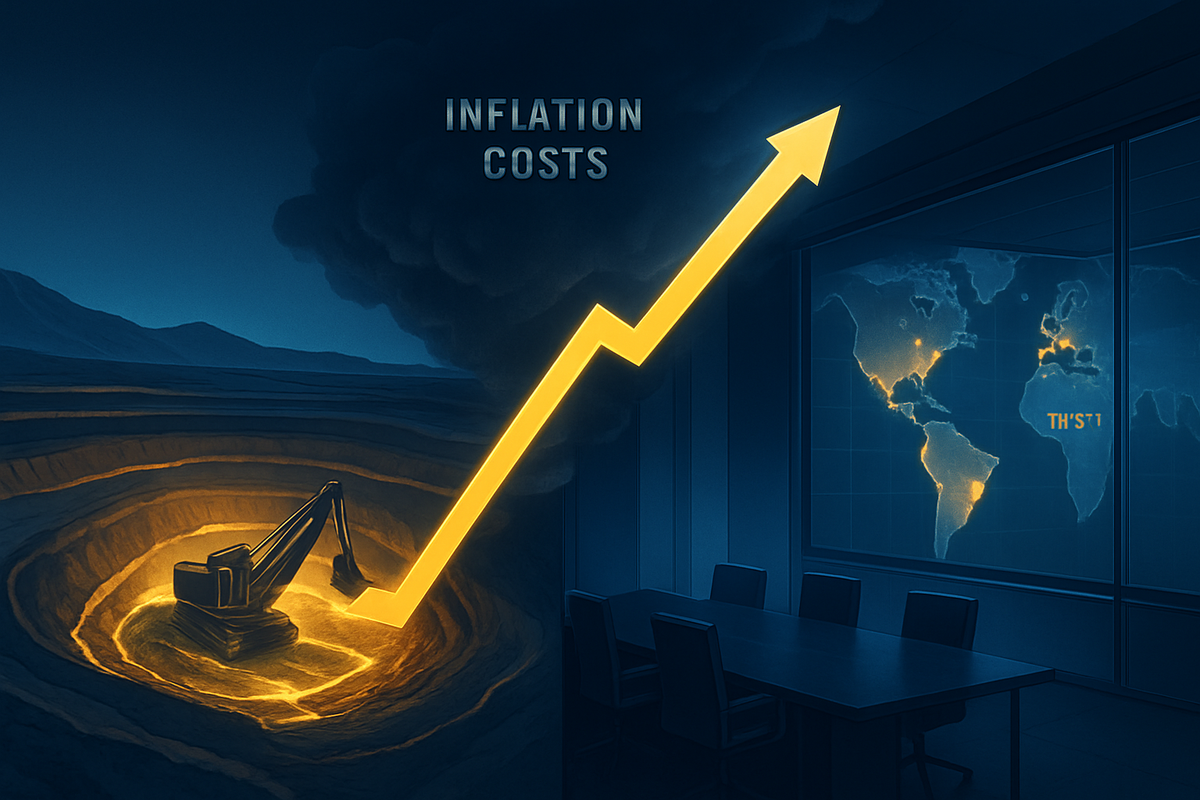
As of March 23, 2026, the gold mining sector is navigating a phenomenon market analysts have dubbed the "Great Decoupling." For the first time in decades, the industry is witnessing a structural break where revenue growth, fueled by record-high bullion prices, is significantly outstripping the persistent cost inflation that plagued the sector in the early 2020s. This shift has fundamentally re-rated the world's largest producers, even as they grapple with maturing assets and shifting geographic priorities.
The current market environment has created a fascinating dichotomy between the two undisputed titans of the industry: Newmont (NYSE: NEM) and Barrick Gold (NYSE: GOLD). While both companies are benefiting from the decoupling, their strategies for 2026 and beyond have diverged. Newmont is hunkering down for a planned "trough year" of production to reset its portfolio, while Barrick is preparing for a radical corporate restructuring that could see its prized North American assets spun off into a new entity.
A Strategic Pivot: Newmont’s Trough Year and the Price of Decoupling
The "Great Decoupling" of 2026 is best illustrated by the widening margins across the sector. With gold prices having established a new floor well above historic averages, the inflationary pressures on labor, energy, and consumables—which once squeezed margins to the brink—have finally been outpaced by top-line growth. However, this windfall has not come without operational challenges. Newmont (NYSE: NEM), the world’s largest gold miner, has officially entered what management describes as a "trough year" for its production cycle.
In its most recent quarterly guidance, Newmont projected a 2026 All-In Sustaining Cost (AISC) of $1,680 per ounce. While this figure is higher than historical norms, it reflects a deliberate strategic choice to prioritize "value over volume." The company is currently engaged in high-stripping phases and intentional mine sequencing at its premier Tier-1 assets, such as the Boddington and Ahafo South mines. This move is designed to clear lower-grade material now to unlock significantly higher-grade ore in 2027 and 2028. Despite the temporary dip in production volume, the "Great Decoupling" ensures that even at $1,680/oz AISC, Newmont’s margin remains robust, providing a safety net that simply didn't exist five years ago.
The market's reaction to this "trough year" has been surprisingly resilient. Historically, a projection of lower production and higher costs would have triggered a sell-off. However, in the 2026 landscape, investors are rewarding Newmont's transparency and its focus on Tier-1 assets—mines capable of producing over 500,000 ounces of gold annually with a life of mine exceeding 10 years. This shift in investor sentiment suggests that the "Great Decoupling" has changed the valuation metrics for the sector, moving from a blind pursuit of ounces to a sophisticated analysis of free cash flow longevity.
Barrick Gold’s Paradox: Production Dips and Price Surges
Across the aisle, Barrick Gold (NYSE: GOLD) is presenting its own set of statistical anomalies. In the closing months of 2025, Barrick reported a sharp 19% drop in production volume. In a traditional market, such a decline would be viewed as a catastrophic operational failure. Yet, in a testament to the power of the current gold bull market, Barrick’s share price surged by 30% over the same period. This paradox highlights the "Great Decoupling" in action: when the price of the underlying commodity rises fast enough, it can more than compensate for dwindling operational output.
Barrick’s leadership has used this financial windfall to accelerate a long-rumored corporate transformation. The company is currently finalizing the details of a North American "NewCo" spin-off. This move would separate Barrick's premier North American assets—including its majority stake in the Nevada Gold Mines joint venture and the Pueblo Viejo mine in the Dominican Republic—into a standalone, US-listed entity. The goal is to eliminate the "geopolitical discount" often applied to Barrick's broader portfolio, which includes significant holdings in Africa and the Middle East, thereby unlocking a higher valuation for its stable, top-tier North American operations.
The proposed spin-off has sparked intense debate among stakeholders. Proponents argue that a pure-play North American gold giant would become the "must-own" stock for conservative institutional investors and pension funds. However, critics point to the logistical complexities and the potential for a legal standoff with Newmont (NYSE: NEM), its partner in Nevada. The tension between these two giants has reached a fever pitch in early 2026, as both companies compete for the same pool of Tier-1 assets and specialized labor in the Great Basin.
The ETF Landscape and the Rise of the Juniors
The divergence between Newmont and Barrick is having a profound impact on the broader investment landscape, particularly through popular exchange-traded funds. The VanEck Gold Miners ETF (NYSE: GDX), which counts both Newmont and Barrick as top holdings, has seen record inflows in the first quarter of 2026. However, the performance of the VanEck Junior Gold Miners ETF (NYSE: GDXJ) has begun to steal the spotlight. As the "Great Decoupling" allows the majors to enjoy super-margins, it has also breathed new life into the junior sector, where smaller players are being aggressively scouted as potential acquisition targets for companies looking to replenish their Tier-1 pipelines.
This trend toward Tier-1 asset focus is not just a corporate buzzword; it is a necessity driven by the increasing difficulty of finding and permitting large-scale deposits. The current cycle has seen a "flight to quality," where investors are shunning marginal mines in favor of massive, long-life assets that can withstand various economic conditions. This has led to a tiered market: the "Haves" (those with Tier-1 assets) are trading at significant premiums, while the "Have-Nots" struggle to attract capital despite the record gold prices.
Furthermore, the "Great Decoupling" is reshaping the competitive landscape for mid-tier producers. Companies that can maintain their AISC below the $1,500 mark while growing production are being re-rated as "mini-majors." This shift is creating a more fragmented industry, as the traditional giants like Barrick and Newmont focus on high-grading their portfolios and spinning off non-core assets, leaving a vacuum that nimble mid-tier firms are eager to fill.
Strategic Risks and the Road Ahead
Looking forward, the remainder of 2026 will be a period of intense strategic maneuvering. For Newmont (NYSE: NEM), the success of its "trough year" strategy hinges on its ability to execute its stripping programs on schedule and transition back to higher-grade zones by early 2027. Any delay in this timeline could test the patience of a market that has so far been willing to look past the current production dip. The company must also navigate a complex labor market, where the demand for skilled miners has led to wage inflation that threatens to eat into those "decoupled" margins.
For Barrick Gold (NYSE: GOLD), the path forward is tied to the successful execution of the "NewCo" spin-off. Beyond the corporate restructuring, Barrick faces the challenge of replenishing its reserves after the 19% production drop seen in late 2025. The company is increasingly looking toward copper as a strategic hedge and growth driver, with major investments in the Reko Diq project in Pakistan. This "gold-plus-copper" strategy is a hedge against the eventual plateauing of gold prices and positions Barrick as a key player in the global energy transition.
The potential for regulatory intervention also looms large. With gold miners reporting record profits while the broader economy struggles with the tail-end of inflation, there are growing whispers of "windfall taxes" in certain jurisdictions. Both Newmont and Barrick have increased their government relations efforts to demonstrate the long-term economic benefits they provide to host communities, arguing that the current high-margin environment is necessary to fund the massive capital expenditures required for the next generation of mines.
A New Benchmark for the Industry
The "Great Decoupling" has fundamentally altered the DNA of the gold mining industry. As Newmont and Barrick navigate their respective paths through 2026, they are setting a new benchmark for how large-scale commodity producers operate in a high-price, high-cost environment. The focus has shifted from simple growth to "quality growth," and from operational scale to financial resilience. The market is no longer satisfied with just "ounces in the ground"; it demands high-margin, Tier-1 production that can generate free cash flow regardless of the broader economic climate.
Investors should maintain a close watch on several key indicators in the coming months. For Newmont, the quarterly AISC figures will be a crucial "health check" on their trough-year progression. For Barrick, any updates on the North American spin-off and the resolution of potential legal disputes with partners will be the primary drivers of volatility. Additionally, the relative performance of GDX vs. GDXJ will provide a signal of whether the market believes the best value lies with the established giants or the aggressive explorers.
Ultimately, 2026 is proving to be a watershed year for gold. The "Great Decoupling" has provided a lucrative window of opportunity, but it has also raised the stakes for management teams. Whether through Newmont’s patient portfolio reset or Barrick’s radical corporate reimagining, the goal remains the same: to turn a finite geological resource into an enduring financial engine.
This content is intended for informational purposes only and is not financial advice