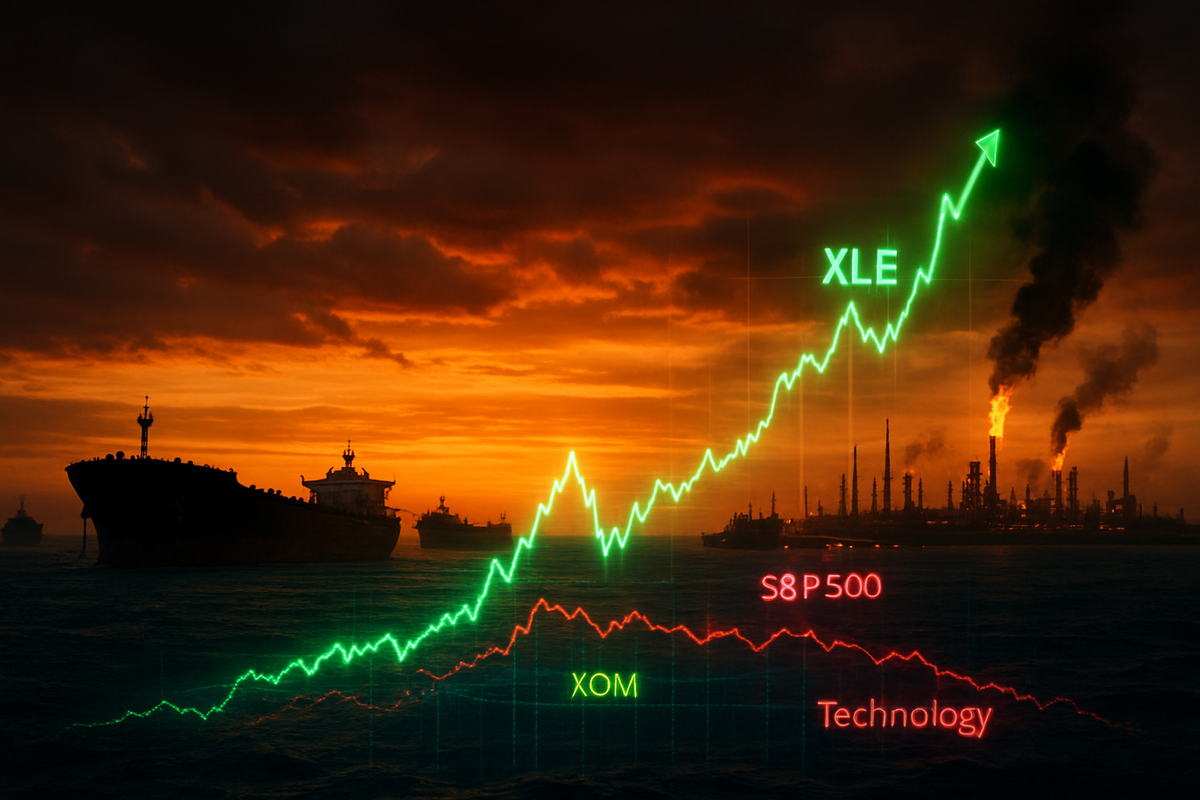
In a dramatic decoupling from the broader markets, the energy sector has emerged as the solitary pillar of strength in the S&P 500 as of March 20, 2026. While the rest of the index grapples with a deepening "Tech Wreck" and renewed inflation fears, Brent Crude oil has surged past the $110 per barrel mark, fueled by a dangerous escalation of military tensions in the Persian Gulf. The rally represents a stark reversal from the low-volatility environment of 2024 and 2025, transforming energy into the market's premier defensive hedge.
The immediate implications are far-reaching: a massive rotation of capital out of high-growth technology and into "hard assets." With the Strait of Hormuz effectively blockaded and global supply chains in disarray, the surge in crude prices is acting as a regressive tax on consumers and a significant headwind for the global economy. As energy giants report record-breaking margins, the broader S&P 500 is facing one of its most challenging quarters in years, highlighting a stark divide between the winners of the commodity super-cycle and the losers of the digital age.
Geopolitics Ignites the Gulf: The Road to $112 Brent
The current crisis traces its roots to late 2025, following the collapse of diplomatic efforts regarding Iran's nuclear program. On September 28, 2025, the "snapback" of UN sanctions was triggered, isolating Tehran and setting a collision course that culminated on February 28, 2026. On that day, a coordinated series of airstrikes—termed "Operation Epic Fury"—was launched by U.S. and Israeli forces against Iranian nuclear and military infrastructure. In swift retaliation, the Islamic Revolutionary Guard Corps (IRGC) initiated a maritime blockade of the Strait of Hormuz, the world’s most vital oil chokepoint through which roughly 20% of global petroleum flows.
As of March 20, 2026, Brent Crude is trading at $112.66 per barrel, a 57% increase over the last 30 days. The market is currently pricing in a "war premium" of nearly $40, as tanker traffic through the Persian Gulf has slowed to a trickle. Over 150 vessels are currently anchored outside the waterway, unable to navigate the minefields and drone-patrolled waters of the Strait. This sudden disruption has forced the International Energy Agency (IEA) to coordinate the largest emergency oil release in history, totaling 400 million barrels, including 172 million from the U.S. Strategic Petroleum Reserve.
The market reaction has been swift and unforgiving. While the S&P 500 has retreated over 5% this month, the Energy Select Sector SPDR Fund has gained over 7%. The "Great Rotation" is no longer a theoretical forecast but a lived reality for traders. Investors who spent years betting on artificial intelligence are now scrambling for exposure to the Permian Basin and offshore drilling, as the scarcity of physical energy assets becomes the dominant theme of the 2026 market landscape.
Winners and Losers: A Tale of Two Economies
The primary beneficiaries of this geopolitical shock are the "Supermajors" and the shipping industry. Exxon Mobil Corporation (NYSE: XOM) and Chevron Corporation (NYSE: CVX) have seen their share prices climb more than 25% year-to-date, buoyed by the prospect of sustained $100+ oil and robust dividend yields. Furthermore, specialized tanker firms like Frontline plc (NYSE: FRO) and Nordic American Tankers Limited (NYSE: NAT) are reaping record revenues as they reroute crude around the Cape of Good Hope, a much longer and more expensive journey that has caused charter rates to skyrocket to levels not seen in a decade.
Conversely, the "losers" list is extensive and led by the formerly invincible technology sector. NVIDIA Corporation (NASDAQ: NVDA), the poster child for the 2024-2025 AI boom, has seen its stock slide roughly 11% from its October peak, as investors grow wary of capital expenditure costs and the "tech wreck" valuation reset. Even Apple Inc. (NASDAQ: AAPL), typically a safe haven, has experienced extreme volatility, suffering a 5% single-day flash crash in mid-February as institutional portfolios rotated into value-oriented energy stocks.
The transport and retail sectors are also under immense pressure. United Airlines Holdings, Inc. (NASDAQ: UAL) and Delta Air Lines, Inc. (NYSE: DAL) have watched their shares tumble between 15% and 20% in the first quarter of 2026, facing an estimated $11 billion annualized fuel headwind. Retail giants like Amazon.com, Inc. (NASDAQ: AMZN) and Target Corporation (NYSE: TGT) are being squeezed from both ends: rising logistics costs for their delivery networks and a reduction in discretionary spending as consumers are forced to pay $4.00 or more per gallon at the pump.
The Broader Significance: A Structural Shift in Global Markets
This event signifies a major pivot in the global economic narrative, shifting from the "disinflation" hopes of 2025 back to the "sticky inflation" fears of the early 2020s. The energy rally has effectively erased market expectations for Federal Reserve interest rate cuts in 2026. Policymakers are now caught in a "stagflationary" trap—rising energy costs are pushing headline inflation higher, while the "Tech Wreck" and higher fuel prices are simultaneously cooling economic growth. This mirrors the oil shocks of the 1970s and 2022, but with the added complexity of a fracturing global trade system.
Historically, sustained oil prices above $110 have been a harbinger of recession. However, the 2026 crisis differs due to the structural under-investment in fossil fuels over the previous decade. This "supply-side" constraint means that even if the blockade were to end tomorrow, the global market would likely remain in deficit. Furthermore, the regulatory environment is shifting; governments that once pushed for rapid decarbonization are now issuing emergency permits for domestic drilling and extending the life of coal and gas plants to ensure national security.
The ripple effects are also being felt in the clean energy space. While high oil prices theoretically make renewables more attractive, the increased cost of raw materials and logistics is hampering the rollout of solar and wind projects. The "Energy Transition" is effectively on pause as Western nations prioritize "Energy Security." This geopolitical reordering is forcing partners like the EU to deepen their reliance on U.S. Liquefied Natural Gas (LNG), further strengthening the hand of North American energy producers at the expense of industrial competitiveness in Europe.
What Comes Next: The Long Road to De-escalation
In the short term, the market's focus will remain squarely on the Strait of Hormuz and the efficacy of the IEA’s massive reserve release. If the 400 million barrels fail to cool prices below $100, we may see the U.S. and its allies consider more direct military "escort operations" for oil tankers, a move that would risk a wider regional war. Strategic pivots are already underway; energy companies are expected to significantly increase their 2026 capex for "short-cycle" production in the U.S. and Guyana to offset the loss of Middle Eastern flows.
The long-term outlook depends on whether this is a temporary spike or a permanent shift in the cost of energy. If the blockade persists through the summer, the "Tech Wreck" could deepen into a broader market contagion, potentially dragging the S&P 500 into a bear market. Market opportunities may emerge in the nuclear energy and "oil field services" sectors, which are poised to benefit from a multi-year effort to diversify supply away from volatile regions.
Potential scenarios range from a diplomatic breakthrough that sees oil return to the $80 range by autumn, to a "worst-case" scenario where damaged infrastructure in Saudi Arabia and Qatar leads to $150 oil and a global recession. For now, the "wait and see" approach has been discarded in favor of aggressive hedging, as the "Energy First" strategy dominates institutional portfolios.
Summary and Investor Outlook
The March 2026 energy rally is a stark reminder that physical commodities still hold the ultimate power over a digital-first global economy. With Brent Crude testing $110 and the energy sector standing as the sole winner in the S&P 500, the narrative of the market has fundamentally changed. The "Great Rotation" from tech to energy is driven by a combination of geopolitical conflict, supply-side scarcity, and a reset of artificial intelligence expectations.
Moving forward, investors should watch for three key indicators: the volume of tanker traffic through the Strait of Hormuz, the impact of the SPR release on headline inflation data, and the Q1 earnings reports from major airlines and retailers. These will reveal the true extent of the "energy tax" on the global consumer. While the energy sector currently offers a safe harbor, the broader market remains vulnerable to the twin threats of energy-driven inflation and a cooling technology sector. The coming months will likely be defined by high volatility and a continued premium on energy security.
This content is intended for informational purposes only and is not financial advice