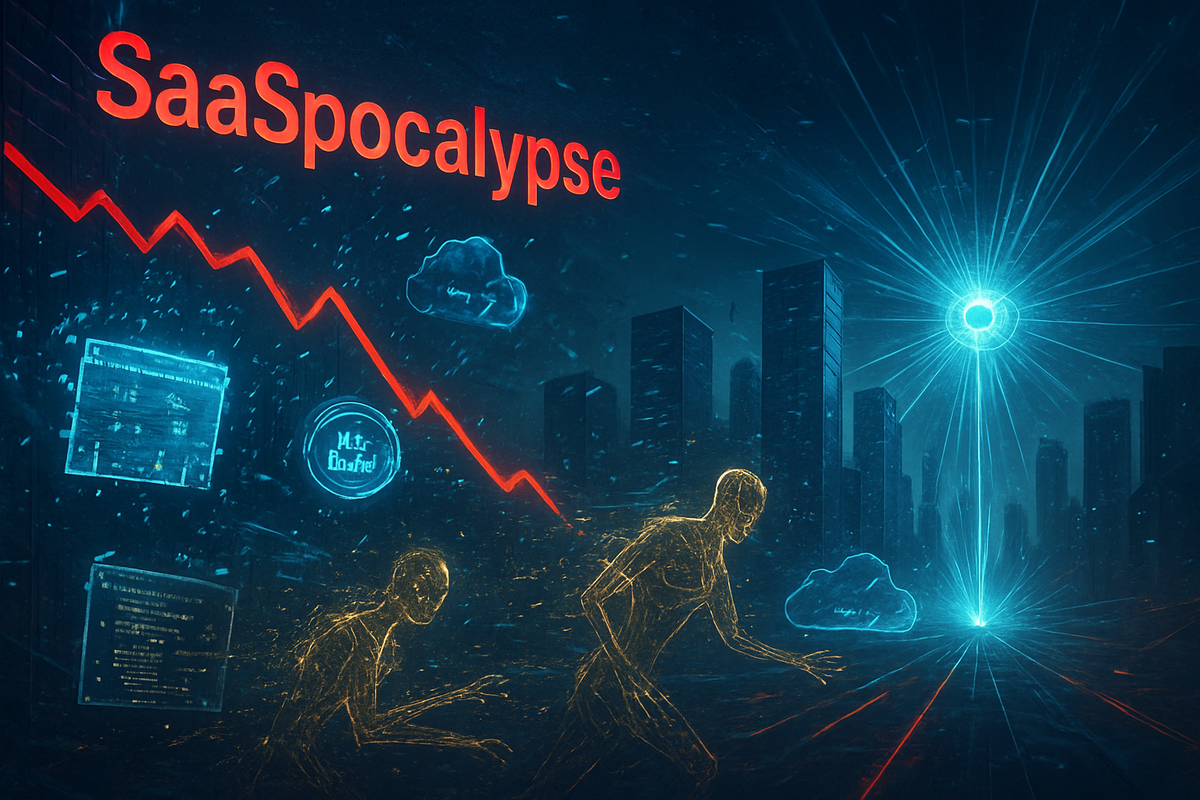
The software-as-a-service (SaaS) sector is reeling from a historic market correction that has wiped over $1 trillion in market capitalization in less than a month. As of February 16, 2026, industry bellwethers Salesforce (NYSE: CRM) and Adobe (NASDAQ: ADBE) have seen their share prices plummet by more than 25% since the start of the year, driven by a paradigm-shifting realization among investors: the traditional "per-seat" business model is under direct assault from autonomous AI agents.
This "Software-mageddon" reached its zenith during the first two weeks of February, following the release of highly capable autonomous agents from Anthropic and OpenAI. These tools, which can perform complex professional tasks with minimal human oversight, have triggered fears of "seat compression"—a phenomenon where companies require significantly fewer human employees, and thus fewer software licenses, to maintain operations. The immediate implication is a fundamental revaluation of the entire software sector, as the metrics that have governed SaaS valuations for two decades are being rewritten overnight.
Black Tuesday and the Rise of the Autonomous Worker
The catalyst for the current rout was "Black Tuesday for Software" on February 3, 2026. On that day, the S&P 500 Software Index saw a staggering 13% one-day drop, its worst performance in history. The sell-off was sparked by the simultaneous launch of Anthropic’s "Claude Cowork" and "Claude Code," alongside OpenAI’s public rollout of its "ChatGPT Agent Mode" (formerly Project Operator). Unlike previous "Copilots" that suggested text or code, these new "agents" are capable of navigating desktop environments, executing multi-step business workflows, and managing entire software development tickets autonomously.
For Salesforce (NYSE: CRM), the impact was immediate. Despite reporting a beat on fiscal Q4 earnings with an EPS of $3.25, the stock fell to a multi-year low of approximately $185 as investors obsessed over declining seat growth. Adobe (NASDAQ: ADBE) faced a similar fate, with shares trading down 23.5% year-to-date. Analysts at Goldman Sachs and Oppenheimer issued rare double-downgrades, citing the "democratization of the creative stack" as AI agents increasingly handle high-end design tasks that previously required expensive Creative Cloud subscriptions.
The timeline leading to this moment began in late 2025, as "Computer-Using Agent" (CUA) models transitioned from research labs to enterprise-ready products. By early 2026, the narrative shifted from "AI as a tool" to "AI as a worker." Market sentiment turned toxic for traditional vendors when reports emerged of mid-sized firms reducing their engineering and administrative headcounts by up to 30%, citing the efficiency gains provided by autonomous agents.
Winners, Losers, and the "Headless SaaS" Pivot
The clear winners in this new era are the "Agentic Infrastructure" providers. Anthropic and OpenAI have effectively become the new operating systems for work. Anthropic’s Claude Code, a CLI-based agent, has reportedly reached a $14 billion revenue run rate, capturing the budgets that were once reserved for junior developer salaries and auxiliary DevOps tools. Similarly, companies like Nvidia (NASDAQ: NVDA), which provide the underlying compute for these agents, continue to see demand decouple from the broader software slump.
On the losing side are the "horizontal" SaaS providers that rely on high-volume seat counts for revenue. Salesforce (NYSE: CRM), ServiceNow (NYSE: NOW), and Workday (NASDAQ: WDAY) are all facing an existential "Productivity Paradox": their tools make employees so efficient that the customers need fewer copies of the software. This has led to the emergence of "Headless SaaS," where the value is no longer in the user interface (UI) or the dashboard, but in the underlying data and API logic. Companies that cannot transition to being the "invisible plumbing" for AI agents risk becoming obsolete.
However, some industry veterans argue that the sell-off is overdone. While "vibe coding"—the ability for non-technical users to build functional apps using natural language—has threatened mid-tier players like Monday.com (NASDAQ: MNDY), established giants still hold massive data moats. The race is now on for these companies to pivot from "per-seat" pricing to "outcome-based" pricing, charging customers for successful tasks completed rather than human logins.
A Structural Shift in the Digital Economy
This event marks the end of the "SaaS Era" as we knew it. For twenty years, the software industry trended toward more users, more seats, and more complexity. The "Agentic Revolution" flips this on its head. We are seeing a move toward "Service-as-a-Software," where the software is the service provider itself. This mirrors the historical transition from manual manufacturing to automated assembly lines; the output remains the same, but the labor required to produce it—and the tools to manage that labor—are fundamentally transformed.
The ripple effects are extending into the labor market and regulatory spheres. Policymakers are already expressing concern over the rapid pace of "seat compression" in white-collar sectors. If the software industry’s value is shifting from human empowerment to human replacement, the social contract of the digital economy may require a total overhaul. This event is being compared to the 2000 dot-com bubble or the 2008 financial crisis, not because of a lack of utility, but because of a massive mismatch between old valuation models and a new technological reality.
The concept of "Vibe Coding" is perhaps the most disruptive trend of all. When a marketing manager can create a bespoke internal CRM in three hours using Claude Cowork, the "moat" of a multi-billion dollar enterprise suite begins to evaporate. This has led to "valuation shocks" for any company that provides "standard" business logic. The industry is realizing that when the cost of creating software drops to near zero, the value must shift to proprietary data and secure execution environments.
The Road Ahead: Adaptation or Obsolescence
In the short term, the market will likely remain volatile as software companies scramble to announce new pricing models. We expect a flurry of "Agentic First" product launches over the next two quarters as Salesforce (NYSE: CRM) and Adobe (NASDAQ: ADBE) attempt to reclaim the narrative. The long-term survivors will be those that can successfully transition to a "pay-per-result" model, effectively becoming AI agencies rather than software vendors.
A potential strategic pivot for these giants will involve aggressive M&A activity. Expect the cash-rich software giants to attempt to acquire "Agentic" startups that specialize in narrow, vertical tasks (e.g., AI-driven legal discovery or autonomous accounting). The market opportunity has not disappeared; it has simply moved from the "seat" to the "outcome." Companies that can prove their AI agents deliver $100 of value for a $10 fee will thrive, regardless of how many humans are clicking buttons.
The ultimate scenario could be a bifurcated market: a few "Titan" platforms that act as the data foundation, and a sea of ephemeral, AI-generated applications that handle specific user needs. The challenge for investors will be identifying which companies can successfully cross this chasm without seeing their margins decimated by the cost of AI inference.
Summary and Investor Outlook
The February 2026 software sell-off is a watershed moment in financial history. It represents the market’s realization that the AI revolution is not just an add-on to existing business models, but a replacement for them. The key takeaways for investors are clear: the "seat-based" growth story is largely over, and "Net Revenue Retention" will now be viewed through the lens of agentic efficiency rather than headcount expansion.
Moving forward, the market will likely reward companies that demonstrate "AI-native" revenue—income derived from autonomous tasks rather than human subscriptions. Watch for a shift in quarterly reporting metrics, as companies begin to disclose "Agentic Work Units" or "Task-Based Billing" figures.
Investors should maintain a cautious stance on traditional SaaS until there is more clarity on the success of these pricing pivots. The coming months will be a period of "creative destruction" where the strongest software firms will reinvent themselves, and the laggards will be replaced by the very agents they helped create. This is not the death of software, but it is certainly the death of software as we have known it for the last two decades.
This content is intended for informational purposes only and is not financial advice.