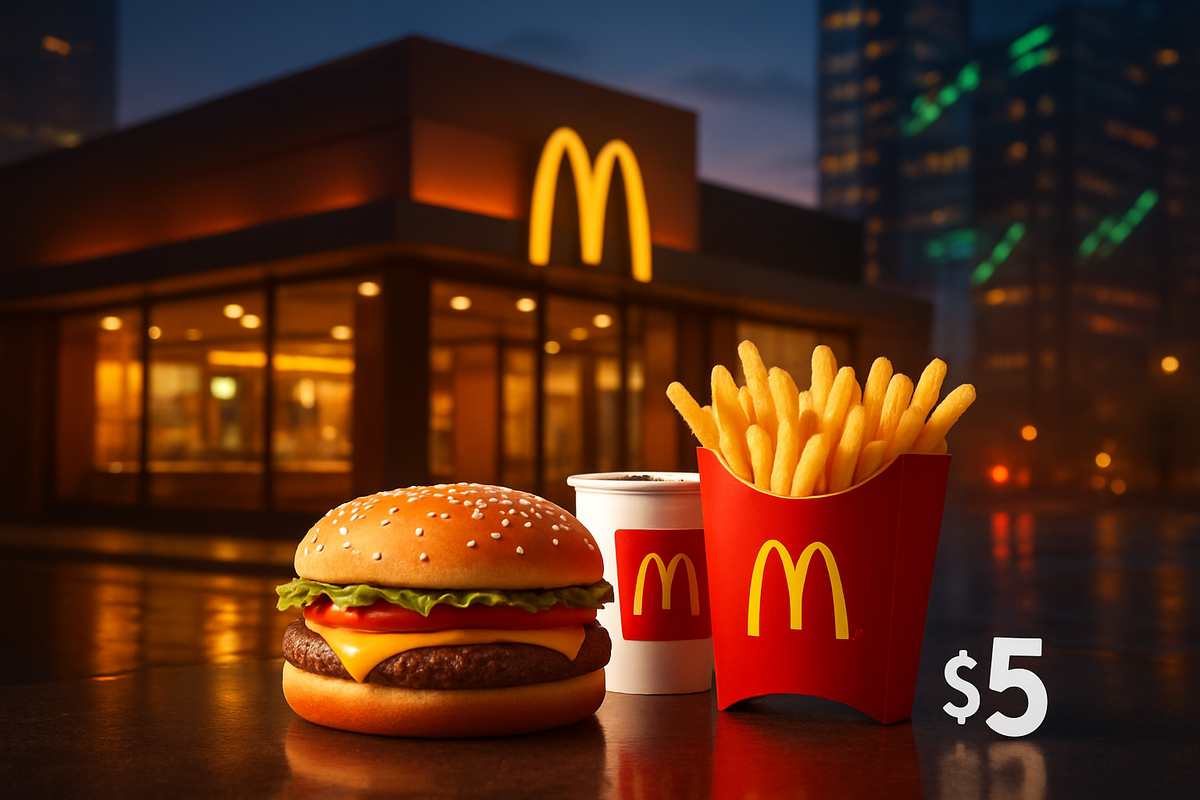
In a decisive victory for the fast-food giant, McDonald’s Corporation (NYSE: MCD) reported a staggering surge in sales this February 2026, marking its most robust growth period in over two years. The Chicago-based chain saw U.S. same-store sales jump 6.8% in the fourth quarter of 2025, a figure that blew past Wall Street’s 4.9% forecast and signaled a major recovery for the brand. The primary engine behind this resurgence? A relentless focus on "deep value," anchored by the permanent expansion of its $5 meal deal, which has successfully lured back price-sensitive consumers who had previously retreated from rising menu prices.
The immediate implications for the broader restaurant industry are profound. McDonald’s results suggest that while inflation is finally "cooling"—with headline CPI hovering near 2.9%—it remains "sticky" enough to dictate consumer behavior. As the gap between the cost of dining out and the cost of groceries continues to widen, McDonald’s has leveraged its massive scale to offer a price floor that competitors are finding increasingly difficult to match. This performance has not only solidified McDonald’s dominance in the quick-service restaurant (QSR) space but has also set off a high-stakes "value war" that is redrawing the map of the American fast-food landscape.
The sales explosion reported on February 11, 2026, was the culmination of a strategic pivot that began in mid-2024. Following a period of "fast-food fatigue," where consumers balked at $12 "value" meals, McDonald's (NYSE: MCD) launched a temporary $5 promotion to regain foot traffic. By early 2025, that promotion evolved into a permanent, multi-tiered "McValue" platform. The success of this platform was evident in the Q4 2025 data, which showed that the $5 bundle—consisting of a McDouble or McChicken, nuggets, fries, and a drink—acted as a powerful "hook" for the low-income demographic (households earning under $45,000).
Timeline-wise, the momentum built throughout late 2025, bolstered by a series of high-impact marketing events. Executives pointed to a "Grinch-themed" meal and the return of the Monopoly promotion in December as catalysts for what they described as the "best sales day in company history." These experiential additions, combined with the core value offering, drove total consolidated revenue to $7.01 billion for the quarter, a 10% year-over-year increase. Adjusted earnings per share reached $3.12, comfortably beating the consensus estimate of $3.05.
Initial market reaction was swift and largely positive. Shares of McDonald's (NYSE: MCD) climbed to a new 52-week high of $333.38 in the wake of the earnings call. Investors were particularly impressed by internal data showing that orders containing the $5 meal bundle often resulted in 12% higher total check amounts, as customers frequently added premium items or digital-only deals to their "value" base. However, some analysts remained cautious, noting that while sales are up, franchisee margins are under pressure due to the heavy mix of discounted items and rising beef costs.
While McDonald’s is taking a victory lap, the competitive landscape is far from uniform. The clear loser in this 2026 value reset has been Wendy’s (NASDAQ: WEN). Despite early attempts to compete with its "Biggie Bag" promotions, the chain struggled to maintain its footing against the Golden Arches’ marketing muscle. Wendy’s reported a devastating 11.3% plunge in U.S. same-store sales for the same period. In a desperate bid to stabilize, the company announced "Project Fresh," a massive restructuring plan that will see the closure of 300 to 350 underperforming U.S. locations in 2026 as it pivots toward higher-traffic suburban sites and automated kitchens.
Conversely, Yum! Brands (NYSE: YUM) has emerged as a resilient co-winner, primarily through the strength of Taco Bell. By leaning into its own "Luxe Value Menu" and digital-first "Saucy Bowls" at KFC, Yum! Brands (NYSE: YUM) saw U.S. same-store sales rise 7%. The company’s "Byte by Yum" AI platform has been a key differentiator, driving nearly 60% of its total sales through digital channels, which allows for highly personalized pricing and promotion delivery that keeps customers coming back.
The middle ground is occupied by Restaurant Brands International (NYSE: QSR), the parent of Burger King. The brand saw a modest 2.6% growth in U.S. sales, falling short of the 3.5% estimate. While its "SpongeBob Movie" tie-in briefly spiked foot traffic, Burger King has been hit harder than its peers by beef inflation, which rose 20% over the last year. This has led to a significant squeeze on franchisee profitability, forcing the chain to lean more heavily on its international segments in Europe and Australia to balance domestic weakness.
The McDonald’s surge is more than just a successful marketing campaign; it is a case study in how the "K-shaped recovery" is manifesting in the American diet. As of early 2026, the economy is defined by a widening "price gap" where the cost of food away from home is rising at nearly double the rate of groceries (4.0% vs. 2.1%). In this environment, even middle-to-high-income consumers are "trading down" from casual dining chains like Darden Restaurants (NYSE: DRI) to more affordable QSR options. This shift has turned McDonald’s (NYSE: MCD) into a defensive play for investors, as the company effectively captures both the value-seeker and the former sit-down diner.
This event also highlights a major shift toward permanent discounting in the industry. The 2024-2025 "Fast Food Fatigue" era taught the industry that temporary promos are no longer enough to sustain loyalty. The move by McDonald’s (NYSE: MCD) and Yum! Brands (NYSE: YUM) to create permanent value platforms suggests a structural change in the QSR business model. Similar to the "dollar menu" wars of the early 2000s, this era is defined by scale; only the largest players with the most sophisticated supply chains can survive on the razor-thin margins that $5 meal deals require.
Furthermore, the surge illustrates the growing threat from an unexpected corner: value grocery stores. Data from February 2026 shows that stores like Aldi are increasingly competing for the "QSR lunch hour" with prepared food sections that undercut even the $5 meal deal. McDonald’s success in this climate proves that brand reliability and speed remain powerful moats, but the proximity of grocery stores to residential and office hubs remains a lingering risk for the entire fast-food sector.
Looking ahead, McDonald’s (NYSE: MCD) is not resting on its laurels. The company has announced an aggressive capital expenditure guidance of $3.9 billion for 2026, targeting the opening of 2,600 new restaurants globally. This "accelerated growth" strategy is designed to further cement its market share before competitors can recover. Short-term, the focus will likely remain on the "McValue" platform, but long-term, the company is expected to pivot more heavily toward "bespoke value"—using its loyalty program data to offer individualized discounts that protect overall margins while maintaining the perception of affordability.
One potential challenge on the horizon is the continued volatility of labor and commodity costs. While inflation is cooling, the "sticky" nature of core prices means that wage pressure is unlikely to abate in 2026. McDonald’s will need to continue its aggressive push into automation and AI-driven ordering to offset these costs. For competitors like Wendy’s (NASDAQ: WEN), the path forward is more fraught; they will need to undergo significant "strategic shrinking" to find a profitable core, potentially ceding even more market share to the "Big Three" of McDonald's, Taco Bell, and Burger King.
The primary takeaway from McDonald’s February 2026 update is clear: in an era of "sticky" inflation, scale is the ultimate weapon. By successfully rebranding itself as the anchor of affordability through the $5 meal deal, McDonald’s (NYSE: MCD) has not only navigated a difficult economic period but has thrived, posting its best numbers in years. The company has effectively re-aligned its brand identity with the needs of a bifurcated consumer base, proving that even a global behemoth can be agile when market conditions shift.
Moving forward, the market will be watching to see if this "value-driven" growth is sustainable or if it will eventually erode the bottom line through franchisee fatigue and margin compression. For investors, the key metric to watch in the coming months will be the "digital mix"—how much of this new traffic is being converted into long-term loyalty members who can be marketed to more efficiently. As the "Value Wars" of 2026 continue, the Golden Arches appear well-positioned to remain the dominant force in a landscape where every dollar counts.
This content is intended for informational purposes only and is not financial advice