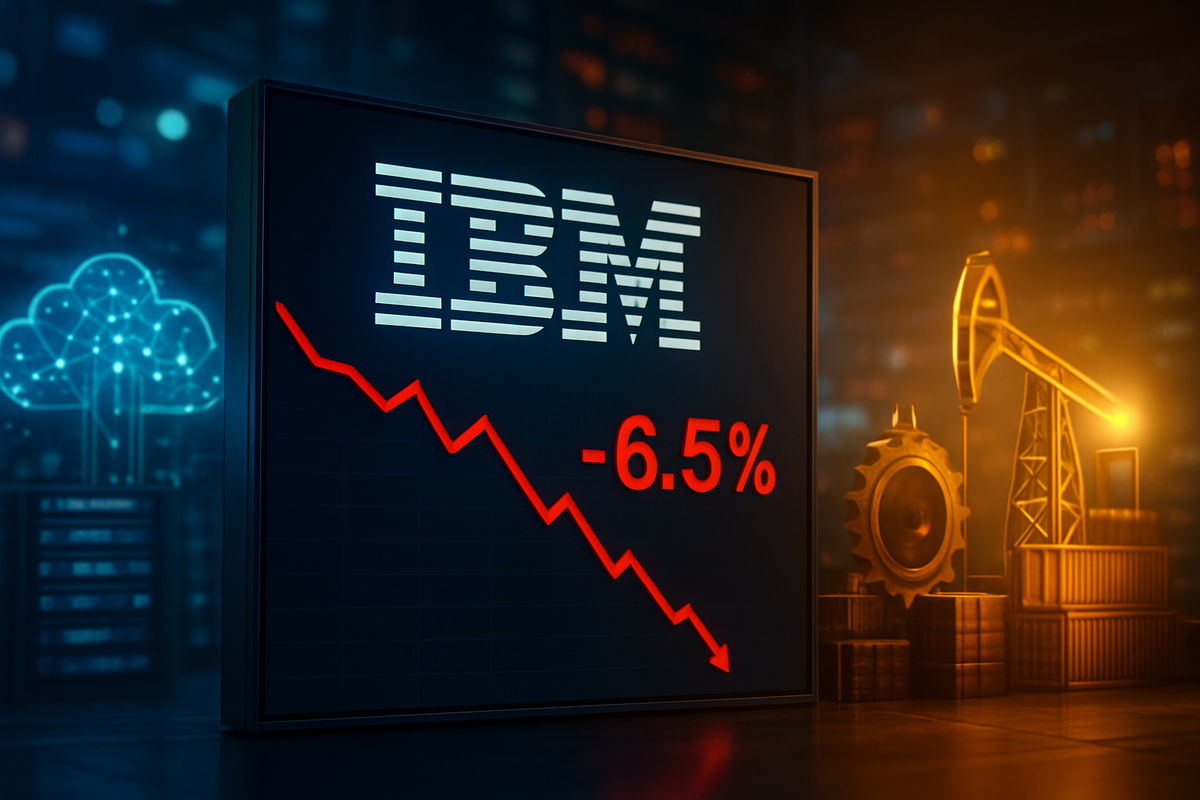
The high-flying momentum of the early 2020s tech recovery hit a significant roadblock on February 12, 2026, as International Business Machines (NYSE: IBM) dominated financial headlines for all the wrong reasons. Shares of the "Big Blue" fell 6.5%, plummeting to a range between $260 and $272, making it the primary laggard of the Dow Jones Industrial Average (INDEXDJX: .DJI). This sharp decline wiped billions in market capitalization and sent a chilling signal through the software and consulting sectors, marking a definitive "sentiment reset" for the "integrated solutions" giant.
The fallout from IBM’s performance is being viewed as more than just a bad day at the office for a single blue-chip firm. It represents a broader pivot in investor psychology—a transition from the exuberant AI experimentation of 2025 to a "prove it" phase in 2026. As markets grapple with the implications of this shift, IBM has found itself at the epicenter of a "Great Rotation," where capital is aggressively migrating away from high-multiple tech giants and into the "Old Economy" value sectors that many investors had previously sidelined.
The 'Prove It' Phase: Anatomy of a Sell-Off
The technical breakdown for IBM began late in the previous session and accelerated through February 12, as the stock sliced through its 50-day moving average. This triggered a wave of algorithmic selling that saw the stock hit an intraday low of $257.21. The primary catalyst appears to be a sudden rationalization of discretionary IT spending among Fortune 500 clients. After a year of massive investment in "Agentic AI" and large language model experimentation, enterprise customers are beginning to pull back, prioritizing immediate return on investment (ROI) over the sprawling, long-term digital transformations that IBM’s consulting arm typically handles.
This spending freeze coincided with a pivotal moment in the company’s strategic timeline: the shareholder vote to approve IBM’s $11 billion acquisition of Confluent Inc. (NASDAQ: CFLT). While the deal was designed to bolster IBM’s data-streaming and real-time AI infrastructure, investors expressed mounting "closing risk" anxieties. The market’s reaction suggests a growing skepticism toward high-premium acquisitions at a time when integration risks are high and the macroeconomic environment is tightening.
Furthermore, IBM’s infrastructure segment—long a stabilizer for the company—is entering a cyclical cooling period for its Z-series mainframes. With the "hardware floor" softening, the pressure shifted entirely to the company's "integrated solutions" stack, which combines its watsonx AI platform with hybrid cloud software and consulting. When several major enterprise clients signaled a pause in these high-margin projects, the lack of a buffer in other segments made the 6.5% drop almost inevitable.
Sector Rotation: Identifying the Winners and Losers
The pain felt by IBM was mirrored across several other enterprise tech staples. As the "AI Capex Fatigue" set in, other "integrated" and SaaS-heavy players like Salesforce (NYSE: CRM), Adobe (NASDAQ: ADBE), and ServiceNow (NYSE: NOW) also saw their valuations compressed. These companies, which had spent the last 18 months convincing the market that AI would be an immediate margin booster, are now facing the same "prove it" mandate from a wary Wall Street.
Conversely, the "Great Rotation" has created a clear set of winners in the "physical reality" sectors. As capital exited IBM and its peers, it flowed rapidly into the Energy Select Sector SPDR Fund (NYSE Arca: XLE) and basic materials stocks. Investors are increasingly looking toward "Old Economy" industrials as a hedge against tech-driven volatility. On the same day IBM fell, energy and industrial components of the Dow saw significant gains, suggesting that the market is prioritizing cash flow and tangible assets over the promise of future AI-driven efficiencies.
Strategic partners and smaller agile competitors may also find an opening. While IBM struggles with the massive task of integrating Confluent and managing its global consulting footprint, niche AI providers that focus on hyper-specific ROI metrics are finding favor with those same Fortune 500 companies that are currently "rationalizing" their broader IBM contracts.
The Significance of Integrated Solutions in a Volatile Market
IBM’s current predicament highlights a fundamental shift in how "integrated solutions" are valued. Historically, the ability to offer a one-stop-shop for software, hardware, and consulting was seen as a moat. However, in the current market of February 2026, this integration has become a double-edged sword. When a company is as deeply embedded in the enterprise stack as IBM, any macro-level decision by a CFO to trim "discretionary" spending ripples through every line of the business simultaneously.
This event echoes historical precedents, such as the tech cooling of 2022, but with a new twist: the AI factor. The market is no longer satisfied with "AI-infused" marketing; it is demanding to see how these tools are reducing costs or driving top-line growth in real-time. The broader industry trend is shifting toward "virtualized efficiency" fatigue, where the cost of running large-scale AI models is being weighed against the actual productivity gains they provide.
Regulatory scrutiny may also play a role in the coming months. As IBM moves forward with the Confluent acquisition, antitrust regulators are expected to look closely at the consolidation of data-streaming assets. The market’s nervous reaction on February 12 partially reflects the fear that a prolonged regulatory battle could tie up capital that IBM desperately needs to reinvigorate its organic growth.
What Comes Next: The Road to Redemption or Further Decline
In the short term, all eyes are on the upcoming U.S. Consumer Price Index (CPI) report. Market participants are currently in a "risk-off" posture, and a hotter-than-expected inflation reading could exacerbate the rotation out of tech laggards like IBM. For Big Blue to regain its footing, the company will likely need to provide a more transparent roadmap for the Confluent integration and demonstrate that its consulting pipeline is not just pausing, but re-tooling for a more ROI-focused client base.
Long-term, IBM’s survival as a Dow leader depends on its ability to prove that its "integrated solutions" model can thrive in a post-hype AI world. This may require a strategic pivot away from broad-spectrum consulting toward more specialized, high-impact AI implementations that offer clear, measurable value within a single fiscal year. The "Agentic AI" era promised a world where AI could act on behalf of the enterprise; now, IBM must prove it can act on behalf of its shareholders.
Market Outlook and Final Thoughts
The 6.5% drop in IBM stock on February 12, 2026, serves as a stark reminder that even the most established names are not immune to shifts in market sentiment. The primary takeaway for investors is that the "AI honeymoon" is officially over. The market is now in a disciplined phase where capital is being reallocated to sectors with proven resilience and away from those with high "execution risk" in the tech space.
Moving forward, the Dow’s performance will likely be dictated by whether this rotation into value is a temporary hedge or a long-term structural shift. Investors should watch the upcoming earnings reports from other enterprise software giants to see if the "spending rationalization" IBM experienced is a company-specific issue or a systemic contagion. For now, IBM remains the primary barometer for the health of the enterprise tech sector—and currently, that barometer is pointing toward a period of turbulence.
This content is intended for informational purposes only and is not financial advice