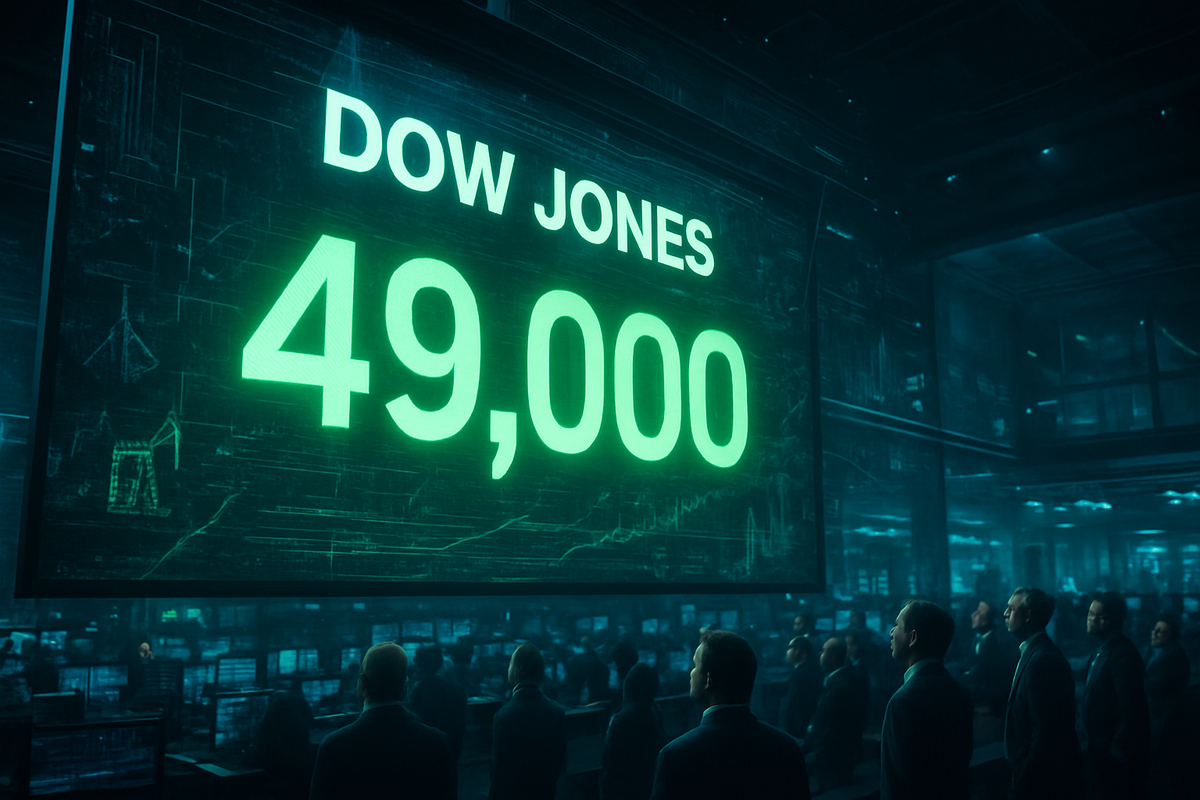
In a stunning display of market resilience, the Dow Jones Industrial Average (DJIA) crossed the historic 49,000 threshold on January 6, 2026, marking a new pinnacle for the "Blue-Chip Renaissance" that has defined the early days of the year. This psychological and technical breakout signals a significant broadening of the market rally, as investor capital rotates out of speculative growth and into the industrial heavyweights that anchor the American economy. The move has placed the elusive 50,000 mark—once considered a distant dream—firmly within the sights of Wall Street analysts for the first quarter of 2026.
The immediate implications of this milestone are profound, as the Dow’s performance is no longer being carried solely by the "Magnificent Seven" technology giants. Instead, a surge in energy, financials, and heavy industrials has provided the index with a sturdier, more diversified foundation. This breakout above 49,000 has triggered a "magnet effect," drawing in institutional and retail "FOMO" (Fear Of Missing Out) capital as the market anticipates the final push toward the 50,000 "Holy Grail."
The Venezuela Catalyst and the Path to 49,000
The climb to 49,000 was punctuated by a dramatic geopolitical catalyst known as the "Venezuela Shock." On January 3, 2026, news broke that U.S. forces had successfully captured Venezuelan President Nicolás Maduro, an event that ignited a massive rally in the energy and industrial sectors. Investors immediately began betting on a total reconstruction of Venezuela's oil infrastructure, a move expected to benefit U.S. engineering firms and energy giants. This geopolitical shift provided the final momentum needed to push the Dow past its previous resistance levels.
The timeline leading to this moment began in late 2025, a year characterized by a "soft landing" that transitioned into a "sustained expansion." Despite a 43-day government shutdown in the fourth quarter of 2025, the Dow hit 45,000 in December, proving the market's underlying strength. Throughout 2025, the Federal Reserve executed three strategic rate cuts, bringing the federal funds rate into a neutral range of 3.50% to 3.75%. This liquidity, combined with corporate earnings growth projected at 12–15% for 2026, created the perfect environment for the January breakout.
Market reaction has been overwhelmingly bullish, with trading volume on the New York Stock Exchange hitting its highest levels since the 2024 AI boom. Institutional desks are reporting a massive "rebalancing" as portfolios move toward value-oriented Dow components. The sentiment is a far cry from the narrow tech-led rallies of 2023; today’s market is characterized by a "physical world" optimism where tangible productivity gains from AI implementation are finally hitting the bottom lines of 100-year-old companies.
Winners and Losers in the Blue-Chip Renaissance
The biggest winners of the 49,000 breakout are the companies leading the "Agentic AI" revolution and those poised to benefit from global infrastructure shifts. Chevron (NYSE: CVX) saw its stock price surge following the Venezuela news, as analysts anticipate the company taking a lead role in revitalizing South American oil fields. Similarly, Goldman Sachs (NYSE: GS) has emerged as a primary beneficiary of the 2026 rally; with interest rates stabilizing, the dormant M&A (mergers and acquisitions) and investment banking landscape has roared back to life, driving the firm's earnings to record highs.
In the technology sector, Microsoft (NASDAQ: MSFT) remains a central pillar of the Dow’s strength. Unlike the speculative fever of 2024, Microsoft’s 2026 performance is driven by the "true inflection" of AI monetization, with its Azure AI services and Copilot integrations becoming standard operating procedures for the Fortune 500. On the industrial side, Caterpillar (NYSE: CAT) and Honeywell (NASDAQ: HON) have seen significant margin expansion. These companies have successfully integrated "Physical AI" into their manufacturing and supply chains, allowing them to trade at higher multiples than their historical averages.
Conversely, some "pure-play" speculative AI firms that failed to demonstrate clear paths to profitability in 2025 are losing ground as the market demands tangible results. Healthcare giant UnitedHealth (NYSE: UNH) has also seen a dramatic turnaround; after a difficult 2025 plagued by regulatory probes and high medical costs, the company successfully integrated AI-driven claims processing to stabilize its margins, earning a "Buy" rating from major analysts as it helps pull the Dow higher.
Broadening the Horizon: AI Implementation and Global Shifts
The Dow’s ascent to 49,000 fits into a broader industry trend of "AI Implementation" over "AI Speculation." In 2024 and 2025, the market was focused on who was building the chips; in 2026, the focus has shifted to who is using them to drive efficiency. This shift has profound ripple effects on global competitors, as American blue-chip firms are now demonstrating productivity gains that are outpacing their international counterparts. The "Blue-Chip Renaissance" suggests that the U.S. economy is entering a period of high-efficiency growth that could last for the remainder of the decade.
Historically, milestones like 40,000 (hit in May 2024) served as confidence boosters, but 49,000 is viewed as a technical gateway. Comparisons are being made to the late 1990s, though analysts argue the current rally is more sustainable due to the "neutral" interest rate environment and more reasonable P/E ratios among the Dow’s industrial components. However, regulatory eyes are beginning to sharpen; as these blue-chip giants become more efficient through AI, policy discussions regarding labor displacement and data privacy are expected to intensify in the coming months.
The Federal Reserve’s role cannot be overstated. By moving to a neutral stance in late 2025, the Fed signaled that the era of "fighting inflation" had transitioned into an era of "supporting expansion." This policy shift has allowed the Dow to flourish without the constant fear of a "higher-for-longer" interest rate regime, though the upcoming transition of the Fed Chairmanship in May 2026 remains a looming variable.
The Road to 50,000 and Beyond
Looking ahead, the primary focus for the market is the psychological hurdle of 50,000. While the short-term outlook remains bullish, the second quarter of 2026 is expected to bring increased volatility due to the "Powell Transition." With Fed Chair Jerome Powell’s term set to expire in May 2026, investors are bracing for potential shifts in monetary policy depending on his successor. Strategic pivots will be required for companies that have relied on cheap debt, as the "neutral" rate of 3.5% is likely the new floor for the foreseeable future.
Market opportunities are emerging in the "reconstruction" trade, particularly for companies involved in global energy and infrastructure. However, the challenge for the Dow will be maintaining this momentum if earnings growth fails to meet the high expectations set by the 49,000 valuation. A "consolidation phase" is likely after the 50,000 mark is breached, as investors look to lock in profits from the historic 2025-2026 run.
Final Assessment: A Milestone of Resilience
The Dow hitting 49,000 is more than just a number; it is a testament to the resilience of the American corporate sector and its ability to adapt to a post-inflationary, AI-integrated world. The key takeaways for investors are the broadening of the rally beyond tech and the importance of "Physical AI" in driving the next leg of market growth. The 2026 rally has proven that the "Old Economy" is far from obsolete; rather, it is being reinvented through technological integration.
As we move forward, the market’s health will depend on the stability of the Federal Reserve leadership and the continued realization of AI-driven productivity. Investors should watch for the Q1 2026 earnings season to see if the fundamental data supports these record-breaking valuations. While the path to 50,000 seems clear, the real test will be the market's ability to hold those gains in the face of leadership changes and geopolitical shifts later this year.
This content is intended for informational purposes only and is not financial advice.