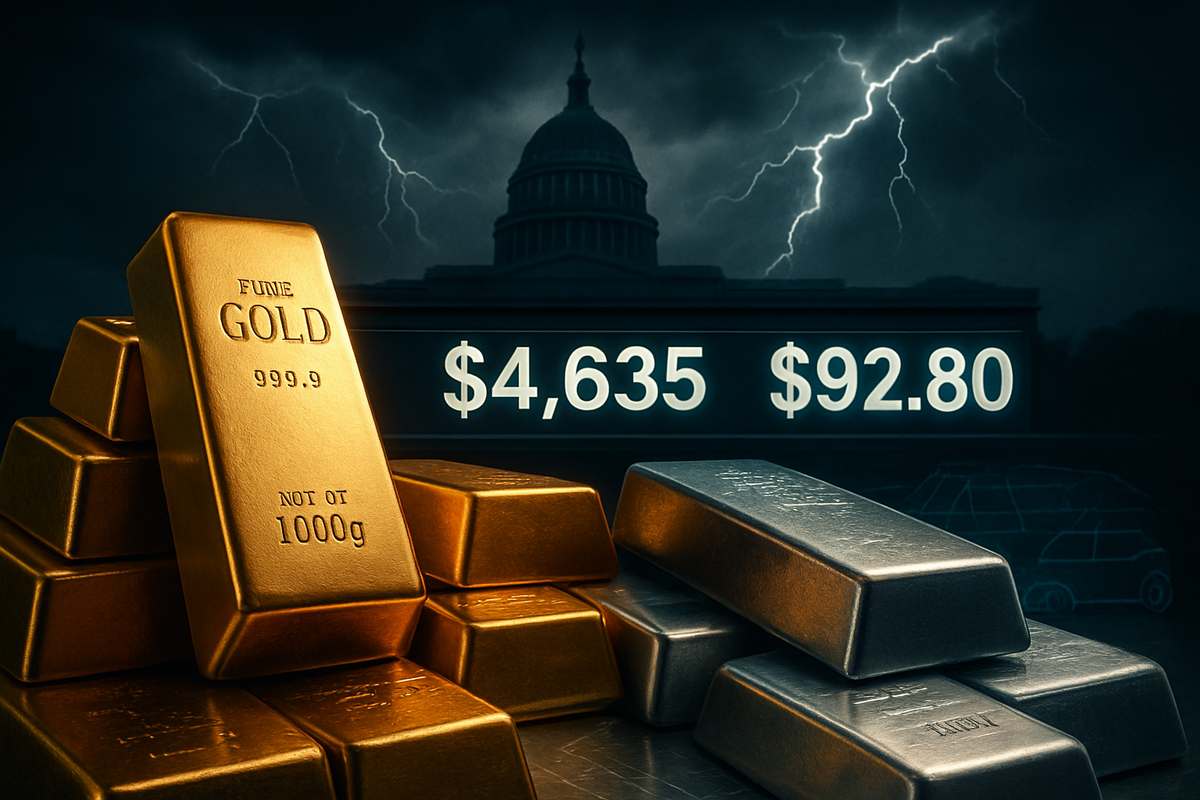
The global financial landscape reached a fever pitch in the first two weeks of 2026, as the "safety trade" transformed into a full-scale rush for hard assets. Gold prices shattered all previous records to settle at a staggering $4,635 per ounce, while silver—long considered the "poor man's gold"—has undergone a violent repricing, hitting $92.80 per ounce. These moves represent a historic shift in capital allocation, as investors flee from traditional fiat currencies and sovereign debt in the face of an unprecedented institutional crisis in the United States and escalating military tensions abroad.
The immediate implications are profound: a massive transfer of wealth is currently underway from industrial consumers to resource holders. While the broader equity markets have shown signs of fatigue, the precious metals sector is experiencing a "super-cycle" event. For the average consumer, this surge is manifesting as heightened inflation in high-tech goods, while for central banks, it is a validation of the multi-year shift toward de-dollarization. As the Federal Reserve finds itself caught between a political firestorm and a weakening currency, the market’s verdict is clear: the era of "cheap" silver and "stable" gold is officially over.
A Perfect Storm: The Path to the Record Highs
The ascent to these record levels was catalyzed by a "black swan" event involving the Federal Reserve. In mid-January 2026, the U.S. Department of Justice opened a criminal investigation into Fed Chair Jerome Powell, ostensibly over a $2.5 billion renovation of the Fed’s Washington headquarters. However, the market quickly interpreted this as a political maneuver to compromise the Fed’s independence and force aggressive interest rate cuts to juice the economy ahead of the 2026 midterms. This loss of institutional trust triggered a massive "flight to safety," with the SPDR Gold Shares (NYSE Arca: GLD) seeing record-breaking daily inflows as the dollar's status as a stable reserve was called into question.
Geopolitical instability has provided the necessary fuel for this fire. The first half of January 2026 saw a series of alarming events: the U.S. intervention in Venezuela to secure oil reserves, a diplomatic fracture within NATO over the "Greenland Crisis," and intense domestic unrest in Iran that has threatened regional stability. These flashpoints have embedded a massive risk premium into gold. Simultaneously, silver has benefited from a structural supply squeeze. Effective January 1, 2026, China implemented strict export licenses for refined silver, effectively cutting off a significant portion of the global supply overnight. This "silver squeeze" pushed the metal into perpetual backwardation, where spot prices trade higher than futures, signaling a desperate scramble for physical metal.
Winners and Losers: Mining Giants vs. Industrial Giants
The primary beneficiaries of this price explosion have been the major miners, who are now operating with the highest margins in the history of the industry. Newmont Corporation (NYSE: NEM) has seen its stock cross the $110 mark, reporting record quarterly free cash flow of over $1.6 billion. Similarly, Barrick Gold Corporation (NYSE: GOLD) has emerged as a top performer, with its share price surging nearly 180% since the start of 2025. Agnico Eagle Mines Limited (NYSE: AEM) also hit new all-time highs of $201.95, as its low-risk jurisdictional profile in Canada and Australia becomes increasingly attractive to institutional investors.
On the silver side, Pan American Silver Corp. (NASDAQ: PAAS) and First Majestic Silver Corp. (NYSE: AG) have seen their valuations skyrocket as silver approached $100. However, the "silver lining" for miners is a dark cloud for industrial users. The solar industry is currently reeling, with silver now accounting for nearly 30% of total solar cell production costs. While First Solar, Inc. (NASDAQ: FSLR) has gained a competitive edge because its thin-film technology does not require silver, silicon-based panel manufacturers are struggling to stay profitable. In the automotive sector, Tesla, Inc. (NASDAQ: TSLA) is facing significant margin pressure, as a standard electric vehicle requires up to 50 grams of silver. Elon Musk has described the price surge as a threat to the clean energy transition, forcing the company to pivot toward "thrifting" and the use of copper-based substitutes that are not yet ready for mass production.
Wider Significance: De-dollarization and the Critical Minerals Pivot
This event marks a turning point in global monetary history. The relentless central bank buying seen throughout 2025 has culminated in a reality where 95% of central banks now expect to increase their gold reserves further. This is no longer just a hedge against inflation; it is an active move toward a multi-polar reserve system. The "de-dollarization" trend, led by the BRICS+ nations and even some traditional U.S. allies, has created a permanent floor for gold prices, regardless of Federal Reserve policy.
Furthermore, the U.S. Geological Survey’s recent decision to add silver to the "Critical Minerals" list has fundamentally changed the regulatory landscape. By categorizing silver alongside lithium and cobalt, the government has signaled that silver is no longer just a precious metal, but a strategic asset essential for national security and the AI-driven industrial revolution. This policy shift is expected to trigger federal subsidies for domestic mining and recycling, potentially sparking a new mining boom in North America as the West seeks to decouple its silver supply chain from China.
The Road Ahead: Targets and Scenarios
In the short term, technical analysts are eyeing the psychological level of $5,000 for gold and $100 for silver. With the Federal Reserve under immense pressure to cut rates despite sticky inflation, real yields are likely to remain deeply negative, providing further oxygen for the rally. However, a "strategic pivot" may be required for the mining sector. As prices stay elevated, the risk of windfall profit taxes or nationalization in volatile jurisdictions increases. Companies will need to prioritize jurisdictional safety over pure ore grade to maintain investor confidence.
Market participants should also watch for the "Red Metal Revolution"—the accelerated push to replace silver with copper in industrial applications. While silver’s conductivity is unmatched, the current price point of $92.80 is making even the most expensive copper-plating processes look economical. If the industrial sector successfully "thrifts" its way out of silver dependency, we could see a decoupling where gold remains high on monetary concerns, but silver begins to track more closely with industrial supply and demand.
Wrapping Up: The New Reality for Investors
The surge of gold to $4,635 and silver to $92.80 is the definitive financial event of early 2026. It represents a confluence of monetary distrust, geopolitical fragmentation, and a genuine physical shortage of the metals that power the modern world. The key takeaway for investors is that the "old rules" of the gold market—where prices moved inversely to the dollar or interest rates—have been superseded by a new regime of strategic accumulation and resource nationalism.
Moving forward, the market will be characterized by extreme volatility as the tug-of-war between industrial demand and monetary hedging continues. Investors should keep a close eye on the ongoing investigation into the Federal Reserve, as any further erosion of central bank independence will likely send gold toward the $5,000 mark. In this environment, physical ownership and high-quality mining equities remain the preferred vehicles for wealth preservation. The "Golden Age" is here, but it brings with it a complexity and cost that the global economy is only beginning to understand.
This content is intended for informational purposes only and is not financial advice