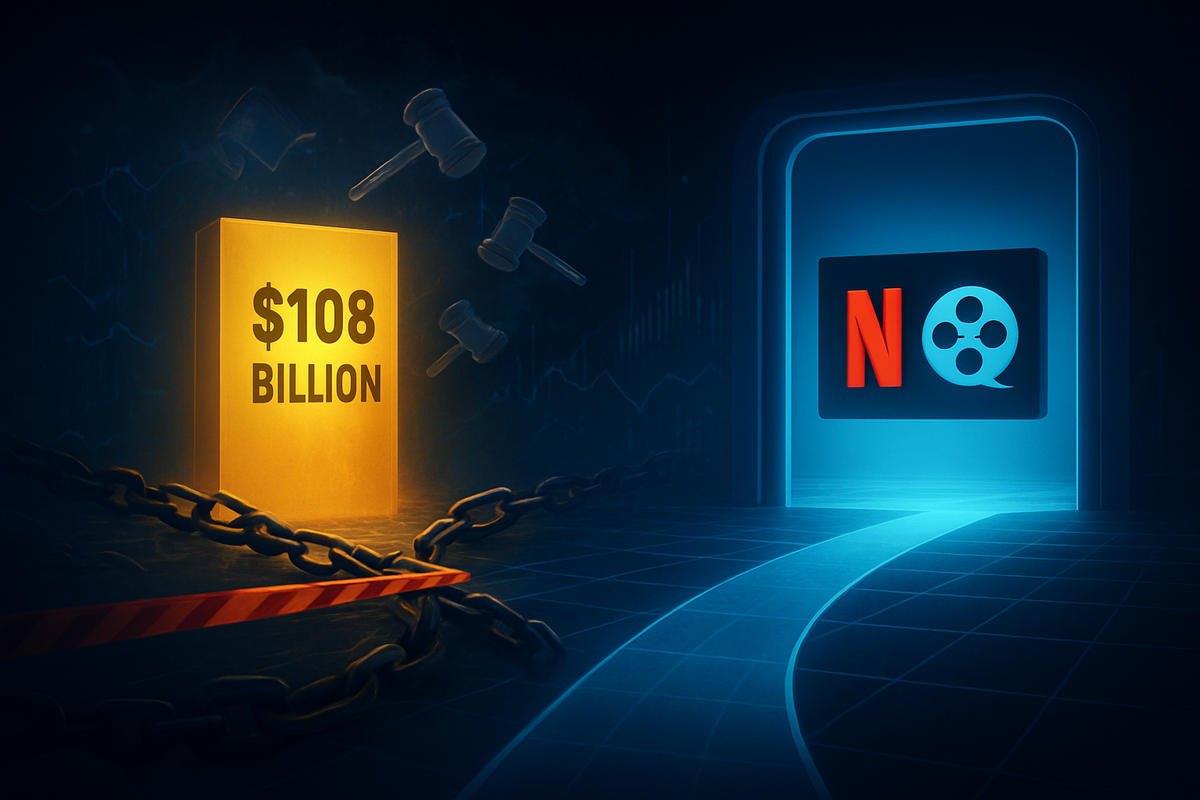
In a move that has sent shockwaves through the media and entertainment landscape, the board of Warner Bros. Discovery (Nasdaq: WBD) has officially rejected a massive $108 billion hostile takeover bid from the newly formed Paramount Skydance Corporation (Nasdaq: PSKY). Instead, the board has signaled its intent to proceed with a smaller, $82.7 billion strategic merger with Netflix (Nasdaq: NFLX). This decision marks a definitive turning point in corporate M&A, where "deal certainty"—the high probability of a transaction actually clearing regulatory hurdles and closing—has officially eclipsed the traditional goal of securing the highest headline price for shareholders.
The implications of this preference are profound for U.S. business leaders and investors. As of January 13, 2026, the marketplace has transitioned into an era where boards are increasingly wary of "phantom premiums." These are high-value offers that come attached to years of regulatory litigation and the risk of eventual collapse. By choosing Netflix over the larger Paramount Skydance offer, WBD is betting that a leaner, more certain path to consolidation is worth forgoing a $25 billion price difference, prioritizing long-term operational stability over immediate, yet risky, capital gains.
The Battle for the Studio: A Timeline of Strategic Rejection
The current standoff is the culmination of a two-year saga that began in late 2023, when WBD CEO David Zaslav first explored a merger with then-Paramount Global. By February 27, 2024, WBD had famously "put pencils down" on those talks, citing a "very high bar" for M&A and a need to manage its $40 billion debt load. However, the landscape shifted dramatically in August 2025 when Skydance Media, backed by the Ellison family and RedBird Capital, successfully completed its acquisition of Paramount Global to form Paramount Skydance Corporation.
Flush with capital and a mandate to scale, Paramount Skydance CEO David Ellison launched a hostile tender offer for WBD in late 2025. The bid offered WBD shareholders a staggering 40% premium over their trading price at the time. Yet, on January 5, 2026, the WBD board formally rejected the overture. The board’s rationale was pointed: they argued that a merger with Paramount Skydance would create a "legacy-heavy behemoth" that would face insurmountable antitrust challenges from the Department of Justice (DOJ), given the overlapping linear television networks and film studio assets. Conversely, the proposed deal with Netflix is seen as a "vertical integration" play that combines WBD’s massive content library with Netflix’s industry-leading distribution infrastructure, a structure regulators have historically viewed more favorably.
Winners and Losers in the Fight for Content Supremacy
The primary winner in this shift is undoubtedly Netflix (Nasdaq: NFLX). If the $82.7 billion deal proceeds, Netflix will transform from a pure-play streamer into a legacy-backed powerhouse, securing the HBO, CNN, and Warner Bros. Pictures brands. For Netflix, the "certainty" of this deal stems from its investment-grade balance sheet and the lack of traditional broadcast assets, which drastically reduces the risk of a blocked transaction.
On the losing end is Paramount Skydance Corporation (Nasdaq: PSKY), which now finds itself in a precarious position. Despite its superior cash offer, the company is being treated as a "regulatory pariah" due to its existing debt and the heavy concentration of linear TV assets it already holds. For PSKY shareholders, the rejection highlights the "conglomerate discount" of the modern era; having more assets is no longer an advantage if those assets prevent you from participating in the next wave of consolidation. Meanwhile, WBD shareholders are split. While some are frustrated by the rejection of the $108 billion bid, institutional investors appear to be siding with the board, fearing that a protracted legal battle with the DOJ over a PSKY merger would leave WBD’s stock "dead money" for years.
The Global Shift Toward Deal Certainty
This event is not an isolated incident but the centerpiece of a broader industry trend that has defined 2024 and 2025. Following high-profile merger collapses like the JetBlue and Spirit Airlines deal and the Adobe-Figma breakup, corporate boards have internalized a "once bitten, twice shy" philosophy. The current regulatory climate has introduced a "chilling effect" where the length of the review process is seen as a business risk in itself. A deal that takes 24 months to close can lead to "deal fatigue," employee turnover, and the strategic paralysis of the target company.
Historically, boards were legally pressured to take the highest offer to fulfill their fiduciary duty to shareholders. However, the WBD/Netflix case study demonstrates a growing legal consensus that "value" includes the probability of closure. This shift represents a return to strategic discipline, where the quality of the partner and the cleanliness of the deal structure are weighted as heavily as the per-share price. In the current environment, a "clean" $80 billion deal is increasingly viewed as superior to a "messy" $100 billion deal.
What Comes Next: The Proxy Battle and Potential Pivots
The immediate future will likely be dominated by a scorched-earth proxy battle. Paramount Skydance has already indicated it will attempt to bypass the WBD board by appealing directly to shareholders with a tender offer, arguing that the board is failing its fiduciary duty. Investors should expect a flurry of litigation in the coming weeks as both sides fight over the definition of "superior value." If PSKY cannot break the board's resolve, they may be forced to pivot, potentially looking toward smaller, niche acquisitions or accelerating their divestiture of linear assets to clear their own regulatory path.
For WBD and Netflix, the goal is speed. By filing for regulatory approval before the end of Q1 2026, they hope to present a "fait accompli" to the market. Strategic pivots may involve WBD selling off non-core assets, such as its gaming division or specific cable channels, to further reduce the regulatory "surface area" and ensure the Netflix merger faces as few hurdles as possible.
The Bottom Line for Investors
The WBD-Paramount-Netflix triangle serves as a definitive playbook for the 2026 M&A market. The key takeaway is that the "highest bidder" no longer carries the day automatically. In a world of aggressive antitrust enforcement and high interest rates, deal certainty is the new currency. The market is now pricing in the "regulatory risk premium," and companies with clean balance sheets and minimal competitive overlap are trading at a significant advantage in the M&A arena.
Investors should watch for two critical indicators in the coming months: the specific language used by the DOJ in its initial response to the WBD/Netflix filing, and the voting behavior of WBD's largest institutional holders. If the Netflix deal gains momentum, it will likely trigger a wave of similar "certainty-first" mergers across the tech and healthcare sectors. For now, the message to business leaders is clear: if you want to win the deal, make sure you can close it.
This content is intended for informational purposes only and is not financial advice.