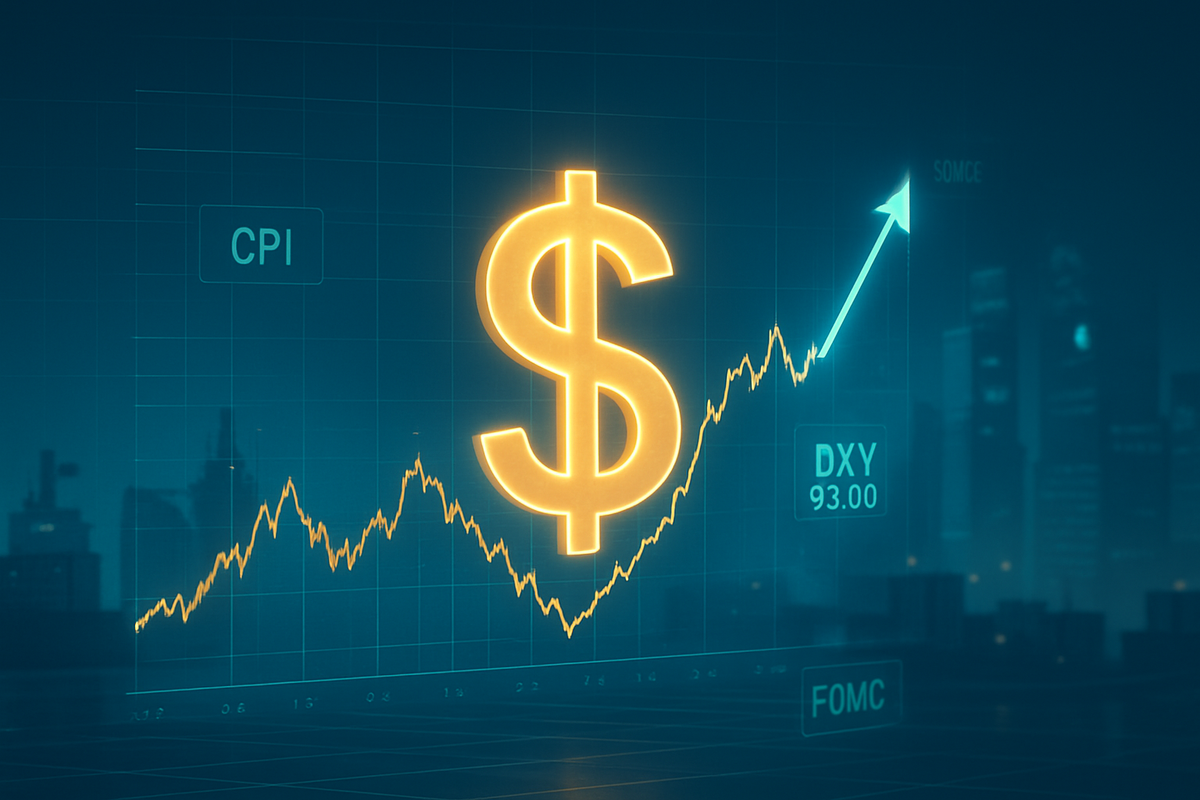
As of January 13, 2026, the United States dollar has staged a commanding recovery, asserting its dominance in global currency markets following a period of high volatility throughout late 2025. This resurgence comes as fresh Consumer Price Index (CPI) data, released this morning, indicates that domestic inflation remains "sticky," complicating the Federal Reserve's path toward further interest rate cuts. With the US Dollar Index (DXY) hovering near the 99.00 mark, investors are recalibrating their portfolios in anticipation of upcoming "Fedspeak" and critical retail sales figures due later this week.
The greenback’s "check-mark" trajectory in early 2026 reflects a broader "US exception" narrative. While global growth appears to be cooling, the American economy continues to show signs of underlying strength, propped up by significant fiscal stimulus and a labor market that refuses to buckle. However, this renewed strength is a double-edged sword, offering a shield against imported inflation while simultaneously creating significant headwinds for American multinational corporations operating in a high-interest-rate environment.
The January Resurgence: Sticky Inflation and a Hawkish Pause
The primary catalyst for the dollar’s robust start to 2026 was today’s CPI report, which showed headline inflation rising 2.7% year-over-year in December 2025. While this represents a significant cooling from the peaks of previous years, it matched November’s gain and remains stubbornly above the Federal Reserve’s 2% target. Core CPI, which excludes the volatile food and energy sectors, held steady at 2.6%, driven largely by persistent shelter costs and the initial "tariff passthrough" effects from recent trade policy shifts. This data has effectively silenced calls for an aggressive rate-cutting cycle in the first half of the year.
The Federal Reserve, led by Chair Jerome Powell, is currently maintaining a "Hawkish Pause," with the federal funds rate held in a range of 3.50% to 3.75%. Market participants are now parsing every word from Fed officials—the so-called "Fedspeak"—for clues on the central bank's next move. Current sentiment suggests that the FOMC is in a "wait and see" mode, prioritizing price stability over immediate economic stimulus. This stance has bolstered the dollar, as the yield on the 10-year Treasury remains elevated at approximately 4.2%, attracting global capital seeking both safety and return.
The timeline leading to this moment has been defined by the implementation of the "One Big Beautiful Bill" (OBBB) Act, a massive fiscal package that has injected liquidity into infrastructure and corporate incentives. While the OBBB Act has supported industrial growth, it has also contributed to the inflationary pressures that are now forcing the Fed to remain vigilant. The market's reaction has been one of "broadening participation," where the S&P 500 and Dow Jones Industrial Average have reached new all-time highs, yet the strong dollar remains a persistent variable that analysts are watching closely.
Winners and Losers: The Multinational Translation Trap
For U.S.-based multinationals, the dollar’s recovery is presenting a complex set of challenges. Heavyweights like Apple Inc. (NASDAQ: AAPL) and Microsoft Corp. (NASDAQ: MSFT) are bracing for "translation drags." As these tech giants generate a vast portion of their revenue in foreign currencies, a stronger dollar means those earnings are worth less when converted back into USD for quarterly reporting. This currency headwind could potentially lead to missed earnings estimates in the coming quarters if the greenback continues its upward march.
Similarly, export-dependent firms such as Boeing Co. (NYSE: BA) face competitive disadvantages on the global stage. A strong dollar makes American-made aircraft and heavy machinery more expensive for international buyers compared to their foreign counterparts. Conversely, companies like Walmart Inc. (NYSE: WMT) and The Coca-Cola Company (NYSE: KO) have been more proactive, utilizing sophisticated dynamic hedging frameworks to mitigate currency volatility. Walmart, in particular, is benefiting from the dollar's strength as it lowers the cost of imported goods, potentially boosting margins as they cater to a consumer base that is increasingly seeking value.
On the winning side of this trend are domestic-focused small-cap stocks. The Russell 2000 Index (NYSEArca: IWM) has seen a surge of 4.6% in early January. These companies typically generate the bulk of their revenue within the United States, making them less susceptible to international currency fluctuations. Investors are pivoting toward these smaller players as they look to capitalize on the domestic economic resilience fueled by the OBBB Act without the exposure to the "translation trap" plaguing the mega-cap tech sector.
Wider Significance: Tariffs, Trends, and the Powell Transition
The current strength of the dollar fits into a larger geopolitical and economic shift toward protectionism and fiscal dominance. The implementation of new trade tariffs has created an inflationary floor that the Fed is finding difficult to breach. Historical precedents, such as the dollar surges of the mid-1980s and the post-2016 period, suggest that while a strong currency can curb inflation, it often leads to widening trade deficits and tension with trading partners. The current environment is no different, as emerging markets feel the squeeze of dollar-denominated debt becoming more expensive to service.
Furthermore, the "value-seeking" behavior observed in recent retail data suggests that the American consumer is reaching a plateau. Despite robust holiday spending, the record use of "Buy Now, Pay Later" (BNPL) programs indicates that credit reliance is at an all-time high. This consumer fragility, combined with the "higher-for-longer" interest rate environment, creates a delicate balance for policymakers. Any misstep in the Fed's communication could trigger a sharp reversal in market sentiment.
The elephant in the room remains the leadership transition at the Federal Reserve. Chair Jerome Powell’s term is set to expire in May 2026, and the uncertainty surrounding his successor is already beginning to influence market pricing. Tension between the Fed and the executive branch regarding interest rate levels has introduced a layer of political risk that hasn't been seen in decades. Investors are increasingly looking at the dollar as a barometer for the central bank’s independence in a high-stakes election and policy cycle.
The Road Ahead: Potential Scenarios and Strategic Pivots
In the short term, all eyes are on the upcoming retail sales figures. If spending remains resilient despite the shift toward value, the dollar could see another leg up, potentially testing the 100.00 level on the DXY. However, if retail data misses expectations, it might provide the Fed with the "cooling" evidence needed to justify a rate cut in late Q1 or early Q2. Strategic pivots are already underway in the corporate world, with many CFOs increasing their currency hedges and shifting supply chains to domestic sources to avoid tariff-related costs.
Looking toward the second half of 2026, the dollar’s path remains bifurcated. Some analysts project a softening toward 94.00 as the global economy stabilizes and the Fed finally enters a more accommodative phase. Others argue that the inflationary nature of the OBBB Act and persistent trade tensions will keep the dollar structurally strong for years to come. The "tariff peak" expected in Q2 2026 will be a critical junction; if the passthrough to consumers is higher than anticipated, the Fed may be forced to abandon rate cuts entirely, a scenario that would likely send the greenback to multi-year highs.
Wrap-Up: Navigating the 2026 Greenback Rally
The recovery of the US dollar in early 2026 is a testament to the underlying resilience of the American economy, but it also serves as a warning of the complexities ahead. The combination of "sticky" inflation, fiscal expansion via the OBBB Act, and a cautious Federal Reserve has created a market environment where "good news is bad news" for those hoping for lower rates. For investors, the takeaway is clear: the era of easy money has been replaced by a period of structural shifts where currency volatility will play a defining role in portfolio performance.
Moving forward, the market will remain hyper-sensitive to "Fedspeak" and any signs of consumer fatigue. The resilience of the greenback has provided a buffer for the US against global instability, but it has also placed a ceiling on the growth of many of its most iconic companies. Investors should watch for the upcoming retail sales report and the Fed’s next "dot plot" for confirmation of the dollar’s long-term trajectory. In this "resilient but cautious" market, the greenback is once again the anchor—for better or for worse.
This content is intended for informational purposes only and is not financial advice.