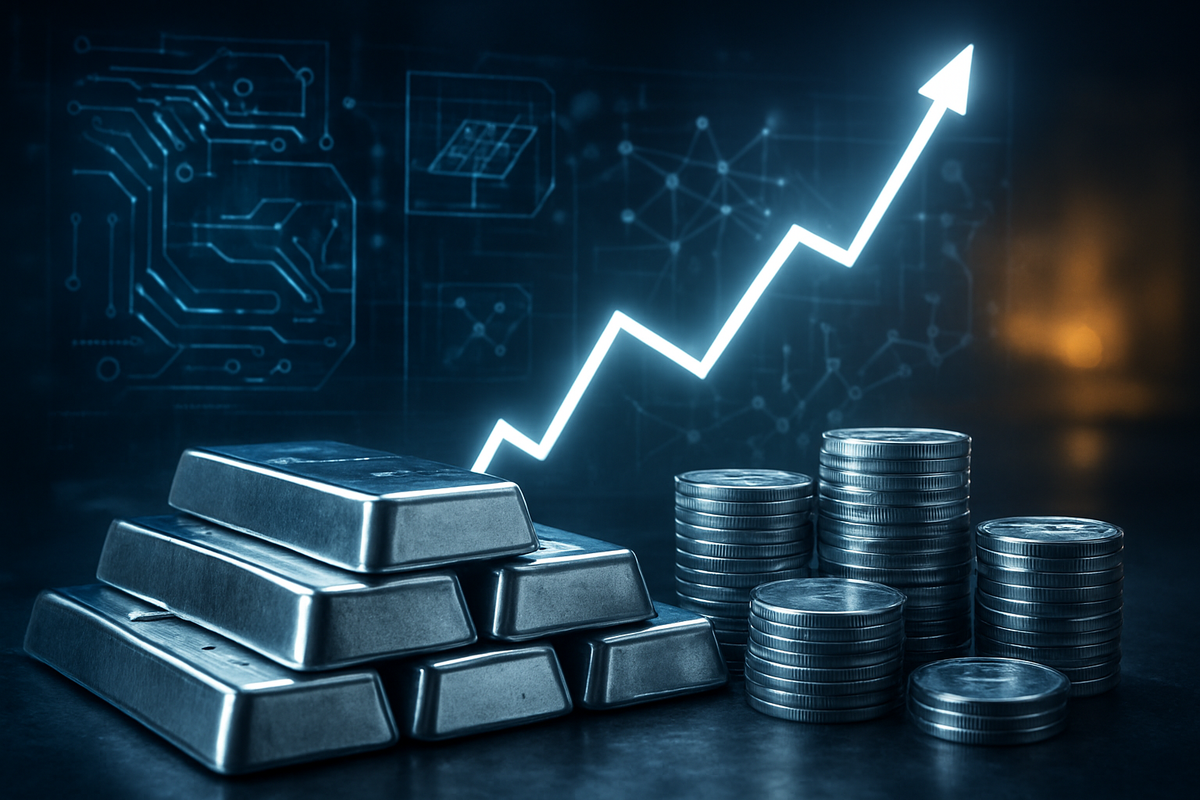
As of January 12, 2026, the global financial markets are witnessing a historic realignment in the precious metals sector. Silver, long dismissed as "poor man’s gold," has shattered all-time nominal records, trading at a staggering $84.50 per ounce. This represents a year-to-date gain of over 18% in just the first two weeks of January, following a blockbuster 2025 in which the metal surged by nearly 150%. While gold has also enjoyed a significant rally, its gains have been dwarfed by silver’s explosive ascent, which is being fueled by a "perfect storm" of structural supply deficits and a sudden, intense convergence of industrial and geopolitical pressures.
The immediate implications of this rally are profound, touching everything from the cost of renewable energy infrastructure to the balance sheets of major technology firms. For the first time in decades, the gold-to-silver ratio—a key metric for metal traders—has compressed to 57:1, down from the extreme 100:1 levels seen as recently as early 2025. This rapid narrowing suggests that silver is no longer merely shadowing gold’s movements as a safe-haven asset; instead, it has emerged as a critical strategic commodity, essential to the dual pillars of the 2026 economy: the green energy transition and the global expansion of Artificial Intelligence (AI) infrastructure.
The Perfect Storm: A Timeline of the Ascent
The journey to $84 silver began in earnest during the final quarter of 2025, sparked by a series of geopolitical shocks and a worsening supply-demand imbalance. In October 2025, silver prices first crossed the psychologically significant $50 mark, a level not seen since the Hunt Brothers’ era or the 2011 peak. The momentum accelerated in December following a dramatic escalation of tensions in South America, specifically the U.S.-led operation that resulted in the capture of Venezuelan leader Nicolás Maduro. This event reignited safe-haven buying across the globe, as investors fled to hard assets amid fears of regional instability and potential disruptions to broader commodity flows.
Simultaneously, the industrial side of the equation reached a breaking point. In late 2025, China, a dominant player in silver production and refining, imposed strict new export licenses on the metal, citing the need to "protect local surplus" for its own burgeoning solar and EV industries. This effectively choked off a significant portion of the global supply to Western markets just as demand from the AI sector began to peak. High-performance data centers, which have seen a massive construction boom throughout 2025, require silver for specialized electrical contacts and thermal management systems, adding a new, high-growth layer to the metal's traditional industrial profile.
The reaction from institutional players has been one of controlled panic. Major silver ETFs, such as the iShares Silver Trust (NYSE: SLV), have seen record inflows, even as physical inventories in London (LBMA) and Shanghai have plummeted to multi-decade lows. The Silver Institute reported a final 2025 supply deficit of 117 million ounces, the fifth consecutive year of shortfalls. This chronic underinvestment in new mining capacity has left the market unable to respond to the sudden price spike, as bringing new silver mines online typically requires a five-to-ten-year lead time.
Central banks and monetary policy have added further fuel to the fire. Throughout late 2025, the Federal Reserve faced intense scrutiny and a "crisis of independence" following public friction with the executive branch and a high-profile investigation into Fed leadership. This instability, combined with cooling U.S. labor data released in early January 2026, has cemented market expectations for aggressive interest rate cuts. In a low-yield environment, the opportunity cost of holding silver—which pays no dividend—vanishes, making it an irresistible target for both speculators and conservative wealth managers.
Winners and Losers: The Corporate Impact
The primary winners of this historic rally are the "pure-play" miners who have maintained high exposure to silver prices. First Majestic Silver (NYSE: AG) has seen its stock price more than triple over the last 12 months, as it remains one of the few large producers deriving over half of its revenue from the metal. Similarly, Pan American Silver (NYSE: PAAS) and Hecla Mining (NYSE: HL) have reported record-breaking quarterly earnings, allowing them to aggressively increase dividends and fund the expansion of existing brownfield projects. Streaming and royalty companies like Wheaton Precious Metals (NYSE: WPM) are also reaping massive rewards, benefiting from the price surge without the direct burden of rising energy and labor costs that plague traditional miners.
On the other side of the ledger, the "losers" are found among the heavy industrial users who can no longer ignore the soaring cost of their raw materials. Solar panel manufacturers are feeling the most acute pain. For companies like JinkoSolar (NYSE: JKS) and Longi Green Energy (SSE: 601012), silver paste is an irreplaceable component of high-efficiency photovoltaic cells. With silver now accounting for nearly 15% of total module production costs—up from just 5% two years ago—these firms are facing a brutal margin squeeze. Many have been forced to announce price hikes for their panels, potentially slowing the pace of the global energy transition.
The automotive and consumer electronics sectors are also under pressure. Tesla (NASDAQ: TSLA) and other EV manufacturers utilize between 25 and 50 grams of silver per vehicle for power management and safety systems. In early January 2026, analysts began downgrading several EV stocks, citing the "silver tax" as a major headwind to achieving price parity with internal combustion engines. Meanwhile, tech giants like Apple (NASDAQ: AAPL) and Samsung Electronics (KRX: 005930) are grappling with rising costs for the specialized connectors and circuits used in their latest AI-integrated devices, leading to warnings of "material-driven inflation" for upcoming product cycles.
Finally, the broader manufacturing sector is seeing a shift in capital allocation. Companies that once ignored silver costs are now investing heavily in "thrift" technologies—researching ways to replace silver with copper or other less conductive materials. However, these technological pivots take years to implement at scale. In the short term, firms that failed to hedge their silver requirements in 2024 or early 2025 are now being forced to buy at record highs to maintain production, leading to a significant divergence in profitability between the "hedged" and "unhedged" players in the electronics and green energy space.
Wider Significance: A New Era for Hard Assets
The 2026 silver rally is more than just a commodity spike; it is a symptom of a broader shift in the global economy toward "hard asset" dominance. For decades, the world relied on a surplus of cheap raw materials to fuel the digital revolution. That era appears to have ended. The current silver squeeze highlights the fragility of global supply chains for critical minerals, drawing parallels to the lithium and cobalt spikes of the early 2020s, but with far wider implications due to silver’s dual role as both an industrial necessity and a monetary asset.
This event also signals a potential "de-dollarization" of the commodities market. With China restricting exports and the U.S. facing internal monetary turmoil, the pricing of silver is increasingly being influenced by the Shanghai Gold Exchange rather than just the COMEX in New York. This shift in the center of gravity for precious metals pricing could have long-term ripple effects on how all commodities are traded and settled, potentially leading to a more fragmented global trade environment where "strategic reserves" of metals become as important as petroleum reserves.
Historically, silver rallies have often been the "tail end" of a bull market in precious metals, but the 2026 surge feels fundamentally different because of the industrial scarcity. Unlike the speculative bubble of 1980, the current demand is driven by physical necessity—you cannot build a 5G network, an AI server, or a high-efficiency solar farm without silver. This "inelastic demand" means that traditional price-driven demand destruction is not happening as quickly as economists expected. Instead, we are seeing a "scramble for supply" that mirrors the historical precedents of wartime economies.
From a policy perspective, the rally is likely to trigger a new wave of government intervention. We are already seeing calls in the U.S. and Europe for "Strategic Silver Reserves" to protect domestic green energy and defense industries. Regulatory bodies may also step in to investigate the extreme volatility in the futures markets, as the disconnect between the "paper" silver market and the "physical" market reaches a breaking point. This could lead to stricter margin requirements for traders and a fundamental restructuring of how precious metals ETFs are allowed to operate.
What Comes Next: $100 Silver and the Copper Pivot
Looking ahead, the market is bracing for a period of extreme volatility as it attempts to find a sustainable "new normal." In the short term, many analysts believe silver could test the $100 per ounce mark before the end of the first quarter of 2026, especially if geopolitical tensions in South America or Eastern Europe escalate further. However, such a rapid ascent carries the risk of a sharp technical correction if industrial users successfully implement "thrifting" measures or if a global economic slowdown reduces overall manufacturing output.
In the long term, the silver market will likely require a massive increase in recycling and "urban mining" to meet demand. We can expect to see companies specializing in the recovery of precious metals from e-waste and decommissioned solar panels become major players in the materials sector. Strategically, mining companies may pivot toward more aggressive exploration in politically stable jurisdictions, even if the ore grades are lower, as the high price of silver makes previously uneconomical deposits suddenly viable.
The most significant scenario to watch is the potential for "silver-to-copper" substitution. If silver remains above $80 for an extended period, the incentive for the solar and electronics industries to switch to copper-based metallization will become overwhelming. While copper is a less efficient conductor and requires more complex manufacturing processes, the sheer cost difference could force a technological leap. If this transition occurs faster than expected, it could lead to a dramatic "demand cliff" for silver in the late 2020s, though the current consensus is that such a shift is still several years away from being viable at scale.
Summary and Market Outlook
The record-breaking silver rally of early 2026 marks a turning point for the commodity markets, as the "Devil’s Metal" finally steps out from the shadow of gold. Driven by a rare convergence of a massive supply deficit, a revolution in AI and green energy, and a crumbling trust in traditional fiat currencies, silver has proven itself to be the indispensable asset of the mid-2020s. The rally has created a clear divide between the mining "winners" who are awash in cash and the industrial "losers" who are struggling to maintain margins in an era of expensive raw materials.
Moving forward, the market will remain highly sensitive to two main factors: the pace of China’s export policies and the stability of the U.S. dollar. Investors should keep a close eye on inventory levels at major exchanges and any announcements from tech giants regarding the "thrifting" of silver in their hardware. While the current price of $84 per ounce may seem high by historical standards, the structural reality of a 100-million-ounce annual deficit suggests that the days of "cheap silver" are firmly in the past.
The lasting impact of this rally will be a fundamental repricing of risk in the technology and energy sectors. Companies can no longer take the availability of critical minerals for granted, and the "just-in-time" supply chain model is being replaced by a "just-in-case" strategy of hoarding and strategic stockpiling. As we move through 2026, silver will continue to be the primary barometer for both industrial health and geopolitical anxiety, making it the most important ticker for investors to watch in the coming months.
This content is intended for informational purposes only and is not financial advice.