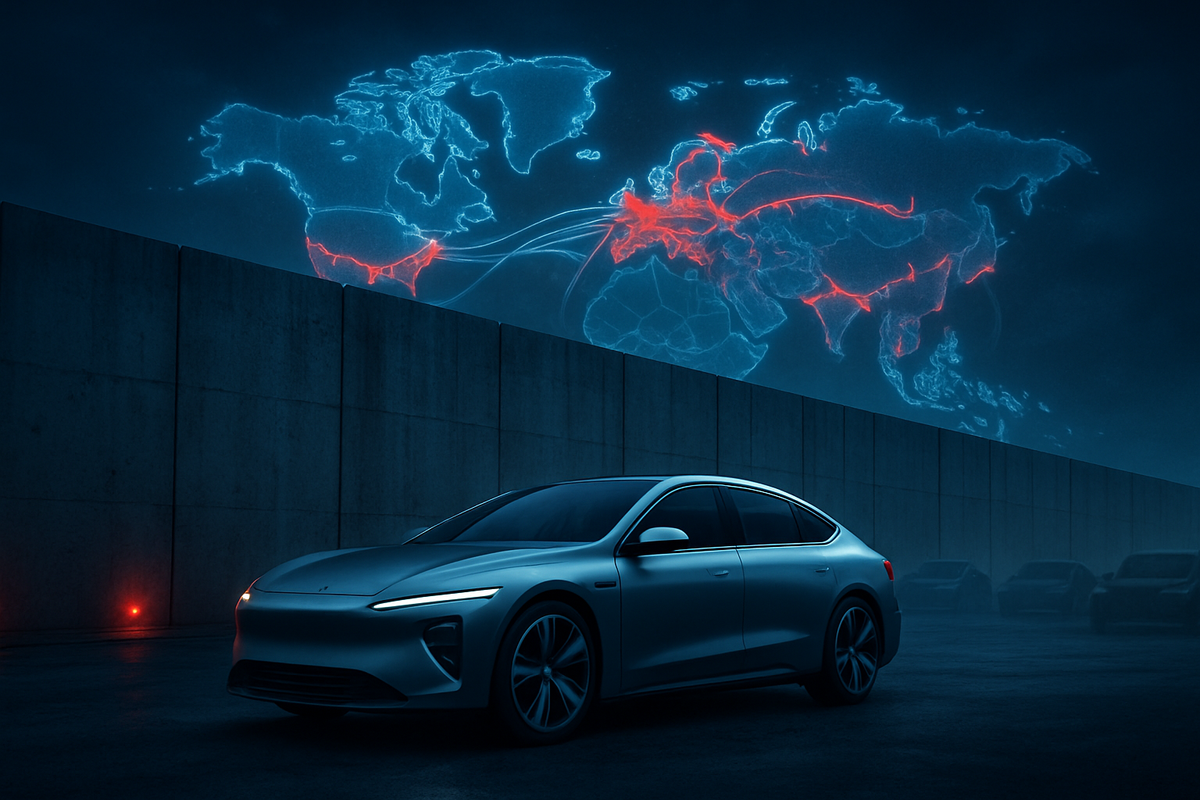
As the calendar turns to January 1, 2026, the global electric vehicle (EV) market finds itself in the grip of what analysts are calling the "Survival Phase." Despite reporting record-breaking delivery numbers for December 2025, Nio Inc. (NYSE: NIO) remains a lightning rod for the volatility currently defining the sector. The Chinese premium EV maker, once hailed as a "Tesla killer," is now navigating a fragmented global landscape where punitive tariffs and the sudden dismantling of U.S. consumer incentives have fundamentally rewritten the rules of international expansion.
The immediate implications are stark: while Nio’s operational momentum is surging—driven by its new mass-market sub-brands—its stock price continues to languish near $5.00, roughly 25% above its 2025 lows but a far cry from its historical peaks. This disconnect between record sales and depressed valuations highlights a market that is no longer rewarding growth at any cost. Instead, investors are laser-focused on how these companies can survive a "tariff-first" world where the 100% duties in the U.S. and definitive duties in the European Union have forced a total rethink of the global EV supply chain.
The 2025 Pivot: Record Deliveries Meet Trade Barriers
The past year was a study in contrasts for Nio. On January 1, 2026, the company reported a record 48,135 vehicles delivered in December 2025, bringing its annual total to 326,028 units—a 46.9% increase over 2024. This growth was largely fueled by the successful scaling of its "Onvo" family brand and the "Firefly" premium small-car line. However, this domestic success has been overshadowed by the "de facto ban" in the United States, where 100% tariffs on Chinese-made EVs remain firmly in place. Furthermore, the EU’s definitive duties, ranging from 17% to 35.3%, were finalized in late 2024, forcing Nio to pivot from a direct-sales model to a "lighter asset" strategy in Europe, partnering with local distributors like the Nic. Christiansen Group to mitigate costs.
The timeline leading to this moment was marked by escalating trade tensions. Throughout 2025, the U.S. administration expanded its protectionist stance, implementing 25% tariffs on non-EV lithium-ion batteries and natural graphite. This move was designed to decouple Western supply chains from China but has instead resulted in a "waiting room" effect in Mexico. In 2025, Chinese EV imports into Mexico exploded by over 2,000%, as manufacturers like Nio and BYD Company (OTC: BYDDF) established beachheads in Latin America while waiting for a shift in U.S. policy.
Key stakeholders, including Nio’s CEO William Li and European trade commissioners, spent much of 2025 in a cycle of negotiations that yielded few concessions. The initial market reaction was one of extreme caution; Nio’s stock experienced double-digit swings following every tariff announcement, as the company was forced to delay its Firefly brand launch in Europe to Q3 2025. Despite these headwinds, Nio’s gross margins improved to 13.9% by late 2025, suggesting that the company is finding ways to squeeze efficiency out of its domestic operations even as its global ambitions are throttled.
Winners and Losers in the Tariff Crossfire
The "tariff wall" has created a sharp divide between those who can afford to localize and those who cannot. Tesla (NASDAQ: TSLA) emerged as a "mixed winner" in 2025. While its vertical integration and U.S.-based manufacturing protected it from the worst of the import duties, the company still faced rising costs for specialized components. More importantly, Tesla gained market share as its domestic rivals, Ford Motor Company (NYSE: F) and General Motors (NYSE: GM), struggled to pivot.
Ford and GM have arguably been the biggest "losers" of the 2025 tariff environment. Both companies were hit by "tariff blowback" on parts from Mexico and Canada, which upended their integrated North American supply chains. In December 2025, Ford announced a massive pivot away from pure-play EVs toward hybrids, taking a staggering $19.5 billion charge for canceled projects. GM saw its 2025 operating profits drop by over $1 billion due to tariff exposure on components. Meanwhile, Toyota Motor Corporation (NYSE: TM) has been a primary beneficiary, as its heavy focus on hybrid technology aligned perfectly with a consumer base that became wary of pure EVs following the loss of federal subsidies.
For Nio, the "win" has been in its technological resilience. By focusing on battery-swap infrastructure—a niche it now dominates—Nio has created a "moat" that is difficult for Western manufacturers to replicate. However, the company remains a "loser" in terms of market access. The 100% U.S. tariff effectively locks Nio out of the world’s most lucrative car market, forcing it to seek growth in secondary markets like Singapore, Uzbekistan, and Costa Rica, where it established its first American foothold in late 2025.
The Death of the IRA and the Rise of the "Survival Phase"
The wider significance of these events cannot be overstated. The most disruptive shift for the U.S. market occurred on July 4, 2025, with the signing of the "One Big Beautiful Bill Act" (OBBBA). This legislation effectively dismantled the primary incentives of the 2022 Inflation Reduction Act (IRA), terminating the $7,500 federal EV tax credit as of September 30, 2025. This caused a massive sales spike in the third quarter followed by a "market plateau" that has persisted into early 2026.
This policy shift fits into a broader global trend of "subsidy fatigue." In China, the full purchase tax exemption for EVs expired yesterday, December 31, 2025. Starting today, January 1, 2026, Chinese buyers face a 5% tax, which is expected to cause a temporary slump in the world’s largest EV market. This simultaneous withdrawal of government support in both the U.S. and China has forced the industry into a consolidation phase. Historical precedents, such as the solar panel trade wars of the early 2010s, suggest that only the most well-capitalized firms with the lowest production costs will survive the next 24 months.
Strategic Pivots and the 2026 Outlook
Looking ahead, Nio and its peers are entering a year of strategic adaptation. For Nio, the short-term focus is on technology licensing. Reports have surfaced that Nio is in talks to license its high-end EV platform and battery-swapping tech to luxury marques like McLaren, a move that would provide high-margin revenue without the need for vehicle exports. This "Intel Inside" model for EVs could become a blueprint for other Chinese firms looking to bypass trade barriers.
In the medium term, Nio plans to enter 20 new markets by the end of 2026, including the United Kingdom. However, the real test will be the performance of the Onvo brand in Europe. If Nio can successfully localize some production or find a "backdoor" through strategic partnerships, it may yet reclaim its status as a global powerhouse. Conversely, if the 5% tax in China leads to a sustained domestic slowdown, Nio’s high R&D burn rate—currently focused on autonomous driving and its "Full Stack" technology—could become a liability rather than an asset.
Investor Takeaways: Watching the 2026 Horizon
The key takeaway for investors is that the EV sector has transitioned from a story of "disruption" to a story of "industrial endurance." The "Survival Phase" will likely see further consolidation, with smaller, unprofitable players being absorbed by giants like BYD or exiting the market entirely. For Nio, the record delivery numbers are a positive sign of brand health, but the stock will remain under pressure until there is clarity on its path to profitability in a high-tariff world.
Moving forward, investors should watch for two critical indicators: first, the success of Nio’s technology licensing deals, which could provide a non-tariff-impacted revenue stream; and second, the rate of consumer adoption of hybrids versus pure BEVs in the U.S. and Europe. As of January 1, 2026, the "EV winter" has not yet thawed, but the companies that can navigate the current protectionist maze will be the ones that dominate the next decade of mobility.
This content is intended for informational purposes only and is not financial advice.