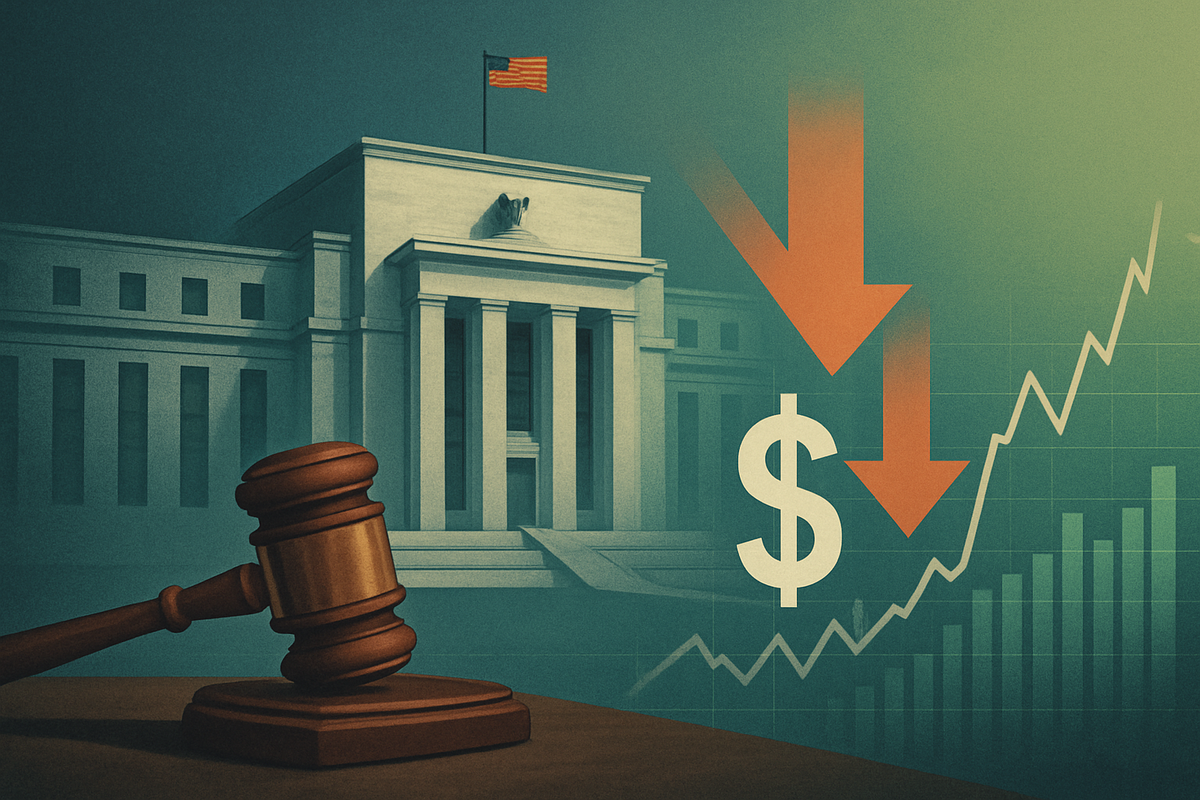
The Federal Reserve's Federal Open Market Committee (FOMC) has commenced its highly anticipated final meeting of 2025 today, December 9, a gathering poised to significantly influence the trajectory of financial markets and the broader economy. With market participants largely pricing in a 25-basis-point interest rate cut, the immediate implications are a mix of cautious optimism for risk assets and heightened scrutiny of the central bank's forward guidance. This potential third consecutive rate reduction signals the Fed's ongoing efforts to navigate a complex economic landscape characterized by a softening labor market and persistent, albeit moderating, inflation.
Investors and analysts are on high alert, anticipating not only the rate decision itself but also the release of the Summary of Economic Projections (SEP), or "dot plot," which will offer crucial insights into policymakers' future interest rate expectations. Federal Reserve Chair Jerome Powell's subsequent press conference will be meticulously dissected for any clues regarding the Fed's economic outlook and its plans for monetary policy in 2026, as his comments could trigger significant shifts in market sentiment and potentially ignite a "Santa rally" in equity markets.
A Deliberate Pivot: Unpacking the Fed's December Deliberations
The two-day FOMC meeting, running from December 9-10, is widely expected to conclude with a quarter-point reduction in the federal funds rate, bringing it to a new range of 3.50% to 3.75%. This move follows similar cuts in September and October 2025, underscoring the Fed's pivot towards an easing monetary policy stance. The impetus for these cuts stems primarily from a cooling labor market, evidenced by slowing job growth and a rising unemployment rate, which reached 4.4% in September. Despite these signs, inflation, as measured by the Fed's preferred index, remains stubbornly above the 2% target, hovering around 2.8%-3.0%. This presents a delicate balancing act for the central bank, tasked with achieving both maximum employment and price stability.
The path to this December meeting has been fraught with complexities. A six-week government shutdown earlier in late 2025 created a "data blackout," leaving the Fed with limited access to up-to-date economic indicators and forcing it to rely on older information or unofficial reports—a situation Chair Powell likened to "driving in the fog." This data void has intensified internal divisions within the FOMC, with "doves" advocating for cuts to bolster the job market and "hawks" expressing concerns about persistent inflation. Market expectations, however, have largely coalesced around a cut, with the CME Group's FedWatch Tool indicating an 87-90% probability. Beyond the rate decision, the updated "dot plot" will reveal individual FOMC members' projections for the federal funds rate, inflation, and growth for 2026 and beyond, providing critical signals about the Fed's long-term policy trajectory.
Key players in this high-stakes decision include the 12 voting members of the FOMC, led by Fed Chair Jerome Powell, whose term is set to expire in May 2026, amidst discussions of a potential replacement. Other influential members include Vice Chair Philip Jefferson and the presidents of the regional Federal Reserve Banks. Stakeholders ranging from consumers and businesses to global financial markets are keenly observing, as the Fed's decisions directly impact borrowing costs, investment plans, and overall economic stability. Initial market reactions are expected to be volatile, with a cut potentially fueling a "Santa rally" but any unexpected hawkish signals or significant dissent within the FOMC likely leading to uncertainty and a reassessment of market expectations.
Corporate Fortunes: Winners and Losers in a Lower Rate Environment
A shift towards lower interest rates by the Federal Reserve is akin to a seismic event in the corporate world, creating distinct advantages for some public companies while posing challenges for others. The overarching goal of rate cuts—to stimulate economic activity by reducing borrowing costs—translates into varying impacts across sectors.
Potential Winners:
The Technology Sector stands to be a significant beneficiary. Companies like Apple (NASDAQ: AAPL), Google (NASDAQ: GOOG), Meta (NASDAQ: META), Microsoft (NASDAQ: MSFT), Nvidia (NASDAQ: NVDA), and Amazon (NASDAQ: AMZN) often leverage cheaper capital for research and development, expansion, and strategic acquisitions. Lower borrowing costs enhance the present value of future earnings, which is particularly beneficial for growth-oriented tech firms. Smaller tech players, such as Marvell Technology (NASDAQ: MRVL), also gain from easier access to funding for scaling operations.
The Real Estate and Homebuilding Sector is highly sensitive to interest rates. Lower mortgage rates make homeownership more affordable, boosting demand for new homes. Companies like Pultegroup (NYSE: PHM), D.R. Horton (NYSE: DHI), and Lennar (NYSE: LEN) are poised for increased sales. Suppliers like Builders FirstSource (NYSE: BLDR) and Mohawk Industries (NYSE: MHK) also benefit from increased construction activity. Real Estate Investment Trusts (REITs) such as AGNC Investment (NASDAQ: AGNC), W.P. Carey (NYSE: WPC), Simon Property Group (NYSE: SPG), and Prologis (NYSE: PLG) can see improved cash flow from reduced debt servicing costs and become more attractive to income-seeking investors.
The Consumer Discretionary Sector typically thrives when consumers have more disposable income. Lower interest rates on loans and credit cards free up household budgets, encouraging spending on non-essential goods and services. Retailers like Crocs (NASDAQ: CROX) and Traeger (NYSE: COOK), automakers such as Ford Motor (NYSE: F), and leisure companies like Royal Caribbean Cruises (NYSE: RCL) and Six Flags Entertainment (NYSE: FUN) could all see a boost in sales and activity.
The Utilities Sector, often seen as defensive, also benefits. These capital-intensive companies, including Duke Energy (NYSE: DUK), CMS Energy (NYSE: CMS), and Sempra Energy (NYSE: SRE), rely on debt for infrastructure projects, so lower rates reduce their financing costs. Their stable dividend yields also become more attractive as bond yields fall. Similarly, telecommunications giants like AT&T (NYSE: T), with substantial debt, would find it cheaper to service and refinance.
Potential Losers (or those facing challenges):
While regional banks like First Horizon (NYSE: FHN) and Comerica (NYSE: CMA) might see increased loan demand, larger, diversified Financial Institutions could experience net interest margin (NIM) compression. This occurs when the interest earned on loans falls faster than the interest paid on deposits, squeezing profitability. Insurance companies with long-duration liabilities could also see their liabilities increase in present value.
Companies holding substantial Cash Reserves will earn less interest income on those holdings in a lower rate environment. While not a primary driver of stock performance, it impacts their treasury operations.
Finally, while generally benefiting from lower rates, some high-flying Growth Stocks, particularly in the tech sector like Nvidia (NASDAQ: NVDA) and Broadcom (NASDAQ: AVGO), could face a pullback if rate cuts are interpreted as a signal of broader economic weakness, or if their valuations are already stretched. Investor optimism could wane if the outlook for aggressive rate cuts diminishes, especially for momentum-driven stocks like Palantir (NYSE: PLTR).
A Broader Canvas: Trends, Ripple Effects, and Historical Echoes
The Federal Reserve's potential rate cuts extend far beyond immediate market fluctuations, embedding themselves within broader economic trends and triggering ripple effects across industries and global markets. As of late 2025, the U.S. economy is navigating a period of slowing growth and a cooling labor market, with real GDP growth projected to moderate into 2026. This easing cycle is primarily a "risk management cut," designed to preempt a deeper economic slowdown rather than respond to a full-blown recession.
The most significant ripple effect will be felt in the housing market. Lower rates typically translate to lower mortgage rates, enhancing affordability and potentially stimulating buyer demand, especially from first-time homebuyers. This could lead to increased transaction volumes and, coupled with persistent supply constraints, potentially push home prices higher in certain regions. For banks, while initial rate cuts might compress net interest margins, the long-term outlook could include increased loan growth and fee income as economic activity picks up. The technology sector, already propelled by the Artificial Intelligence (AI) investment cycle, stands to gain further, as lower borrowing costs reduce the discount rate on future cash flows, boosting company valuations and making fundraising and M&A more attractive. Conversely, the U.S. dollar might weaken, making American exports more competitive and potentially boosting commodity prices like oil. Lower U.S. rates also tend to redirect capital flows towards higher-yielding emerging market assets, offering temporary relief to developing economies.
From a regulatory and policy standpoint, these rate cuts are a direct exercise of the Fed's monetary policy mandate to achieve maximum employment and price stability. An accommodative stance signals the Fed's concern for the labor market, indirectly influencing government fiscal policy by affecting the cost of government borrowing. However, rising government debt levels and a weakening dollar could keep long-term Treasury yields elevated, creating a complex interplay between monetary and fiscal policy. Discussions around the Fed's independence, particularly with potential new appointments, could also introduce volatility into long bond yields.
Historically, the Fed has undertaken several rate reduction cycles, each under different economic circumstances. The current anticipated third consecutive cut in late 2025 mirrors "adjustment" or "risk management" cuts seen in 1998 and 2019, where the Fed implemented a series of 25-basis-point reductions preemptively. Notably, not all rate cut cycles lead to a recession; less than 50% have done so since 1980. When cuts do coincide with recessions, the Fed is typically more aggressive. The current situation, with a relatively low unemployment rate but signs of weakening, aligns with these historical preemptive actions. However, the effectiveness of these cuts might be slower than in the past, as many corporations and households have already locked in low fixed rates during previous cycles, potentially muting the immediate impact on refinancing and spending.
Charting the Course: The Road Ahead for Rates and Markets
The Federal Reserve's December meeting and its subsequent actions will set the stage for the economic and market landscape in 2026 and beyond. In the short term (next 3-12 months), the consensus among financial institutions points to continued, albeit potentially measured, rate easing throughout 2026. Projections from J.P. Morgan, BlackRock, Goldman Sachs, and Charles Schwab all anticipate additional rate cuts, driven primarily by a weakening labor market. While a pause after December's likely cut is possible, the overall trajectory suggests a gradual reduction in the federal funds rate, potentially reaching 3.0-3.5% by the end of 2026.
Long-term possibilities (beyond 2026) suggest a continued normalization towards a neutral rate, which some economists peg around 3%. However, even with Fed easing, upward pressure on long-term Treasury yields is anticipated due to rising equilibrium rates and the rebuilding of global term premia, alongside increasing supply of government and corporate bonds. In a more pessimistic scenario of a sharp economic slowdown, aggressive cuts of 200-300 basis points in 2026 are not out of the question, as suggested by UBS.
These evolving rate dynamics necessitate strategic pivots and adaptations for both businesses and investors. For businesses, lower borrowing costs present a prime opportunity for refinancing existing debt, securing new loans for expansion, and investing in technology and AI. Companies should prioritize profitability and cash flow, especially if heavily reliant on credit, and adopt proactive treasury management to mitigate interest rate risk. Investors, on the other hand, may consider reallocating from cash into bonds with higher earnings potential, focusing on short-to-intermediate duration bonds. Maintaining an overweight position in U.S. large-cap equities, particularly those benefiting from AI tailwinds, is often recommended, as stocks have historically reacted positively to rate cuts. Diversification with alternative investments can also help manage volatility.
Market opportunities will include reduced borrowing costs for consumers, stimulating spending and boosting sectors like retail and automotive. The equity market is likely to see a boost as corporate borrowing costs fall, making equities more attractive. The bond market could also see gains, with existing bonds becoming more appealing and corporate bond issuance rising. However, challenges loom, including the risk of reigniting inflationary pressures if cuts are too aggressive, lower returns for savers relying on interest income, and the potential for increased household debt. There's also the risk of market over-optimism outpacing the Fed's actual decisions, leading to volatility.
Several potential scenarios and outcomes could unfold. A "soft landing" scenario, where the Fed successfully implements preemptive cuts to avert a slowdown without triggering renewed inflation, would foster global confidence and lead to rallies in both equities and bonds. Conversely, "too little, too late" could lead to a recession and a significant decline in equities, while "too much, too early" might reignite inflation, causing bonds to fall while equities rally. A hawkish Fed outcome (fewer cuts than expected) would strengthen the dollar and potentially negatively impact stocks, whereas a dovish outcome (more aggressive easing) would likely boost stocks and gold. The coming months will reveal which path the Fed ultimately takes, demanding vigilance and adaptability from all market participants.
Navigating the Currents: A Look Ahead for Markets
The Federal Reserve's December 2025 meeting marks a significant juncture, solidifying a pivot towards an easing monetary policy. The widely anticipated rate cut, likely the third consecutive, underscores the central bank's commitment to supporting a softening labor market while carefully monitoring persistent inflation. The immediate takeaway is a potential boost for risk assets, though the true impact will depend heavily on the Fed's forward guidance and the nuanced interpretation of Chair Powell's statements.
Moving forward, the market is poised for continued, albeit gradual, rate cuts throughout 2026. This environment presents a landscape of both opportunity and challenge. Companies in growth-oriented sectors like technology, along with interest-rate-sensitive industries such as real estate and homebuilding, are likely to benefit from reduced borrowing costs and increased consumer activity. Conversely, some financial institutions may face margin compression, and savers will see diminished returns on cash holdings. The broader significance extends to global markets, influencing capital flows, the U.S. dollar, and the coordinated actions of other central banks.
Investors should watch closely for the Fed's updated economic projections, particularly the "dot plot," for signals on the future pace and magnitude of rate cuts. Any divergence from market expectations could introduce volatility. Key economic indicators, especially those related to inflation and employment, will remain paramount in shaping the Fed's decisions. Strategic adaptation, including thoughtful portfolio rebalancing and a focus on companies with strong fundamentals, will be crucial for navigating the evolving economic currents. The coming months will undoubtedly test the Fed's ability to engineer a soft landing, making vigilance and a long-term perspective essential for all market participants.
This content is intended for informational purposes only and is not financial advice