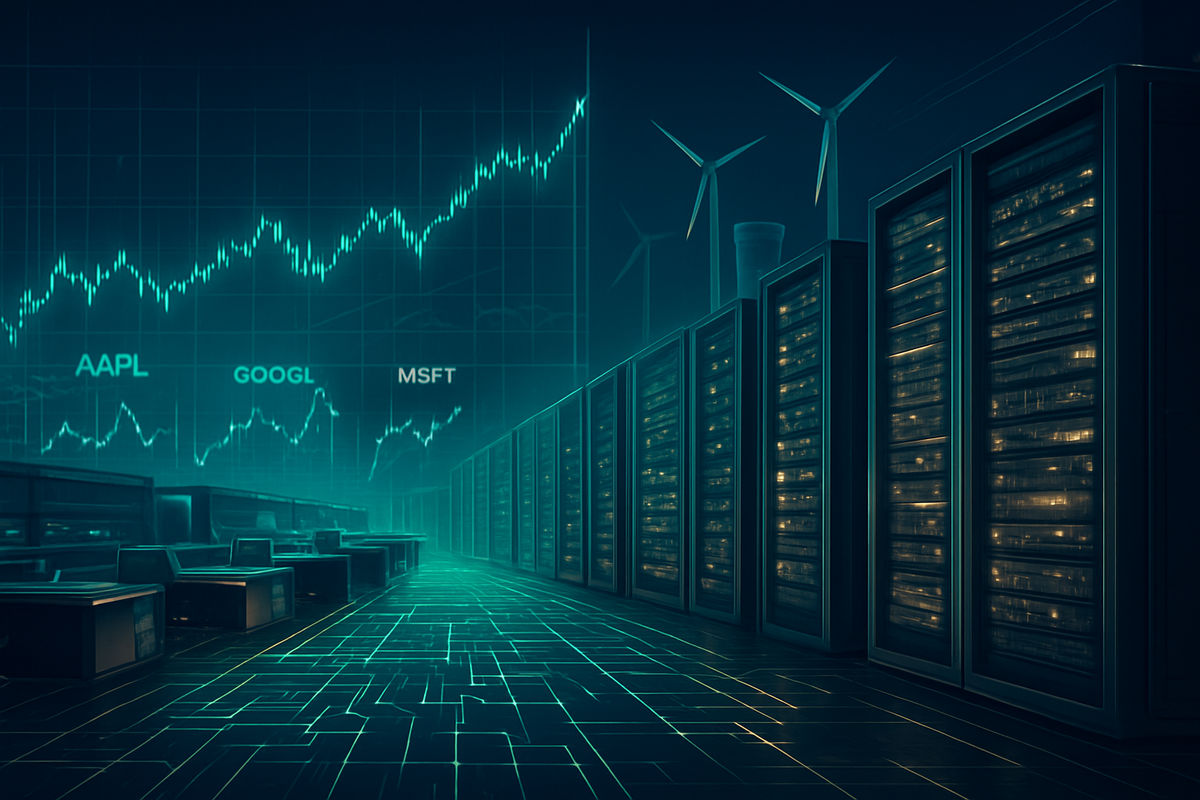
As the final bells ring on the trading floors of 2025, the financial world is breathing a collective sigh of relief—and perhaps a bit of exhaustion. For the past twelve months, the "AI Bubble" was the most debated topic in global markets, drawing constant comparisons to the dot-com crash of 2000. Yet, as we close out the year on December 31, 2025, the narrative has shifted from existential dread to a more nuanced reality. The bubble didn’t burst; it matured into what analysts are now calling the "Validation Phase."
The year was defined by a brutal tug-of-war between staggering capital expenditures and the first wave of true generative AI revenue. While many predicted that a $400 billion spending spree by Big Tech would lead to a market-wide collapse, the actual earnings reports told a different story. Leading AI companies managed to navigate a series of mid-year shocks, proving that while the hype was indeed inflated, the underlying economic engine of artificial intelligence was more resilient than the skeptics anticipated.
A Year of Shocks and Resilience: The 2025 Timeline
The year 2025 began with a localized panic known as the "DeepSeek Shock" in January. The launch of a high-performance, low-cost Chinese model forced investors to question the "compute moat" of American tech giants. If a model could be trained for a fraction of the cost previously thought necessary, was the billions spent on hardware a waste? This fear was compounded in April by a $3.1 trillion one-day market sell-off triggered by new international trade tariffs, which briefly sent NVIDIA (NASDAQ: NVDA) and its peers into a tailspin.
However, the tide began to turn in the autumn. By October 2025, NVIDIA defied gravity once again, becoming the first company to hit a historic $5 trillion market cap, driven by insatiable demand for its Blackwell architecture. The "arms dealer" of the AI revolution proved that even as competitors emerged, the sheer scale of infrastructure required for the next generation of "Agentic AI" was still expanding. The market’s initial reaction to high spending was fear, but by the fourth quarter, investors began rewarding companies that could demonstrate a clear Return on Invested Capital (ROIC).
The Winners and Losers of the AI Selective Market
The performance gap among the "Magnificent Seven" widened significantly this year, creating a market of "haves" and "have-nots." Alphabet Inc. (NASDAQ: GOOGL) emerged as the year’s surprise champion, with its stock surging over 65%. Alphabet successfully monetized its Gemini models through Google Cloud and integrated AI search, proving that it could protect its core advertising business while expanding into new high-margin AI services. Similarly, Meta Platforms (NASDAQ: META) saw its stock recover from mid-year volatility to end the year up 22%, thanks to its Advantage+ AI advertising tools reaching a massive $60 billion annual run rate.
On the other side of the ledger, Amazon.com Inc. (NASDAQ: AMZN) and Microsoft Corp. (NASDAQ: MSFT) faced a more difficult path. Amazon was the group’s laggard, with a modest 5.5% gain, as a staggering $125 billion infrastructure budget weighed heavily on its free cash flow. Microsoft, while still growing its Azure AI revenue by nearly 40%, saw its stock gains capped at 16% as capacity constraints and the sheer weight of its $80 billion CapEx slowed its momentum. For these giants, 2025 was a year of building the foundation, but the market was less patient with their timeline for profitability compared to the advertising-driven models of Alphabet and Meta.
From Training to Inference: The Great Technical Pivot
The most significant shift in the 2025 AI landscape was the industry-wide transition from "training" to "inference." In 2023 and 2024, the focus was on building massive models; in 2025, the focus shifted to running them for hundreds of millions of users. By year-end, inference accounted for 40% of all AI-related revenue. This shift led to the rise of custom silicon, or ASICs. To lower the astronomical costs of using general-purpose GPUs, companies like Alphabet and Amazon accelerated the deployment of their own chips, such as the TPU v7 and Trainium 3, which were reported to be four times more cost-effective for specific tasks.
This transition also brought the energy crisis to the forefront of the financial debate. The massive power requirements of gigawatt-scale data centers led to a surge in partnerships between tech companies and the energy sector. We saw a historical precedent as tech giants began investing directly in nuclear and solar energy projects to ensure their AI clusters remained operational. This has effectively turned Big Tech into some of the world’s largest energy speculators, a move that has regulatory bodies in both the U.S. and the EU scrambling to update policy frameworks for the "AI-Energy Nexus."
What Lies Ahead: The Road to 2026
Looking into the short-term future, the primary challenge for the market will be the shift toward "Agentic AI"—systems that don't just generate text but can execute complex tasks autonomously. This will require a new wave of strategic pivots, as software companies must move beyond simple "copilot" add-ons to fully integrated AI agents. The market opportunity remains vast, but the barrier to entry has risen; only companies with the capital to sustain high inference costs and the talent to build reliable agentic frameworks are likely to survive the next phase of competition.
In the long term, the "AI Bubble" debate is likely to fade, replaced by a focus on productivity metrics. We are entering an era where the success of an AI investment will be measured by how many man-hours it saves in the enterprise or how much it increases conversion rates in retail. The challenge for 2026 will be managing the diminishing returns of scaling—finding the point where adding more compute no longer yields a proportional increase in intelligence.
Closing the Books on 2025: A Mature Market
As we reflect on 2025, the key takeaway is that the "AI Bubble" did not burst because the technology's utility was grounded in real-world economic gains. While speculative froth was certainly purged during the January and April corrections, the companies that provided the essential infrastructure and the most effective monetization platforms ended the year stronger than ever. The market has become "AI Selective," punishing aimless spending while rewarding efficiency and clear revenue pathways.
Moving forward, investors should keep a close eye on two things: the cost of inference and the stability of the energy grid. The "arms race" has not ended; it has simply moved from the laboratory to the power plant and the custom chip fab. 2025 proved that AI is not a fleeting trend like the metaverse or a speculative bubble like the early 2020s crypto craze—it is the new industrial backbone of the global economy.
This content is intended for informational purposes only and is not financial advice.