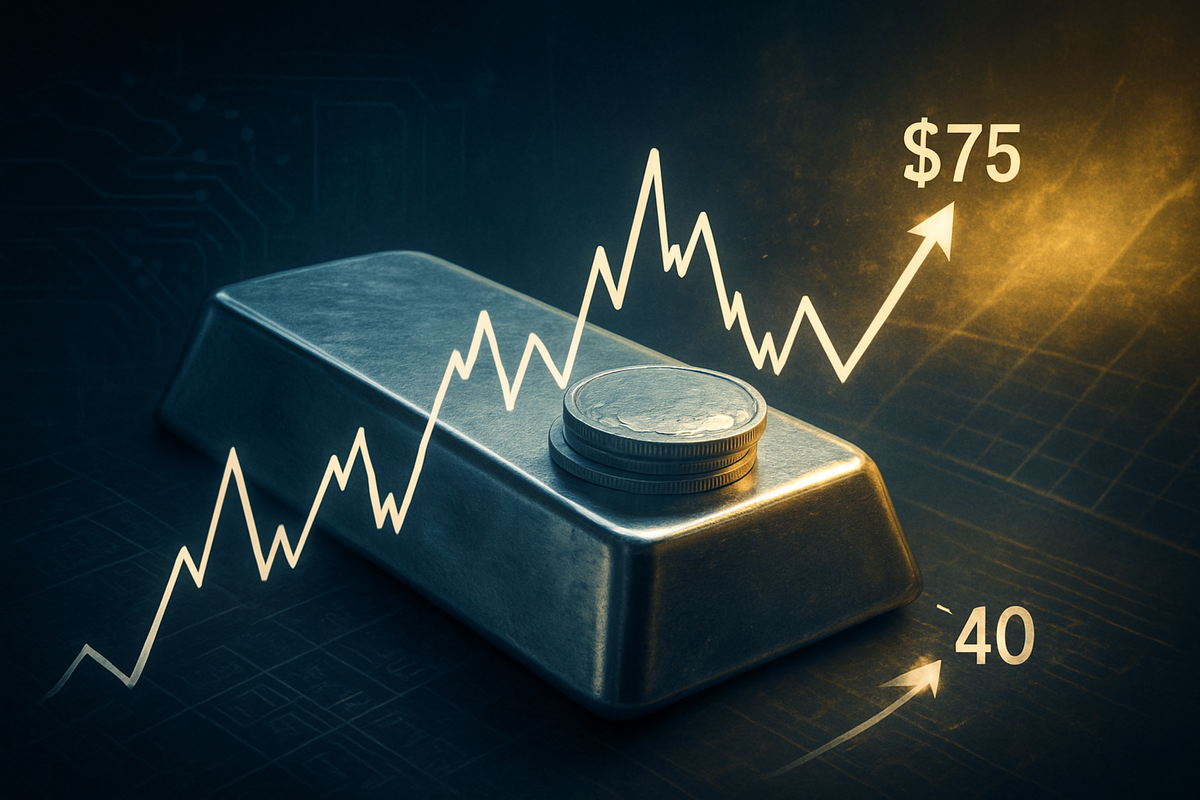
As of early December 2025, silver, often dubbed "poor man's gold," finds itself at a pivotal juncture, exhibiting the characteristic volatility that has defined its market for decades. After a remarkable year, with prices soaring by approximately 100% year-to-date and briefly touching an all-time high of $61.44, the precious metal is now trading around $58.37 per troy ounce. This parabolic rally has caught the attention of market strategists, most notably Bloomberg Intelligence Senior Commodity Strategist Mike McGlone, who warns of the metal's inherent instability and outlines two starkly different paths forward: a potential surge to $75 or a sharp retreat to $40.
This forecast underscores the complex interplay of industrial demand, safe-haven appeal, and broader macroeconomic forces that dictate silver's trajectory. For investors, understanding these dynamics is paramount as the metal navigates a landscape shaped by both inflationary pressures and potential deflationary headwinds, making its next major move a critical determinant for portfolios worldwide.
McGlone's Dire Warnings and Silver's Wild Ride
The recent "parabolic rally" in silver has been described by McGlone as "a little scary," a sentiment rooted in historical precedents where such extreme upward movements "never ended well." This cautionary stance comes as silver has not only seen a 23.78% increase over the past month but an astounding 86.37% rise compared to the previous year, culminating in its temporary breach of the $60 mark. The metal's history is replete with such dramatic swings; from its peak of over $50 an ounce in 1980, followed by a swift crash, to another near-$49 high in 2011 amidst global economic uncertainty. Its annual market volatility is estimated to be around 30%, making it one of the most unpredictable precious metals.
McGlone's analysis posits that silver's next major price move could either propel it to an unprecedented $75 per ounce or send it plummeting back to the $40 level. While a precise timeframe for these targets remains fluid, the strategist suggests a near-to-medium-term outlook, emphasizing that for him to become more bullish, silver "needs to spend some time above $50." He also links silver's ultimate ascent to $75 to gold's performance, stating, "it needs gold to go up and I fully expect gold it's just a matter of time to get $4,000." This highlights gold as a crucial anchor for silver's future.
Several key drivers underpin McGlone's dual forecast. Primarily, silver's rally is significantly "on the back of gold," with McGlone anticipating gold reaching $4,000, which would provide substantial support for silver. Secondly, silver's evolving identity as an "industrial metal" is critical; over half its demand now stems from industrial applications like electronics, solar panels, and healthcare, contrasting with gold's increasing role as a monetary asset. McGlone suggests that excessively high silver prices could dampen industrial demand, creating downward pressure. Moreover, silver exhibits a stronger correlation with the broader stock market than gold, implying that a significant U.S. stock market downturn could adversely impact its price.
Finally, McGlone points to the complex interplay of "deflationary and inflationary forces." He notes that silver is caught between U.S. inflationary pressures (driven by advancing risk assets) and deflationary forces emanating from China. The economic principle that "the cure for high prices is high prices" also plays a role, suggesting that sustained high prices could eventually lead to reduced demand or increased supply, correcting the market.
Companies Navigating Silver's Volatile Currents
The inherent volatility of silver prices presents a double-edged sword for companies heavily invested in its mining, refining, and industrial applications. A sustained rally towards McGlone's $75 target would usher in a period of unprecedented profitability for silver producers, while a drop to $40 would significantly squeeze margins and potentially halt expansion plans.
Major silver mining companies stand to be the primary beneficiaries or casualties. For instance, Fresnillo PLC (LSE: FRES), one of the world's largest primary silver producers, would see its revenues and earnings surge with higher prices, boosting investor confidence and potentially leading to increased dividends. Similarly, Pan American Silver Corp. (NASDAQ: PAAS), with operations across the Americas, would experience enhanced cash flows, enabling debt reduction, share buybacks, or investments in new projects. Wheaton Precious Metals Corp. (NYSE: WPM), a prominent silver and gold streaming company, would also benefit significantly, as its streaming agreements grant it the right to purchase silver at a fixed, low cost, meaning wider profit margins as market prices rise. Conversely, a sharp decline to $40 would reverse these fortunes, leading to reduced profitability, potential mine closures for higher-cost operations, and a re-evaluation of capital expenditures across the industry.
Beyond mining, companies in sectors reliant on silver for industrial applications would also feel the impact. Manufacturers of solar panels, electric vehicles, and high-tech electronics, which utilize silver for its superior conductivity, would face increased input costs if prices soar. While some may have hedging strategies in place, prolonged high prices could necessitate passing costs onto consumers or seeking alternative, albeit less efficient, materials. Conversely, a price drop would alleviate cost pressures for these industries, potentially stimulating demand for their products. The supply chain for silver, from exploration and extraction to refining and distribution, involves numerous stakeholders, all of whom are acutely sensitive to price fluctuations, making strategic planning a constant challenge in this dynamic market.
Wider Implications: Silver's Role in a Shifting Global Economy
Silver's pronounced volatility and its dual identity as both a precious metal and an industrial commodity embed it deeply within broader industry trends and macroeconomic shifts. Its price movements offer a unique barometer of global economic health, reflecting investor sentiment towards inflation, industrial growth, and financial stability.
The potential for silver to reach $75 or fall to $40 has significant ripple effects across the entire precious metals complex. While often correlated with gold, silver's higher beta means it typically amplifies gold's movements. A sustained rally in silver could signal robust industrial demand and/or heightened inflationary expectations, potentially drawing investment away from other commodities or even equities as investors seek tangible assets. Conversely, a sharp decline could indicate weakening industrial output or a flight from risk assets, potentially benefiting traditional safe havens like gold or government bonds. Regulatory or policy implications could also emerge, particularly if extreme price swings lead to calls for increased market oversight or changes in trading rules to curb speculative excess, reminiscent of historical interventions during periods of market manipulation.
Historically, silver has played a crucial role during periods of economic uncertainty and technological advancement. Its use in emerging green technologies, such as solar energy and electric vehicles, positions it as a critical material for the global energy transition. This industrial demand provides a fundamental floor for its price, distinguishing it from purely monetary assets. However, this also links its fate to the pace of industrial innovation and global economic growth. Comparisons can be drawn to past commodity supercycles, where rapid price appreciation was followed by significant corrections, often driven by changes in supply-demand dynamics or broader economic downturns. The current environment, marked by ongoing geopolitical tensions, supply chain reconfigurations, and varying monetary policy stances across major economies, creates a complex backdrop against which silver's next move will unfold.
What Comes Next: Navigating Silver's Future Paths
The coming months will be critical in determining whether silver embarks on a path towards $75 or retreats to $40. Short-term possibilities include continued price discovery around its current levels, with minor fluctuations driven by daily news, economic data releases, and shifts in investor sentiment. The immediate trajectory will heavily depend on the performance of gold; if gold begins its anticipated ascent towards $4,000, as McGlone suggests, it could provide the necessary impetus for silver to break past resistance levels and target higher valuations. Conversely, any significant weakening in gold prices or a broader downturn in the U.S. stock market could trigger a rapid descent for silver, aligning with the $40 downside scenario.
Long-term possibilities hinge on several macroeconomic and technological trends. If global industrial demand for silver continues its robust growth, particularly from the renewable energy and electronics sectors, a sustained upward trend towards $75 becomes more plausible. However, if economic slowdowns or technological innovations reduce silver's industrial necessity, the downside risk increases. Potential strategic pivots for investors might involve diversifying holdings, considering options contracts to hedge against volatility, or focusing on silver streaming and royalty companies that offer exposure with reduced operational risks. Market opportunities may emerge for those adept at timing the market, leveraging silver's volatility for short-term gains, while long-term investors might view any dip towards $40 as a buying opportunity, betting on its eventual recovery driven by fundamental demand.
Potential scenarios and outcomes are varied. A "bullish" scenario sees silver benefiting from persistent inflation, a weakening U.S. dollar, and surging industrial demand, particularly from green technologies, propelling it towards $75. A "bearish" scenario involves a stronger dollar, rising interest rates, a global economic recession curbing industrial demand, and a significant correction in the broader stock market, pushing silver back to $40. A "neutral" scenario could see silver consolidating around its current levels, reacting to a balanced interplay of these forces, perhaps hovering in the $50-$60 range for an extended period as the market awaits clearer signals.
A Volatile Asset at a Critical Juncture
Silver's journey through late 2025 has been nothing short of spectacular, marked by a near-doubling in price and a brief flirtation with all-time highs. Yet, as Bloomberg Intelligence's Mike McGlone astutely observes, this parabolic ascent places the volatile metal at a critical juncture, facing equally compelling arguments for a surge to $75 or a sharp retraction to $40. The key takeaways from this analysis underscore silver's unique position as both a monetary hedge and a vital industrial commodity, making its price exceptionally sensitive to a confluence of factors, from gold's performance and industrial demand to broader economic conditions and speculative sentiment.
Moving forward, the market will undoubtedly remain captivated by silver's trajectory. Its strong correlation with gold suggests that the yellow metal's performance will be a primary indicator of silver's next move. Furthermore, the ongoing global energy transition and the increasing demand for silver in solar panels, electric vehicles, and other high-tech applications will provide a fundamental underpinning, but also a source of vulnerability if industrial growth falters. Investors should prepare for continued volatility, recognizing that silver's historical patterns suggest that dramatic rallies can often be followed by significant corrections.
In the coming months, investors should closely watch several key indicators: the price of gold, particularly its ability to reach McGlone's $4,000 target; global economic growth figures and manufacturing PMIs, which will signal industrial demand; inflation data and central bank monetary policies, impacting silver's appeal as a hedge; and the overall performance of the U.S. stock market, given silver's correlation. Ultimately, silver remains a high-risk, high-reward asset. Its next major move will not only shape the portfolios of individual investors but also offer profound insights into the underlying health and direction of the global economy.
This content is intended for informational purposes only and is not financial advice