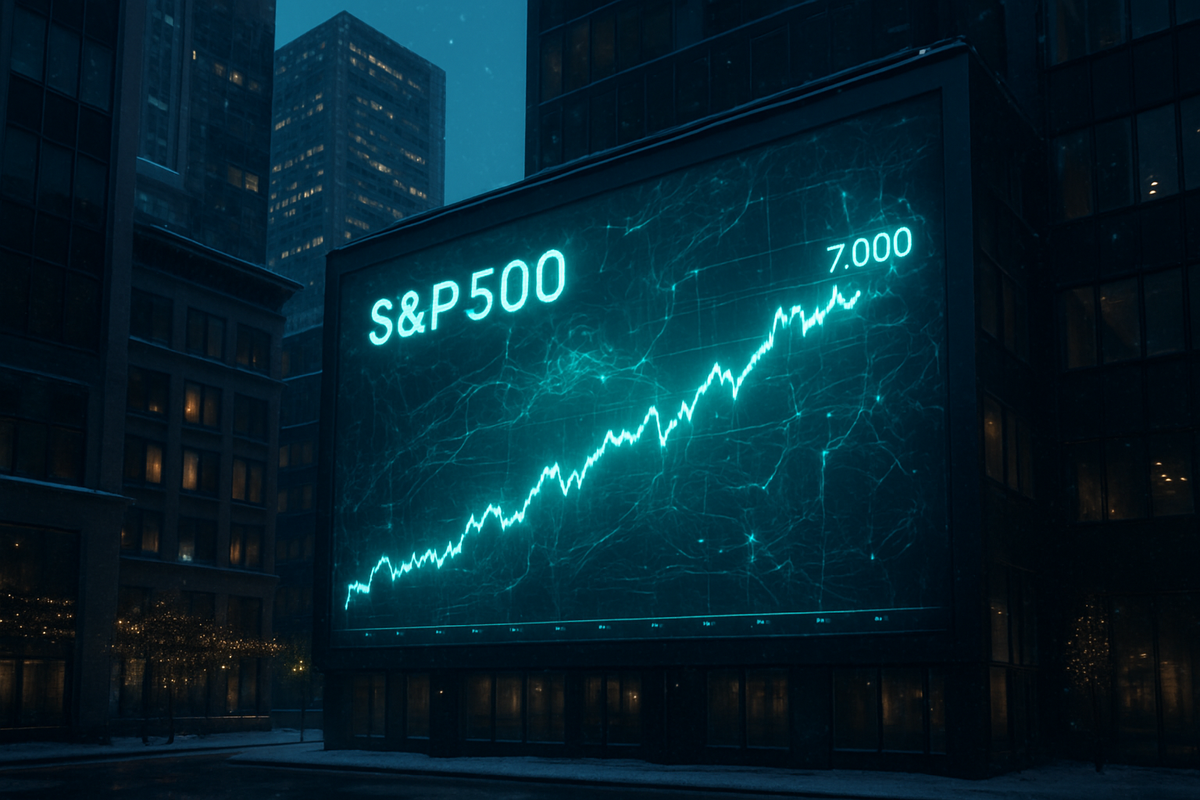
As the final trading days of 2025 wind down, the S&P 500 stands as a testament to the resilience of the American economy and the transformative power of artificial intelligence. Despite a year punctuated by geopolitical friction and a mid-year "tariff storm," the index has defied skeptics to deliver a staggering year-to-date return of approximately 19%. As of today, December 29, 2025, the market is entering a period of much-needed consolidation, retreating slightly to the 6,909 level after coming within striking distance of the historic 7,000 milestone just days ago.
This year-end cooling is being characterized by Wall Street strategists not as a reversal, but as a "healthy breather." After a blistering "Santa Claus Rally" that saw the index hit an all-time intraday high of 6,932.05 on December 24, investors are beginning to lock in profits. With valuations sitting at a rich 24 times forward earnings and thin holiday liquidity magnifying small price swings, the current consolidation reflects a market weighing its massive 2025 gains against the inflationary uncertainties of the coming year.
A Timeline of Resilience: From the 6,000 Floor to the 7,000 Ceiling
The story of 2025 began with the S&P 500 hovering around the 6,000 mark, a level it first touched in late 2024. The first quarter was defined by a "higher-for-longer" interest rate environment as the Federal Reserve, led by Chair Jerome Powell, waited for definitive proof that inflation was under control. However, the market’s resolve was tested on April 2, 2025—a day now referred to as the "April Tariff Storm"—when the implementation of a 10% universal baseline tariff and 25% levies on North American imports triggered a sharp 10.5% correction.
The recovery from that spring slump was fueled by two primary engines: a pivot in Federal Reserve policy and a fundamental shift in the AI narrative. By mid-year, the Fed began a series of three "insurance cuts," eventually lowering the federal funds rate to a range of 3.50%–3.75% by December. Simultaneously, the market moved past the initial AI "hype" phase into a "maturity phase." Companies were no longer just talking about AI; they were reporting massive productivity gains and surging revenues from AI infrastructure. By June, the index decisively broke above 6,000, setting the stage for an eight-month winning streak—the longest since 2017.
The momentum culminated in the fourth quarter, supported by a revised Q3 GDP growth rate of 4.3%. The surge was so potent that by Christmas Eve, the index had notched over 25 new all-time highs for the year. The current year-end retreat is a byproduct of this rapid ascent, as the 10-year Treasury yield remains elevated at 4.13%, acting as a natural brake on further equity expansion.
Winners and Losers: The AI Divide and the Tariff Toll
The 2025 market was a tale of two cities, with the "AI Infrastructure" sector leading the charge while legacy software and tariff-exposed industries struggled. The clear winners were the hardware and memory providers essential for the generative AI revolution. Nvidia (Nasdaq: NVDA) maintained its dominance, but the spotlight expanded to include memory and storage giants like Western Digital (Nasdaq: WDC), Seagate (Nasdaq: STX), and Micron (Nasdaq: MU), all of which saw triple-digit or high double-digit gains as data center demand reached a fever pitch.
Conversely, the year was punishing for companies perceived as being on the wrong side of the AI disruption. Legacy enterprise firms like Salesforce (Nasdaq: CRM) and Adobe (Nasdaq: ADBE) faced significant valuation contractions as investors worried that agentic AI tools would cannibalize their core subscription models. Information services were hit even harder; Gartner (NYSE: IT) saw its stock price nearly halve by year-end, as the market feared that Large Language Models would replace traditional research and advisory services.
Outside of tech, the "Liberation Day" tariffs created a difficult environment for global manufacturers and financials. Tesla (Nasdaq: TSLA) struggled throughout the first half of the year, at one point trading 45% below its record highs due to supply chain volatility and increased component costs. Financial heavyweights like JPMorgan Chase (NYSE: JPM) and Bank of America (NYSE: BAC) also faced headwinds as trade tensions threatened to slow global trade financing, leading to periodic sell-offs during the index's more volatile months.
Analyzing the Wider Significance: A Paradigm Shift in Productivity
The S&P 500’s performance in 2025 represents more than just a bull market; it signals a fundamental shift in how the market values productivity. The transition from AI speculation to AI maturity suggests that investors are now pricing in long-term efficiency gains across the entire economy. This shift has allowed the U.S. market to absorb the shock of higher tariffs and trade friction—factors that in previous eras might have triggered a prolonged bear market.
Historically, 2025 will likely be compared to the late 1990s in terms of technological enthusiasm, but with a crucial difference: the earnings are real. The robust GDP growth seen in the latter half of the year suggests that the massive capital expenditures by big tech are starting to permeate other sectors, from logistics to healthcare. However, the regulatory landscape remains a wildcard. As AI becomes more pervasive, the policy implications regarding data privacy and labor displacement are beginning to weigh on investor sentiment, contributing to the cautious tone seen in late December.
Furthermore, the Fed’s ability to orchestrate a "soft landing" while navigating tariff-induced inflation has rewritten the central banking playbook. The "insurance cuts" delivered in late 2025 provided the liquidity necessary to keep the engine running, but they have also left the market sensitive to any sign of a re-acceleration in consumer prices.
What Comes Next: The Road to 7,500 or a 2026 Reset?
As we look toward 2026, the primary question for investors is whether the S&P 500 can sustain its momentum or if the current consolidation is a precursor to a more significant pullback. In the short term, the psychological 7,000 level remains the immediate target. Many analysts expect a "January Effect" to push the index over this hurdle as institutional buyers return to their desks with fresh capital.
However, the long-term outlook requires a strategic pivot. Companies that failed the "AI Value Test" in 2025 will need to demonstrate clear integration strategies to regain investor trust. Meanwhile, the broader market must contend with the "tariff-fueled inflation" risks that are currently being priced into the bond market. If the 10-year yield continues to climb toward 4.5%, the high P/E ratios of the tech sector may become unsustainable, leading to a rotation into more defensive, value-oriented sectors like Healthcare or Utilities, which were laggards this year.
Final Wrap-Up: A Historic Year with a Cautious Finish
The S&P 500’s journey through 2025 has been nothing short of historic. From the depths of the April correction to the heights of the December records, the index has proven its ability to weather geopolitical storms and interest rate uncertainty. The key takeaway for the year is the undeniable dominance of the AI ecosystem and the resilience of the American consumer in the face of shifting trade policies.
As we move into 2026, the market is in a position of strength but also extreme sensitivity. The current consolidation is a reminder that even the most powerful bull markets need to pause. Investors should keep a close watch on inflation data in the first quarter and the Federal Reserve's response to any potential price spikes. While the 7,000 milestone is within reach, the quality of earnings and the stability of the global trade environment will ultimately determine if the S&P 500 can continue its record-setting run.
This content is intended for informational purposes only and is not financial advice.