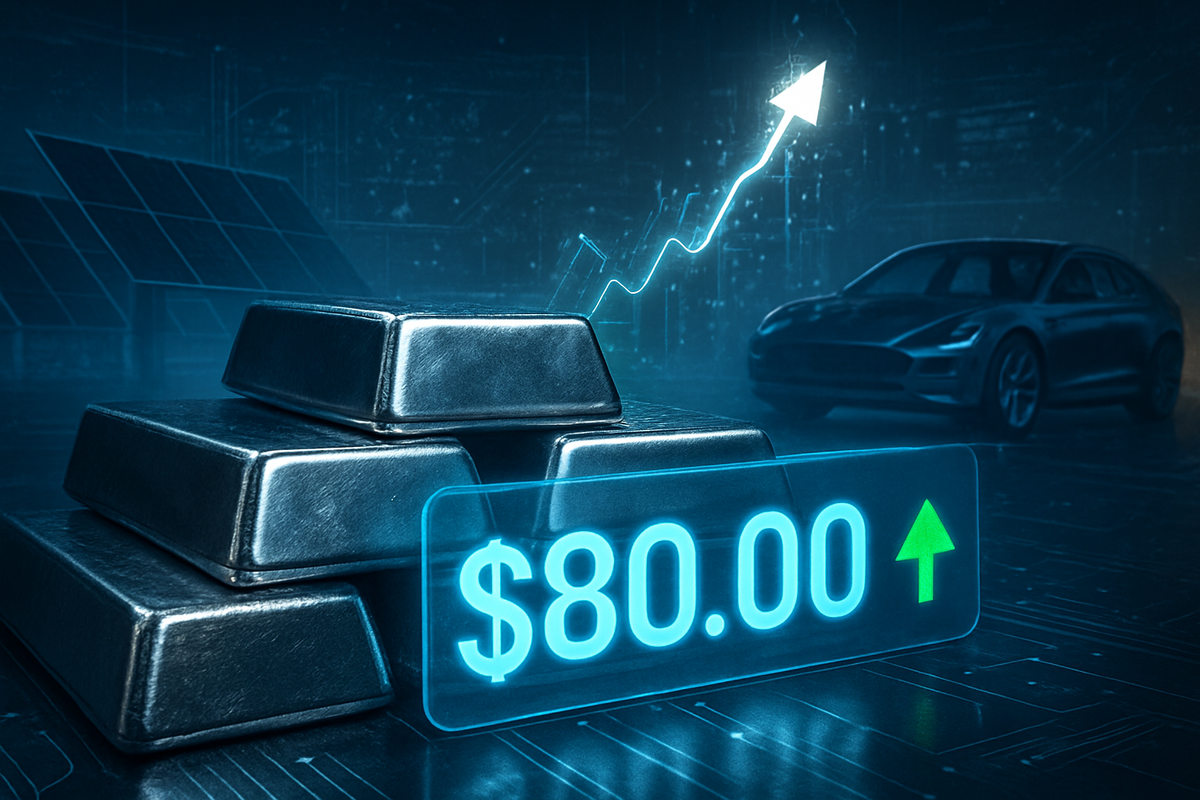
In a historic upheaval of the precious metals market, silver prices have shattered all previous records, surging past the psychological barrier of $80 per ounce in the final days of December 2025. This parabolic rally, which saw the metal climb from $29 at the start of the year to an intraday peak of $84.00 on December 29, represents a fundamental shift in how the world values silver. No longer viewed merely as gold’s volatile "younger sibling," silver has been reclassified by investors and governments alike as a strategic critical mineral essential for the 21st-century economy.
The immediate implications of this "Silver Squeeze" are being felt across the globe, from the trading floors of London and New York to the manufacturing hubs of the Silicon Valley and Shanghai. As the global supply deficit reaches a breaking point, the surge is creating a massive wealth transfer from industrial consumers to mining jurisdictions. With the gold-to-silver ratio collapsing to levels not seen in decades, the financial world is witnessing a historic realignment that challenges the traditional hierarchy of safe-haven assets.
The Perfect Storm: A Timeline of the 2025 Squeeze
The ascent to $80 was not a sudden fluke but the culmination of a "perfect storm" of industrial desperation and geopolitical friction. The year began with silver in a modest range, but the narrative shifted in February 2025 when the U.S. administration imposed a 25% tariff on imports from Mexico—the world’s largest silver producer—and a 10% universal baseline tariff. This move effectively added an immediate "tax" on silver for U.S. manufacturers, triggering a scramble for domestic supply that never truly abated.
By October 2025, the market entered a state of acute physical shortage. A record-breaking Diwali season in India saw physical demand for silver jewelry and investment bars skyrocket, while the London Bullion Market Association (LBMA) reported its lowest vault holdings in history. This led to the "Great Silver Squeeze of October," where silver lease rates spiked above 39%, forcing a massive short-covering event. As hedge funds were squeezed out of their positions, the price surged past its 1980 high of $50, turning the rally into a vertical climb that ultimately breached $80 this week.
The final catalyst arrived in late December when the U.S. Geological Survey (USGS) officially added silver to its Critical Minerals List. This designation, intended to secure supply for national defense and energy infrastructure, triggered a "panic buy" among institutional investors. Simultaneously, China’s announcement of new export licensing requirements for silver, set to take effect on January 1, 2026, acted as the final spark, sending prices into a frenzy as Western buyers rushed to secure remaining stockpiles before the gates closed.
Winners and Losers: The Industrial Fallout
The primary beneficiaries of this price explosion have been the primary silver miners, many of whom have seen their market valuations triple in a single year. Hecla Mining Company (NYSE: HL) has emerged as a standout winner; as the largest U.S.-based silver producer, its domestic assets like the Greens Creek mine are exempt from import tariffs and have been re-rated as strategic national assets. Similarly, First Majestic Silver Corp. (NYSE: AG) saw its shares rise over 220% following its timely acquisition of the Cerro Los Gatos mine, allowing it to capitalize on the $70 and $80 price levels with expanded production capacity. Pan American Silver Corp. (NYSE: PAAS) also reported record-breaking free cash flow, with margins expanding exponentially as their all-in sustaining costs remained anchored near $15 while spot prices quadrupled.
On the other side of the ledger, the "Silver Squeeze" has become a nightmare for the green energy and automotive sectors. Tesla, Inc. (NASDAQ: TSLA) reported a significant decline in its fourth-quarter net income, with CEO Elon Musk citing the "insane" cost of silver as a primary headwind for EV production. An average electric vehicle contains up to 50 grams of silver for its electrical contacts and battery management systems; at $80 an ounce, this adds hundreds of dollars in raw material costs to every car.
The solar industry is facing an even more existential threat. First Solar, Inc. (NASDAQ: FSLR) and other photovoltaic manufacturers have seen their profit margins compressed as the cost of silver paste—essential for conductivity in solar cells—tripled. The industry’s shift toward high-efficiency TOPCon solar cells, which require 50% more silver than previous generations, has backfired in the face of these prices, forcing companies to accelerate "thrifting" efforts to reduce silver content or risk making solar energy uncompetitive with traditional power sources.
A Wider Significance: The End of the Gold-Silver Ratio as We Knew It
The 2025 squeeze has fundamentally altered the relationship between gold and silver. Historically, the gold-to-silver ratio has hovered between 60:1 and 80:1, but as of late December 2025, it has collapsed to nearly 40:1. While SPDR Gold Shares (NYSEARCA:GLD) have performed well, hitting records near $4,500 per ounce, silver’s "high-beta" nature has allowed it to significantly outperform its yellow counterpart. This suggests that silver is decoupling from its role as a "quiet" inflation hedge and is instead being traded as a high-growth technology asset.
This event also highlights the fragility of global supply chains in the face of aggressive trade policy. The 2025 tariffs served as a stark reminder that "just-in-time" inventory management is incompatible with a world of resource nationalism. The U.S. reliance on Mexico and China for silver has been exposed as a strategic vulnerability, leading to a frantic push for domestic recycling and the reopening of dormant mines across the American West. This shift aligns with a broader trend of "friend-shoring," where nations prioritize trade with political allies to secure the materials needed for the energy transition.
Furthermore, the "Critical Mineral" designation for silver is a regulatory milestone. It signals that governments now view silver not just as money or jewelry, but as a component of national security. This could lead to future government stockpiling programs, similar to the Strategic Petroleum Reserve, which would provide a permanent floor for silver prices but also introduce new layers of government intervention in the precious metals markets.
What Comes Next: The Road to $100 or a Correction?
As we look toward 2026, the market is divided on whether silver can sustain these levels. In the short term, the extreme volatility of the past week suggests a period of consolidation is likely. Market participants are watching for any signs of a "demand destruction" event, where high prices force industrial users to switch to cheaper alternatives like copper or aluminum. However, silver’s unique conductive properties make it difficult to replace in high-performance electronics and advanced solar panels, suggesting that demand may remain inelastic despite the cost.
Long-term, the focus will shift to the supply side. At $80 per ounce, many previously uneconomic deposits become highly profitable. We may see a "silver rush" in mining jurisdictions like Idaho, Nevada, and British Columbia. However, because 70% of silver is produced as a byproduct of copper and lead mining, silver supply cannot be turned on like a faucet; it depends on the global demand for base metals. If the global economy slows, silver supply could actually tighten further, even as prices remain high.
Strategic pivots are already underway. Manufacturers are expected to invest heavily in silver recycling technologies to recover the metal from old solar panels and electronics. We may also see the emergence of new financial products, such as "silver-backed" digital assets, as investors seek ways to own the metal without the logistical challenges of physical storage in a high-theft, high-value environment.
Summary and Final Thoughts
The Silver Squeeze of 2025 will be remembered as the moment the "white metal" finally stepped out of the shadow of gold. Driven by a relentless structural deficit, the transition to green energy, and the unintended consequences of global trade wars, silver’s breach of $80 marks the end of an era of cheap industrial commodities. For investors, the takeaway is clear: the energy transition is not just a technological challenge, but a resource-intensive one that will continue to place a premium on scarce physical assets.
Moving forward, the market remains in uncharted territory. While the parabolic move of late 2025 may invite a temporary pullback, the fundamental supply-demand imbalance remains unresolved. Investors should keep a close eye on the iShares Silver Trust (NYSEARCA:SLV) and the Global X Silver Miners ETF (NYSEARCA:SIL) for indications of institutional sentiment.
As we enter 2026, the question is no longer whether silver is a valuable asset, but how the world will manage a future where its most conductive metal is also one of its most expensive. The "Silver Squeeze" has proven that in the race to electrify the planet, the most significant bottleneck may not be technology, but the very earth beneath our feet.
This content is intended for informational purposes only and is not financial advice.