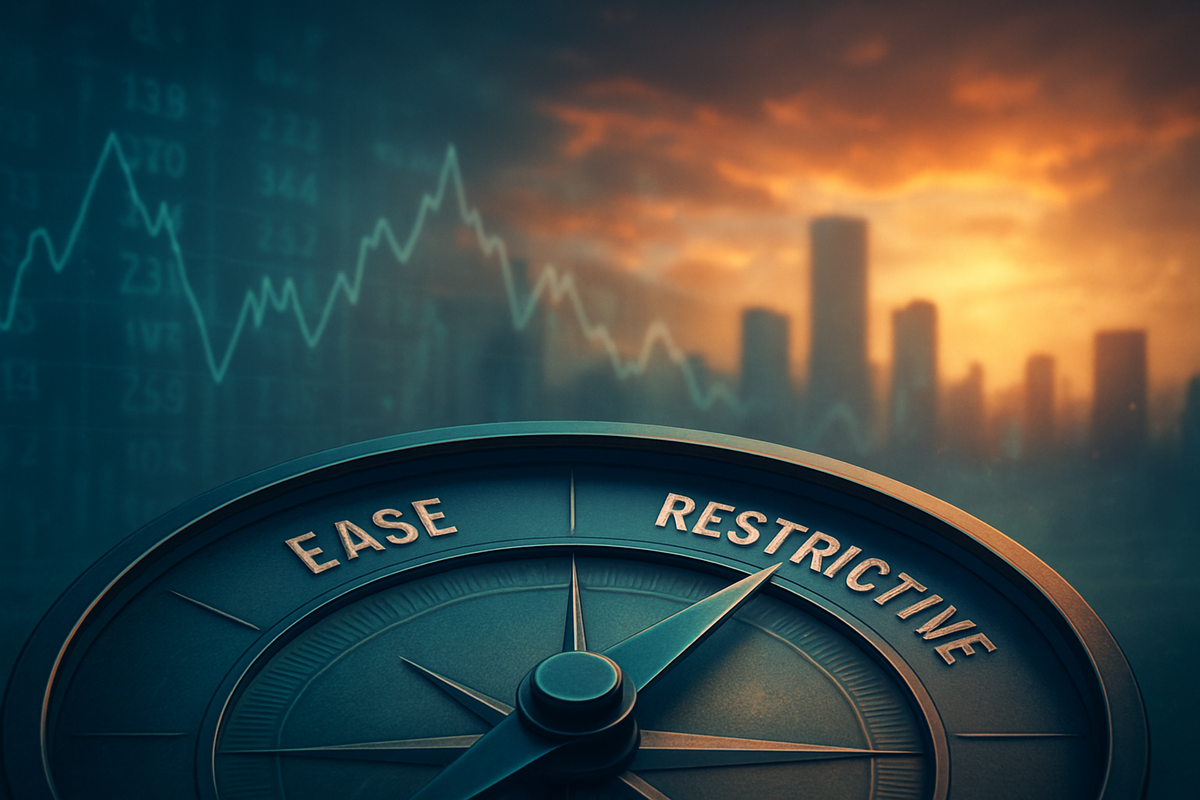
As the holiday season of 2025 winds down, a paradoxical chill has settled over global financial markets. Despite the Federal Reserve delivering a third consecutive interest rate cut earlier this month, investors are not celebrating a victory over inflation. Instead, a growing chorus of analysts and fund managers is sounding the alarm on a "hawkish pivot risk"—the fear that the central bank’s easing cycle is nearing a premature end, or worse, that it may have to reverse course entirely in 2026.
The immediate implications are visible in the bond market, where the 10-year Treasury yield remains stubbornly high near 4.5%, even as short-term rates fall. This "bear steepening" of the yield curve suggests that while the Fed is lowering the cost of borrowing today, the market expects a resurgence of price pressures tomorrow. For the public, this means that the relief expected from lower mortgage and credit card rates may be shallower and more short-lived than previously hoped.
The "Hawkish Cut" and the 2025 Data Blackout
The current unease stems from the Federal Open Market Committee (FOMC) meeting on December 11, 2025. While the Fed lowered the federal funds rate by 25 basis points to a range of 3.50%–3.75%, the move was far from unanimous. In a rare display of internal friction, three members dissented—the first time since 1988 that such a wide split has occurred. Jeffrey Schmid and Austan Goolsbee voted to pause the cuts, citing "sticky" services inflation, while Stephen Miran argued for a more aggressive 50-basis-point cut to stave off a cooling labor market.
The timeline leading to this moment was marred by a 43-day federal government shutdown in October and November 2025, which created a "data blackout." For nearly two months, the Fed was forced to "fly blind," relying on private-sector proxies rather than official CPI or jobs reports. When the data finally emerged in late November, Headline CPI sat at 2.7%, down from 3.0% in September, but the Fed’s updated "Dot Plot" shocked the market by signaling only one more potential cut for the entirety of 2026. This signaled to investors that the "last mile" of the inflation fight is proving to be the most difficult, complicated by new tariff-induced price levels and a resilient domestic economy.
Winners and Losers in a High-Floor Environment
The prospect of a higher-than-expected "neutral rate" has created a stark divide among public companies. In the banking sector, JPMorgan Chase (NYSE: JPM) has emerged as a primary beneficiary. The firm recently projected a record Net Interest Income of $94 billion for 2025, as the un-inverting yield curve allows it to earn significantly more on its vast loan portfolio than it pays out in deposits. Similarly, Bank of America (NYSE: BAC) has seen its "catch-up trade" materialize; as its lower-yielding pandemic-era bonds mature, the bank is reinvesting that capital into the current 4.5% yield environment, boosting its margins.
Conversely, the technology sector is facing a valuation squeeze. While Nvidia (NASDAQ: NVDA) continues to dominate with its Blackwell Ultra architecture, maintaining gross margins in the mid-70s, its stock has become increasingly sensitive to the cost of capital. Investors are now questioning if the massive AI infrastructure spend can be sustained if interest rates remain above 3.5% through 2027. Apple (NASDAQ: AAPL) is also under pressure, grappling with a product gross margin dip toward 35.9% as rising component costs and "tariff taxes" on overseas manufacturing eat into its bottom line. In the real estate space, homebuilders like PulteGroup (NYSE: PHM) and D.R. Horton (NYSE: DHI) are thriving by offering subsidized mortgage rates as low as 4.99% to bypass the resale market's "lock-in effect," while industrial giants like Prologis (NYSE: PLD) are seeing a rebound in warehouse development as capital costs stabilize, even if they aren't plummeting.
The Neutral Rate Debate and Global Ripple Effects
The wider significance of this hawkish pivot lies in the shifting definition of the "neutral rate," or r-star—the interest rate that neither stimulates nor restrains the economy. Before the pandemic, this was widely believed to be around 2.5%. However, by late 2025, institutional giants like Goldman Sachs and Morgan Stanley have adjusted their projections, suggesting the new neutral rate may sit between 3.0% and 3.5%. This shift reflects a structural change in the global economy, driven by massive fiscal deficits, the energy transition, and AI-driven productivity gains that allow the economy to run "hotter" without immediate inflationary consequences.
This trend is not isolated to the United States. The "higher-for-longer" shadow is affecting global competitors and partners alike. As the Fed signals a slower descent, other central banks are forced to maintain higher rates to protect their currencies against a resurgent U.S. dollar. This creates a policy headache for emerging markets that are desperate to lower rates to stimulate growth but fear capital flight. Historically, this environment mirrors the "stop-and-go" policy of the 1970s, where premature easing led to a second wave of inflation that required even more drastic hikes later—a precedent Jerome Powell is clearly desperate to avoid.
Navigating the 2026 Outlook
Looking ahead to 2026, the market must prepare for a "stop-and-go" policy scenario. Short-term, the Fed is likely to pause its cutting cycle in the first quarter to assess the full impact of the late-2025 easing. This will require a strategic pivot from investors who had been betting on a return to near-zero rates. The primary challenge will be the "refinancing wall" in commercial real estate, where billions in debt must be renegotiated at rates significantly higher than their original terms.
However, market opportunities may emerge in "quality" companies with strong cash flows and minimal debt. If the economy maintains its 2.3% GDP growth forecast despite higher rates, the narrative may shift from "fearing the Fed" to "embracing the growth." Potential scenarios include a "no-landing" outcome where inflation remains slightly above the 2% target but the economy continues to expand, forcing the Fed to accept a 3% inflation floor as the new reality.
Summary of the Market's Path Forward
The "Hawkish Pivot Risk" represents a fundamental shift in the 2025 market narrative. While the series of rate cuts provided a temporary boost to sentiment, the underlying reality is that the era of "easy money" is not returning. The Federal Reserve's cautious stance, underscored by internal dissents and a higher projected terminal rate, suggests that the battle against inflation is entering a persistent, structural phase rather than a cyclical one.
Moving forward, investors should watch for the January and February 2026 inflation prints to see if the "tariff tax" begins to manifest in consumer prices. The resilience of the labor market and the trajectory of the 10-year Treasury yield will be the most critical indicators of whether the Fed has successfully engineered a soft landing or if a more restrictive pivot is on the horizon. For now, the watchword for the coming months is "vigilance," as the market adjusts to a world where 3.5% is the new floor, not the ceiling.
This content is intended for informational purposes only and is not financial advice.