As the final bells of 2025 ring across Wall Street, the U.S. stock market stands at a historic crossroads. On December 24, 2025, the S&P 500 (INDEXSP: .INX) surged past the psychological 6,900 barrier to close at an all-time high of 6,932.05, capping a year of remarkable 17.8% gains. This "Santa Claus rally" has been fueled by a resilient 4.3% GDP growth rate and the Federal Reserve’s third interest rate cut of the year, which brought the federal funds rate down to a range of 3.50%–3.75%. However, beneath the surface of these record-breaking numbers, a tension is brewing between price action and investor sentiment.
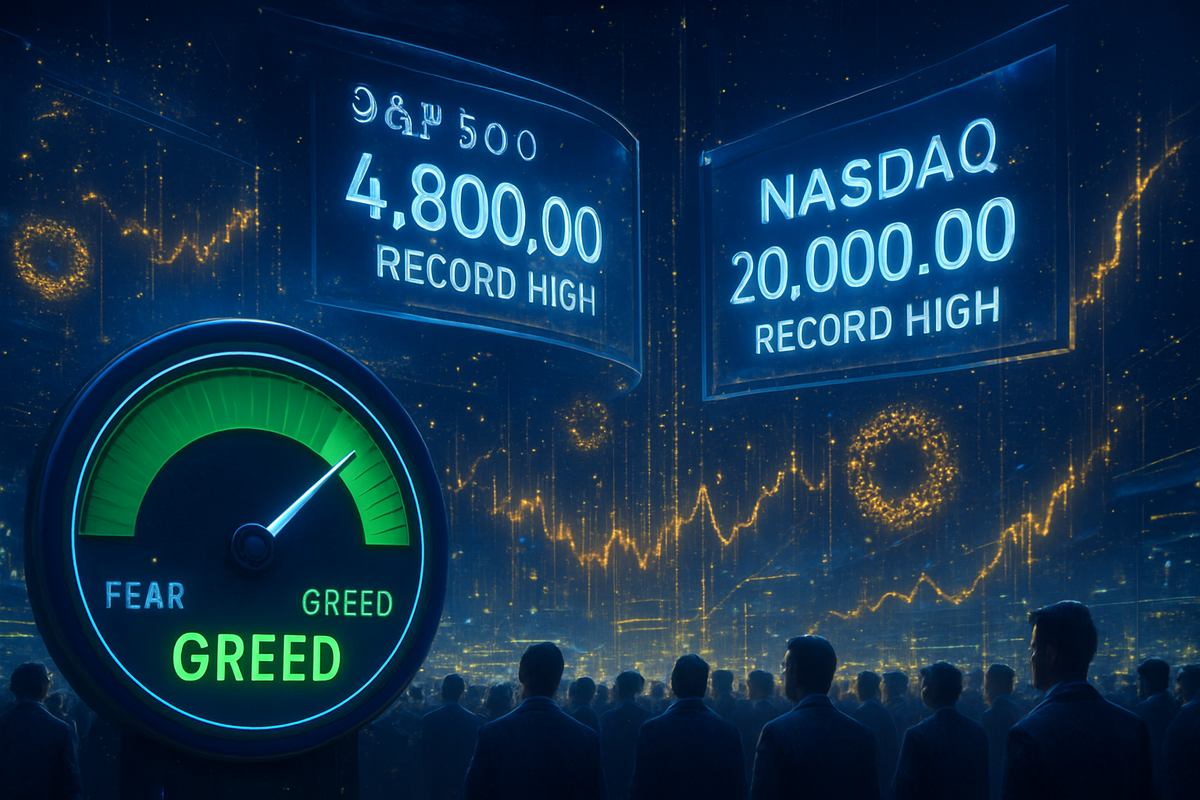
The current market environment is defined by a "cautious greed." While the CNN Fear & Greed Index has climbed to 59—firmly in the "Greed" zone—it remains notably below the "Extreme Greed" levels that typically signal an immediate blow-off top. Meanwhile, the AAII Investor Sentiment Survey shows a surprising level of skepticism, with bullish sentiment actually dropping to 37.4% in the final week of December. This divergence suggests that while institutional capital continues to push indices higher, the retail public and individual investors are increasingly wary of a valuation "air pocket" as the market enters 2026.
A Year of Resilience and Record-Breaking Milestones
The path to the record highs of late 2025 was paved by a series of pivotal shifts in the macroeconomic and technological landscape. The year began with fears of a "hard landing," but by mid-summer, it became clear that the U.S. economy was decoupling from global stagnation. The primary catalyst was the "industrialization of AI." Unlike the speculative hype of 2023 and 2024, 2025 saw artificial intelligence move into a high-margin production phase. A major turning point occurred in the fourth quarter when Nvidia Corp (NASDAQ: NVDA) confirmed that its "Blackwell Ultra" chip architecture had reached full-scale production, providing the hardware backbone for the next generation of autonomous enterprise systems.
The timeline of this rally was further accelerated by the Federal Reserve’s pivot in late 2025. On December 10, the Fed delivered a 25-basis-point cut, but Chair Jerome Powell’s accompanying "hawkish" commentary served as a sobering reminder that the battle against 2.7% CPI inflation was not yet won. This "hawkish cut" initially sparked volatility, but the market quickly recovered as the Nasdaq Composite (INDEXNASDAQ: .IXIC) powered to a record 23,613.31. Key stakeholders, from massive institutional hedge funds to the rising class of "0DTE" (zero days to expiration) retail options traders, have spent the final weeks of the year repositioning for what many hope will be a "soft landing" extension into the new year.
The Winners of the 2025 Surge and the Stocks at Risk
The 2025 rally has not been a "rising tide lifts all boats" scenario; rather, it has been a year of sharp divergence. The clear winners have been the "picks and shovels" of the AI and infrastructure boom. Western Digital Corp (NASDAQ: WDC) and Seagate Technology Holdings PLC (NASDAQ: STX) emerged as top performers, gaining 261% and 217% respectively, as data center storage requirements exploded. In the financial sector, Citigroup Inc (NYSE: C) became the comeback story of the decade, surging 73% YTD as it finally surpassed its tangible book value. Meanwhile, the "M&A Renaissance" of late 2025 propelled Goldman Sachs Group Inc (NYSE: GS) to an all-time high of $911.03.
However, the "Magnificent Seven" dominance is showing signs of fracture. While Apple Inc (NASDAQ: AAPL) hit a $4 trillion market cap on Christmas Eve, driven by the iPhone 17 "AI Supercycle," Nvidia Corp (NASDAQ: NVDA) has actually retreated approximately 11% from its October peak. Analysts are flagging several stocks as dangerously overextended. Micron Technology Inc (NASDAQ: MU) and Intel Corp (NASDAQ: INTC) are currently trading at premiums of 60% and 43% above their fair value estimates. Most concerning to value investors is Tesla Inc (NASDAQ: TSLA), which carries a staggering 300x P/E ratio as of late December, a valuation that hinges entirely on the pending regulatory approval of its "unsupervised" Robotaxi network—a gamble that could lead to a sharp correction if legal hurdles persist.
Historical Parallels and the Regulatory Reckoning
Market historians are drawing increasingly frequent comparisons between the current climate and the peaks of 1999 and 2021. The Nasdaq’s return-to-volatility ratio of 1.9 mirrors the levels seen just months before the 2000 dot-com crash. Furthermore, the concentration of the S&P 500 is at an all-time high, with just seven stocks accounting for 31% of the total index value. This "top-heavy" structure has drawn the eyes of regulators. The Department of Justice (DOJ) is currently investigating Nvidia’s chip allocation practices, while the Federal Trade Commission (FTC) is probing Microsoft Corp (NASDAQ: MSFT) over its "talent acquisition" of Inflection AI, which critics call a "masquerade" to bypass formal merger reviews.
The wider significance of these events lies in the shift from growth-at-all-costs to a "regulatory-adjusted" growth model. As Apple begins to allow third-party app stores in markets like Brazil and Japan to satisfy antitrust rulings, the high-margin "walled garden" model is under threat. This regulatory pressure, combined with a "manufacturing renaissance" that has boosted industrial players like Sterling Infrastructure Inc (NASDAQ: STRL) and Comfort Systems USA Inc (NYSE: FIX), suggests that the market leadership of 2026 may look very different from the tech-heavy winners of the past three years.
The 2026 Outlook: Strategic Pivots and Potential Scenarios
Looking ahead to the first half of 2026, the market faces two primary scenarios. The "Bull Case" assumes that the "Agentic AI" revolution—where AI moves from answering questions to performing autonomous tasks—will drive a massive productivity boom that justifies current 26x forward earnings multiples. In this scenario, the rally broadens further into healthcare and small-cap stocks as interest rates continue their slow descent. Companies that can successfully pivot to "AI-as-a-Service" subscriptions will likely lead the next leg of the bull market.
The "Bear Case," however, centers on the "valuation air pocket." If corporate earnings in Q1 2026 fail to meet the lofty expectations set by the 2025 rally, a 10–20% "healthy correction" is highly probable. Goldman Sachs has already warned of a "Lost Decade" for U.S. equities, forecasting annualized returns of just 3% over the next ten years due to high starting valuations. Investors should watch for a potential strategic pivot toward "defensive growth" or high-quality dividend payers as the "AI fatigue" sets in and the reality of "higher-for-longer" sticky inflation limits the Fed's ability to provide further liquidity.
A Fragile Milestone: Final Thoughts for Investors
The record highs of December 2025 are a testament to the incredible resilience of the U.S. economy and the transformative power of the AI era. However, the "Greed" indicators flashing across Wall Street serve as a necessary reminder that momentum is not a substitute for value. The key takeaway for the end of the year is that the market has transitioned from a phase of discovery to a phase of execution. The easy gains of the AI hype cycle are likely behind us, and the coming months will reward companies that can turn technological potential into tangible, sustainable cash flow.
As we move into 2026, investors should keep a close watch on three specific factors: the steepness of the 2s-30s bond yield curve, which is at its most extreme level since 2021; the outcome of the DOJ and FTC investigations into Big Tech; and the sustainability of consumer spending in the face of 4.6% unemployment. While the Santa Claus rally has provided a festive end to the year, the "overextended" nature of the current market suggests that the first quarter of the new year will be a rigorous test of investor conviction.
This content is intended for informational purposes only and is not financial advice.