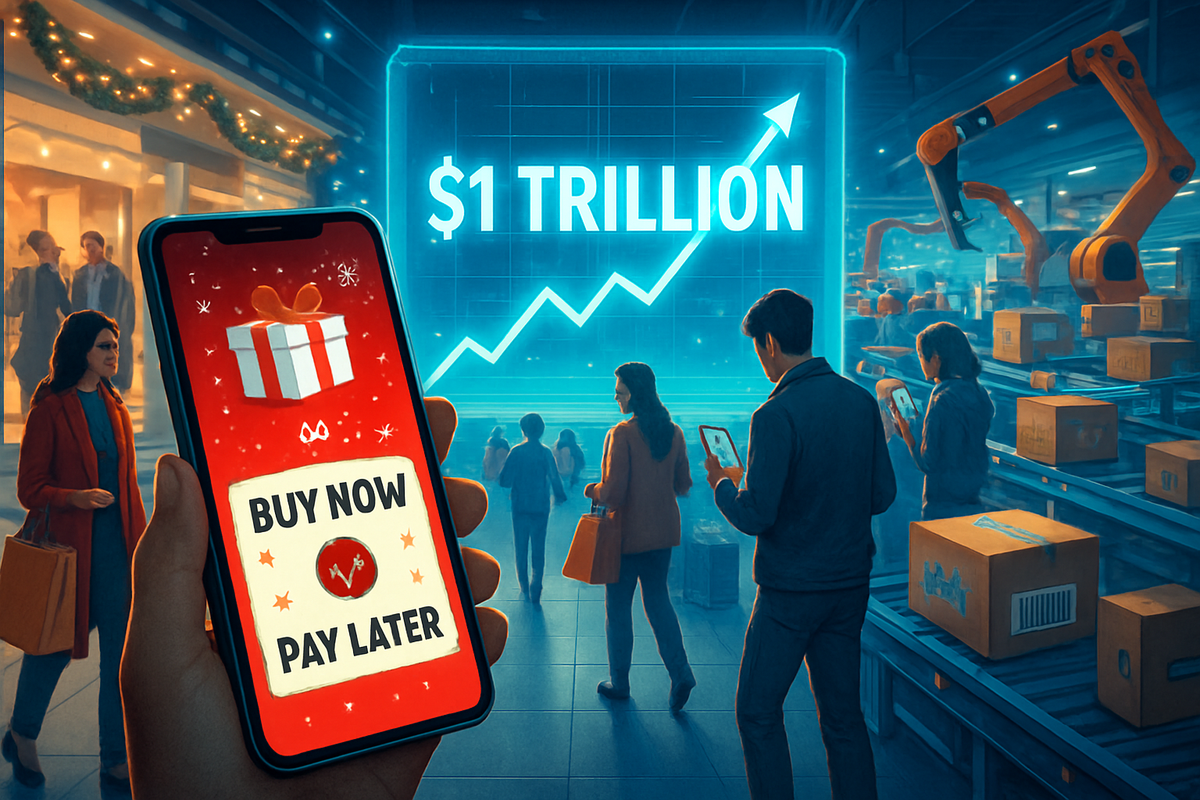
As the final wrapping paper is cleared away this Christmas morning, the early data for the 2025 holiday shopping season points to a historic, albeit complicated, victory for the American retail sector. For the first time in history, total US holiday retail sales are projected to surpass the $1 trillion milestone, driven by a record-breaking Cyber Week and a consumer base that refused to blink in the face of persistent price pressures. However, beneath the headline-grabbing numbers lies a "K-shaped" reality: while nominal spending has reached new heights, the actual volume of goods moving through checkout lines tells a story of surgical precision and a heavy reliance on credit.
The 2025 season has been defined by a "value-at-all-costs" mentality. Preliminary reports from the National Retail Federation (NRF) and major payment processors suggest that while shoppers spent between 3.7% and 4.2% more than last year, much of that growth was fueled by price inflation and new tariffs rather than an increase in the number of items purchased. This morning, as investors digest the preliminary results, the clear takeaway is that the US consumer remains the engine of the global economy, but that engine is increasingly running on the high-octane fuel of "Buy Now, Pay Later" (BNPL) services and deep promotional discounts.
A Record-Breaking Cyber Week Sets the Stage
The momentum for this trillion-dollar season was solidified during a blockbuster Cyber Week. From Thanksgiving through Cyber Monday, online sales hit a record $44.2 billion, representing a 7.7% increase over 2024. Black Friday alone saw digital receipts reach $11.8 billion, a 9.1% year-over-year jump. Interestingly, while the digital storefront hummed with activity, physical foot traffic remained nearly flat, growing only 1.17%. This shift highlights a permanent pivot toward convenience, as even traditional "doorbuster" hunters opted to shop from their mobile devices, which accounted for a staggering 57.5% of all Cyber Monday sales.
This season was also marked as the "First AI Holiday." Generative AI shopping assistants played a pivotal role in navigating the sea of discounts. Amazon.com Inc. (NASDAQ: AMZN) reported that its AI agent, Rufus, saw an 805% surge in usage as shoppers used the tool to cross-reference prices and analyze product reviews in real-time. This technological layer allowed consumers to be more "surgical" in their shopping, waiting for specific price triggers before committing to a purchase.
The timeline leading up to this Christmas peak was fraught with economic anxiety. Earlier in the fall, the introduction of the "Liberation Day" tariffs sent ripples through the supply chain, leading to 20% price hikes in electronics and apparel. Retailers responded by pulling forward their holiday promotions as early as October, effectively turning the "holiday season" into a three-month marathon. By the time December arrived, the Federal Reserve had cut interest rates to a range of 3.75%–4.00%, providing a slight psychological boost to consumers, even if credit card APRs remained stubbornly high.
The Winners and Losers: A Tale of Two Retailers
The clear winner of the 2025 season has been Walmart Inc. (NYSE: WMT). The retail giant successfully captured the "trade-down" effect, attracting higher-income households who sought to offset inflation by shopping for groceries and essentials at discount prices. Walmart's e-commerce segment reached a major milestone this season, achieving profitability for the first time as its logistics network enabled nearly half of all Black Friday orders to be delivered in under three hours. By positioning itself as the ultimate destination for value, Walmart solidified its market share against both traditional peers and specialized discounters.
Conversely, Target Corp. (NYSE: TGT) faced a more turbulent season. Caught in what analysts call "retail no-man's land," Target initially struggled to compete with Walmart's price leadership and Amazon’s logistical dominance. The company reported a 3.2% decline in comparable store sales in the early weeks of the season. However, a late-December pivot—including aggressive price cuts on over 8,000 items and a highly successful partnership tied to the Wicked film franchise—helped the retailer claw back some momentum in the final ten days before Christmas.
Amazon (NASDAQ: AMZN) continued its reign as the holiday anchor, with an estimated 83% of US shoppers making at least one purchase on the platform. The company’s focus on "Prime Speed" and its expanding private-label offerings allowed it to capture a massive share of the mid-tier gift market. While specialty retailers and mid-market department stores struggled under the weight of declining unit volumes, the "Big Three" utilized their massive scale to negotiate better terms with suppliers, allowing them to offer the deep discounts that 2025 shoppers demanded.
The Wider Significance: Debt, AI, and the New Normal
The broader significance of the 2025 season lies in the changing mechanics of how Americans pay for their lives. BNPL usage reached an all-time high, with services like Affirm Holdings Inc. (NASDAQ: AFRM) and Klarna becoming essential tools for the middle class. Total BNPL spending for the season hit $20.2 billion, with over $1 billion spent on Cyber Monday alone. This suggests that while the $1 trillion total spend is a sign of resilience, it is also a sign of a consumer base that is increasingly leveraged, using short-term debt to maintain their standard of living during the holidays.
Furthermore, the 2025 season has proven that the integration of AI into the retail experience is no longer a gimmick but a core competitive advantage. Retailers that invested heavily in predictive inventory management and AI-driven personalization were able to maintain higher margins despite the heavy promotional environment. This trend is likely to trigger a wave of tech-focused capital expenditures across the industry in 2026, as smaller players scramble to keep pace with the data capabilities of the industry titans.
From a historical perspective, 2025 will be remembered as the year the "volume-to-value" shift became permanent. Despite the record dollar amounts, unit volumes actually fell by 4.4% during Cyber Week. This indicates that the American consumer is becoming more efficient, buying fewer but higher-quality items, or simply cutting out the "fluff" that characterized the stimulus-fueled spending sprees of the early 2020s.
What Comes Next: The 2026 Outlook
Looking ahead to the first quarter of 2026, the retail industry faces a potential "hangover" effect. With BNPL balances coming due in January and February, discretionary spending is expected to cool significantly. Retailers will likely need to pivot their strategies toward "wellness and renewal" themes to capture the remaining consumer dollars. We may also see a surge in returns, which have historically plagued e-commerce margins in the weeks following Christmas.
Strategic adaptations will be required for mid-tier retailers who found themselves squeezed this year. The success of Walmart and Amazon suggests that scale and technological integration are the only true defenses against a bifurcated economy. We should expect to see more consolidation in the retail space as smaller chains seek the safety of larger balance sheets. Additionally, the impact of the 2025 tariffs will continue to be a wild card, potentially forcing another round of price adjustments in the spring.
Final Wrap-up: A Trillion-Dollar Milestone with a Warning
The 2025 holiday season has been a landmark event for the US economy. Reaching the $1 trillion mark in total retail sales is a testament to the enduring strength of the American consumer and the incredible efficiency of the modern retail supply chain. However, investors should remain cautious. The reliance on BNPL debt and the decline in unit volumes suggest that the "growth" we are seeing is more fragile than the headline numbers imply.
Moving forward, the market will be watching for the Q4 earnings reports from Walmart, Amazon, and Target in early 2026 to see the true impact on their bottom lines. The key metrics to watch will not just be total revenue, but operating margins and inventory turnover. For now, the "Santa Claus Rally" seems to have delivered for the retail giants, but the true test of the US consumer will come in the cold light of January’s credit card statements.
This content is intended for informational purposes only and is not financial advice.