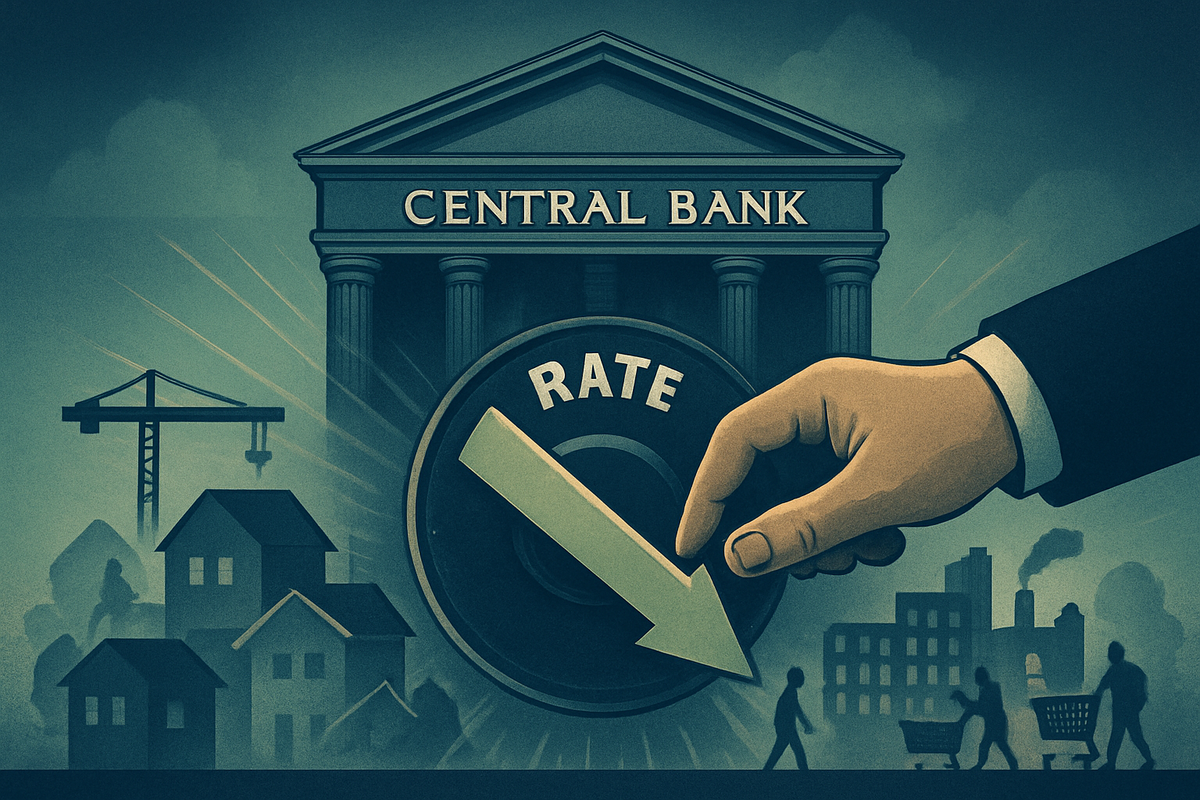
In a decisive and unexpected move on December 15, 2025, The Central Bank announced a significant reduction in its benchmark policy rate by 50 basis points, signaling an aggressive pivot to combat burgeoning economic slowdown and disinflationary pressures. This substantial rate cut, double the conventional 25 basis point adjustment, underscores the central bank's deep concerns regarding the health of the economy, particularly in the face of weakening labor markets and persistent underperformance in key growth indicators. The bold action aims to inject much-needed liquidity into the financial system, making borrowing cheaper for consumers and businesses alike, thereby stimulating investment, spending, and overall economic activity.
The immediate implications of this dramatic policy shift are expected to ripple through global financial markets, influencing everything from mortgage rates and corporate lending to currency valuations and commodity prices. While designed to avert a more severe economic downturn and steer inflation back towards the central bank's target, the move also raises questions about the underlying fragility of the economy and the potential for unintended consequences, including lower returns for savers and a possible resurgence of inflationary pressures in the long run. Investors and economists are now keenly watching for further signals on the central bank's forward guidance and the market's sustained reaction to this significant monetary policy intervention.
The Central Bank's Urgent Intervention: A Deep Dive into the 50 BPS Cut
The Central Bank's announcement came precisely at 2:00 PM EST on December 15, 2025, a pre-scheduled release that nonetheless sent shockwaves through financial markets due to the magnitude of the policy shift. The official statement, delivered by Chairperson [Name of Chairperson], articulated a grim assessment of the current economic landscape, citing persistent weakness in labor market indicators, including a surprising uptick in the unemployment rate and a deceleration in wage growth over the past two quarters. Furthermore, the central bank noted that inflation, while previously a concern, had begun to consistently undershoot its 2% target, raising fears of a disinflationary spiral if left unchecked. The committee's vote, revealed shortly after the announcement, showed a near-unanimous decision, highlighting the broad consensus among policymakers regarding the urgent need for aggressive stimulus.
This dramatic intervention follows a period of escalating economic concern. Throughout late 2024 and early 2025, various economic reports had painted a picture of a decelerating economy. Manufacturing output had shown contraction for three consecutive months, consumer confidence surveys indicated growing apprehension, and business investment had stalled. The central bank had initially responded with more modest forward guidance and targeted liquidity operations, but these proved insufficient to stem the tide of weakening sentiment and economic activity. The 50 basis point cut, therefore, represents a significant escalation in the central bank's efforts, a recognition that the economic headwinds were far more potent than initially assessed. Key stakeholders involved in this pivotal decision included the Monetary Policy Committee, comprising the Board of Governors and a rotating selection of Regional Bank Presidents, all of whom contributed to the rigorous analysis and debate leading up to today's announcement.
Initial market reactions were swift and pronounced. Equity markets, after an initial surge driven by the prospect of cheaper capital, quickly turned volatile as investors grappled with the implications of such a large cut – specifically, whether it signaled a more severe underlying economic weakness than previously understood. The Dow Jones Industrial Average (DJIA) initially jumped over 300 points but pared back gains significantly by market close. Government bond yields plummeted across the curve, particularly for shorter-dated maturities, as demand for fixed-income assets surged, pushing bond prices higher. The U.S. Dollar (USD) experienced a notable depreciation against a basket of major currencies, as lower interest rates made dollar-denominated assets less attractive to international investors. In the commodity markets, gold prices (XAU) saw a sharp rally, benefiting from its status as a safe-haven asset and the reduced opportunity cost of holding non-yielding assets. Oil prices, however, saw mixed reactions, with initial gains tempered by concerns that a weakening global economy could ultimately curb demand.
Market Movers: Winners and Losers in the Wake of the Rate Cut
The Central Bank's aggressive rate cut is set to redraw the competitive landscape for numerous public companies, creating distinct winners and losers across various sectors. The overarching theme will be the reduced cost of capital, which will disproportionately benefit companies reliant on borrowing for growth or consumer financing.
Real Estate and Homebuilders are poised to be significant beneficiaries. Lower mortgage rates, a direct consequence of the policy rate cut, will immediately boost housing affordability and stimulate demand from prospective homebuyers. Companies like Lennar Corporation (NYSE: LEN) and D.R. Horton, Inc. (NYSE: DHI), major homebuilders, are likely to see increased sales volumes and potentially higher home prices. Real estate investment trusts (REITs) such as Simon Property Group (NYSE: SPG), which often carry substantial debt, will also benefit from lower borrowing costs for refinancing and new acquisitions, potentially improving their profitability and dividend payouts. The increased demand for real estate could also trickle down to related industries like home improvement retailers.
Technology and Growth Stocks, particularly those with high growth potential but not yet substantial profits, are also set to thrive. Lower interest rates reduce the discount rate applied to future earnings, effectively increasing their present-day valuation. Tech giants like Amazon.com Inc. (NASDAQ: AMZN) and Microsoft Corporation (NASDAQ: MSFT), which often invest heavily in R&D and expansion, will find it cheaper to finance these initiatives. Smaller, innovative tech firms and startups will also find it easier and more affordable to secure capital for their ambitious projects, potentially accelerating their growth trajectories and fostering further innovation within the sector.
Conversely, the Banking Sector faces a more nuanced and potentially challenging outlook. While lower funding costs could encourage more lending, the significant 50 basis point cut threatens to compress net interest margins (NIM) – the difference between what banks earn on loans and pay on deposits. Large commercial banks like JPMorgan Chase & Co. (NYSE: JPM) and Bank of America Corporation (NYSE: BAC) might experience pressure on their profitability, especially if their deposit rates don't fall as quickly as their lending rates. Regional banks, which are often more reliant on traditional lending, could be particularly vulnerable to NIM compression. However, increased loan volumes driven by stimulated economic activity could partially offset these pressures, making the ultimate impact dependent on their ability to adapt their balance sheets.
Consumer Discretionary companies stand to gain as consumers find more disposable income due to lower debt servicing costs on credit cards, auto loans, and adjustable-rate mortgages. This increased purchasing power could translate into higher sales for retailers like Target Corporation (NYSE: TGT) and Nike, Inc. (NYSE: NKE), as well as companies in the travel and leisure sector. Meanwhile, Commodity-related sectors could see a mixed but generally positive impact. Energy companies like Exxon Mobil Corporation (NYSE: XOM) and mining firms such as BHP Group (NYSE: BHP) might benefit from increased global demand driven by economic stimulation, and a weaker U.S. dollar, which makes dollar-denominated commodities more attractive to international buyers. Precious metals miners, like Barrick Gold Corporation (NYSE: GOLD), are particularly well-positioned as gold becomes more appealing in a lower interest rate environment where the opportunity cost of holding non-yielding assets diminishes.
A Paradigm Shift: Unpacking the Wider Significance of the Central Bank's Move
The Central Bank's decision to slash its policy rate by 50 basis points represents more than just a monetary adjustment; it signifies a potential paradigm shift in economic policy, with profound implications that extend across industries, influence global financial flows, and carry significant regulatory weight. This aggressive easing signals a central bank willing to act decisively to support economic growth, even at the risk of challenging its previous stance.
One of the most immediate broader industry trends will be a renewed focus on debt-financed growth. Companies across sectors, from manufacturing to services, will find it cheaper to expand operations, invest in new technologies, and undertake mergers and acquisitions. This could ignite a wave of corporate restructuring and innovation, particularly benefiting sectors with high capital expenditure requirements. Conversely, industries that rely on higher interest rates for profitability, such as certain segments of the insurance industry or pension funds, may face headwinds as their investment income declines. The ripple effects on competitors and partners will be significant; companies with stronger balance sheets and less reliance on external financing may find themselves in a more advantageous position to acquire struggling rivals or expand market share, potentially leading to increased industry consolidation. Smaller businesses, often more sensitive to borrowing costs, could experience a much-needed lifeline, fostering local economic growth.
From a regulatory and policy perspective, this aggressive cut sends a clear signal that the central bank is prioritizing economic stability and employment over immediate inflation containment, at least for now. This shift in emphasis could prompt other central banks globally to reassess their own monetary policies, potentially leading to a synchronized global easing cycle if similar economic headwinds are perceived. For example, the European Central Bank (ECB) or the Bank of Japan (BOJ) might face increased pressure to follow suit to prevent their currencies from appreciating too sharply against the dollar, which could harm their export-oriented economies. Domestically, the move might also reignite debates about the limits of monetary policy and the need for complementary fiscal measures from governments to ensure a balanced approach to economic stimulus.
Historically, 50 basis point rate cuts are often reserved for periods of significant economic stress or as preemptive measures against looming crises. Comparisons can be drawn to the Federal Reserve's actions during the early 2000s dot-com bust (January 2001), the nascent stages of the Global Financial Crisis (October 2007), and the onset of the COVID-19 pandemic (March 2020). In each instance, the aggressive cuts aimed to inject liquidity and confidence into a faltering economy. While these moves often provided initial market relief, their long-term effectiveness depended heavily on the underlying economic conditions and the presence of other supportive policies. The current cut, occurring on December 15, 2025, suggests the central bank perceives the current economic fragility to be on par with these historical periods, underscoring the gravity of the situation and the urgency of their response.
The Road Ahead: Navigating the Post-Rate Cut Landscape
The Central Bank's substantial 50 basis point rate cut on December 15, 2025, sets the stage for a dynamic and potentially volatile period, with both short-term adjustments and long-term strategic considerations for businesses and investors. The immediate aftermath will be characterized by market recalibration, while the coming months and years will test the efficacy of this aggressive monetary intervention.
In the short term, markets will closely scrutinize incoming economic data for signs that the rate cut is having its intended effect. We can expect continued volatility as investors weigh the stimulus against the underlying economic weakness that necessitated such a drastic measure. The housing market is likely to see an immediate boost as lower mortgage rates entice buyers, potentially leading to increased sales volumes and a stabilization, if not an uptick, in home prices. Consumer spending, particularly on big-ticket items like automobiles and appliances, could also see a modest rebound as borrowing costs decrease. However, the risk of a "false dawn" remains, where initial optimism gives way to renewed concerns if economic indicators do not show sustained improvement.
Looking further out, the long-term possibilities hinge on whether the central bank can successfully orchestrate a "soft landing" – bringing inflation under control without triggering a full-blown recession. If successful, we could see a period of sustained, albeit moderate, economic growth, supported by cheaper capital and renewed business confidence. However, if the underlying economic headwinds prove too strong, or if the rate cut inadvertently fuels asset bubbles or a resurgence of inflation, the economy could still face a recessionary scenario. Businesses will need to make strategic pivots, leveraging the lower cost of capital for expansion, R&D, and debt refinancing. Companies with strong cash flows and diversified revenue streams will be better positioned to weather any lingering economic uncertainty.
For investors, this environment presents both opportunities and challenges. The lower-rate regime typically favors growth stocks and sectors like technology and real estate, as future earnings are discounted at a lower rate, boosting valuations. Dividend-paying stocks may also become more attractive in a lower-yield environment. However, the challenge lies in discerning which companies are truly poised for growth and which are merely benefiting from a temporary liquidity surge. Fixed-income investors will need to adjust their strategies, as bond yields are likely to remain subdued, potentially pushing them towards longer-duration bonds or alternative income-generating assets. A weaker domestic currency could also open up opportunities in international markets, particularly in export-oriented economies or those with dollar-denominated debt.
Potential scenarios range from a successful "soft landing" where the economy gradually recovers, to a more challenging recessionary outcome if the rate cut proves insufficient or if external shocks materialize. Another less likely, but possible, scenario is a period of stagflation, where growth remains stagnant while inflation persists, presenting a difficult challenge for policymakers. Investors should remain agile, diversifying their portfolios and focusing on companies with robust fundamentals, strong balance sheets, and adaptable business models that can thrive in various economic conditions.
The New Economic Reality: A Comprehensive Wrap-up and Investor's Watchlist
The Central Bank's bold decision to slash its policy rate by 50 basis points on December 15, 2025, marks a pivotal moment in the current economic cycle. The key takeaway is a clear signal of the central bank's commitment to aggressively counter economic deceleration and support employment, even if it means departing from a more hawkish stance. This move fundamentally alters the cost of capital, making borrowing cheaper for consumers and businesses, and is designed to inject much-needed liquidity and confidence into a fragile economy. However, it also underscores the severity of the economic headwinds perceived by policymakers.
Moving forward, the market will remain in a state of heightened sensitivity to incoming economic data and central bank communications. While initial market reactions can be volatile, the long-term trajectory of equities, bonds, and commodities will largely depend on whether this aggressive easing successfully averts a deeper recession. Sectors such as real estate, technology, and consumer discretionary are likely to find a more favorable operating environment due to reduced borrowing costs and potentially increased consumer spending. Conversely, the banking sector will face the delicate balancing act of managing compressed net interest margins against potentially higher loan volumes. A weaker domestic currency, a likely outcome, will also present opportunities for export-oriented businesses and could influence global capital flows.
The significance and lasting impact of this 50 basis point cut cannot be overstated. It represents a forceful intervention, akin to actions taken during periods of significant economic crisis or looming recession. While the central bank aims for a "soft landing," the path ahead is fraught with uncertainty. The lasting impact will be determined by whether this stimulus can genuinely re-ignite sustainable growth without triggering an undesirable resurgence of inflation or creating asset bubbles. It also sets a precedent for how aggressively the central bank is willing to act in future periods of economic stress.
For investors in the coming months, vigilance will be paramount. Key indicators to watch for include:
- Employment Data: Crucial metrics like the unemployment rate, non-farm payrolls, and wage growth will indicate whether the labor market is stabilizing or deteriorating further.
- Inflation Reports: The Consumer Price Index (CPI) and Personal Consumption Expenditures (PCE) will reveal if disinflationary pressures persist or if the stimulus begins to reignite price increases.
- GDP Growth: Quarterly GDP figures will provide a broader picture of overall economic activity and the effectiveness of the rate cut.
- Corporate Earnings: Company reports will shed light on how businesses are adapting to the new interest rate environment, their investment plans, and future outlooks.
- Central Bank Forward Guidance: Future statements, press conferences, and economic projections from the central bank will offer critical clues about the potential for further policy adjustments.
- Global Economic Developments: International trade relations, geopolitical events, and the economic performance of major trading partners will also influence domestic market conditions.
This content is intended for informational purposes only and is not financial advice